CS Core & Software Engineering · Data Structures & Algorithms
Graph Colouring by Backtracking
m-colouring as a search: assign each vertex a colour in 1..m, abandon a partial colouring the moment a neighbour clash appears. Distinct from the chromatic-number decision…
Four concepts on graph colouring as search — the assignment problem versus the NPC decision, the choose-check-unchoose loop, a 3-colouring of the square-plus-diagonal, and why m=2 is BFS instead. N-Queens and subsets stay in recursion and backtracking; chromatic-number decision stays in NP-complete graph problems.
- CS Core & Software Engineering
- Medium level
- 4 concepts
1Produce a colouring, do not classify the decision
A proper colouring of an undirected graph gives every vertex a colour so that the two ends of every edge have different colours. The search problem, given G and an integer m, is to write down such an assignment with colours \{1,\ldots,m\}, or to say that none exists.
That is a different outcome from chromatic-number decision, which only asks whether \chi(G) \le k and, for k \ge 3, is NP-complete. This topic builds the assignment. The NPC sentence is already taught; it is the reason the search is allowed to be exponential, not a second proof.
Same triangle ABC that forced three colours in the NPC topic. This page's job is to search, not to restate that 3-colouring is NPC.
Two questions, one graph
- DecisionDoes a k-colouring exist? Certificate = the colour list. NPC for k \ge 3.
- SearchWrite the colour list, or report failure. This topic.
- Do not mixA successful search on one triangle is not a polynomial algorithm for every graph.
| Question | Topic |
|---|---|
| \chi(G) \le k?, k=2 in P, k\ge 3 NPC | NP-complete graph problems |
| Write an m-colouring by choose / unchoose | This topic |
| N-Queens / subsets | Recursion and backtracking |
Graph-colouring backtracking is
- A search that writes a proper m-colouring or reports none
- A polynomial algorithm for 3-colouring, contradicting NP-completeness
- The same outcome as 'is \chi(G) \le 3?' with no assignment
Search produces the object. NPC is about all instances and polynomial time, not about one triangle. The decision question does not write colours.
2Try a colour, check neighbours, unchoose
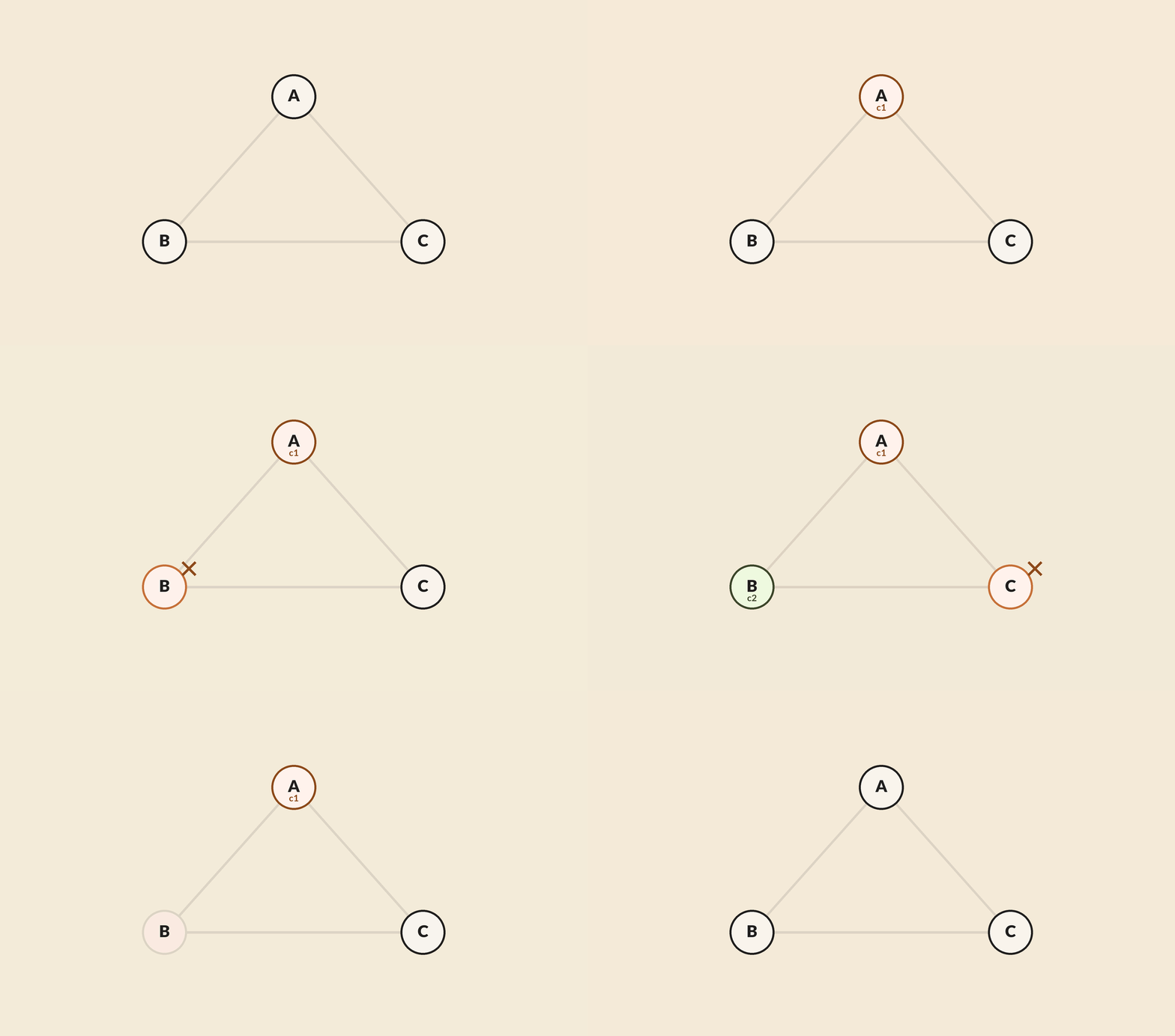
Fix an order of the vertices, v_0,\ldots,v_{n-1}. At v_i try each colour c \in \{1,\ldots,m\}. A colour is legal when no already-coloured neighbour of v_i holds c. If it is legal, assign it, recurse to v_{i+1}, then unassign it and try the next c. Success at i=n is a complete colouring.
That is the same choose-explore-unchoose skeleton as N-Queens. The clash test is the only new piece: a neighbour's colour, not a shared column or diagonal.
One vertex
- Try cEach colour in 1..m.
- Clash?Reject c if some neighbour already holds c.
- UnchooseOn failure of the recursive call, clear v_i and try the next c.
m-colouring
def colour(graph, m):
    n = len(graph)
    col = [0] * n

    def ok(v, c):
        return all(col[u] != c for u in graph[v])

    def rec(v):
        if v == n:
            return True
        for c in range(1, m + 1):
            if ok(v, c):
                col[v] = c
                if rec(v + 1):
                    return True
                col[v] = 0
        return False

    return col if rec(0) else None
When vertex v_i tries colour c, the clash test looks at
- Already-coloured neighbours of v_i
- Every vertex in the graph, including those not yet coloured
- Only the previous vertex v_{i-1}
Uncoloured neighbours have colour 0 and do not clash. A non-neighbour never clashes. Restricting the test to v_{i-1} would miss the rest of the adjacency list.
3Triangle plus a pendant-free D, m = 3
Running graph: vertices A, B, C, D. Edges AB, BC, CD, DA, AC. A, B, C are a triangle, so m=2 is impossible. D is adjacent to A and C only.
Order A, B, C, D. A=1, B=2 (1 clashes with A), C=3 (1 and 2 taken by neighbours A and B), D=2 (1 and 3 taken by A and C; 2 is free because DB is not an edge). First success: (1,2,3,2).
Figure. Triangle ABC uses three colours. D reuses B's colour 2 because the edge DB is absent. Roles mark c1 / c2 / c3, not good versus bad.
First successful branch
- A, BA=1. B rejects 1, takes 2.
- CNeighbours A,B hold 1,2 — C takes 3.
- DNeighbours A,C hold 1,3 — D takes 2.
Why D may reuse 2
After A=1, B=2, C=3, which colours are illegal for D, and why is 2 legal?
- neighbours of DA and C (not B)
- colours on A, C1 and 3
- colour 2 on Dlegal — no edge DB
- assignmentA1 B2 C3 D2
Pro tip. If the missing edge were AB instead of DB, the triangle would sit elsewhere and the first success would be a different 4-tuple. The clash test follows the edges you actually have.
Coding lab. 3-colour the square plus diagonal runs in the app, with checks on your output.
On the running graph with m=3, D can take colour 2 because
- D is not adjacent to B, who already holds 2
- Any leftover colour is legal, even on a neighbour
- m=3 always lets the last vertex reuse colour 1
Legality is 'no neighbour holds this colour'. A and C hold 1 and 3. Reusing 1 would clash with A.
4Prune on a clash; do not backtrack 2-colouring
A colour that already sits on a neighbour is rejected before the recursive call. That prune is the whole speedup: the subtree in which v_i holds a clashing c is empty of solutions, so it is not explored. On the running graph, B never tries colour 1; C never tries 1 or 2.
When m=2, do not run this tree. A graph is 2-colourable if and only if it is bipartite, and BFS (or DFS) 2-colours each component or reports an odd cycle in linear time. The running graph has a triangle, so BFS reports failure without a 2^4 search. Backtracking is the tool for a general m, usually m \ge 3.
Same A-B-C-D figure. For m=2 the triangle is an odd cycle; BFS reports that without growing a 16-leaf tree.
Pick the algorithm
- m=2BFS 2-colour. Odd cycle → no.
- m \ge 3, small nBacktracking as in the listing.
- Large n, m \ge 3Exact search may be hopeless; that is the NPC sentence, not a new proof.
m = 2 dies at C
Same graph, m=2. After A=1, B=2, which colours can C try, and what does the search return?
- C's neighbours A, Bcolours 1 and 2 — both of m
- legal colours for Cnone
- unchoose B, try B=1clashes with A immediately
- search resultno 2-colouring
Pro tip. BFS would have said the same thing after seeing the odd cycle ABC. The backtracking tree is the long way to that one fact when m=2.
2-colouring a graph should be done by
- BFS (or DFS) bipartiteness, in linear time
- The m-colouring backtracking tree with m=2
- A reduction from SAT
2-colouring is in P. The backtracking tree works but is the wrong tool. SAT reductions are for hardness proofs, not for colouring a given instance.
Notes
- A proper m-colouring assigns each vertex a colour in \{1,\ldots,m\} so that every edge is bichromatic. The search problem is: produce such an assignment, or report that none exists.
- Backtracking tries a colour for vertex v, checks that no already-coloured neighbour shares it, recurses to v+1, then unchooses the colour. The first clash prunes the whole subtree.
- 2-colouring is not this tree: it is the bipartite BFS already named under chromatic-number decision. Use backtracking for a general m, typically m ≥ 3.
- The decision 'does a k-colouring exist?' for k ≥ 3 is NP-complete. This topic is the exponential search you run on a small graph after that sentence, not a second NPC proof.
- N-Queens is the same choose-explore-unchoose skeleton with a different clash test. Colouring's clash test is 'this colour already sits on a neighbour'.
Formulas
- At most m^n assignments, n vertices, m colours.
- A partial assignment on the first i vertices is legal iff every edge among those i is bichromatic.
- Degree bound: \chi(G) \le \Delta(G)+1 (greedy colouring). Backtracking may still need to search; the bound only names a sufficient m.
- 2-colouring: O(n+m_{\mathrm{edges}}) by BFS, not 2^n backtracking.
Exam traps & shortcuts
- Colour vertices in a fixed order (say 0..n-1). Reordering can change the size of the tree, not the existence answer.
- The clash test uses only already-coloured neighbours. A later neighbour is not a reason to reject a colour now.
- Finding one colouring is search. Counting all colourings is a different, harder output. This topic stops at the first success unless a stem asks for a count.
- Do not quote this search as a polynomial 3-colouring algorithm.
Reference tables
Edges AB, BC, CD, DA, AC. No BD.
| Vertex | Neighbours | First-success colour |
|---|---|---|
| A | B, C, D | 1 |
| B | A, C | 2 |
| C | A, B, D | 3 |
| D | A, C | 2 |
Recap
Night-before colouring-search pegs.
- Search
- Write an m-colouring. The NPC decision is a different topic.
- Loop
- Try c, reject if a neighbour holds c, recurse, unchoose.
- Walk
- A1 B2 C3 D2 on the triangle-plus-D. No edge BD.
- m=2
- BFS bipartite test, not this tree.
Practise Graph Colouring by Backtracking
Reading is free and needs no account. Practice, mocks and progress live in the app.
- A 5-question practice set that ends the chapter
- 4 quick checks with worked explanations
- Timed mocks scored with the real marking scheme
- Readiness tracked per topic, kept on your device