RRB NTPC (Railways) · General Intelligence & Reasoning
Embedded Figures & Figure Counting
Find figure X embedded in an option with rotation not allowed; complete a missing-figure pattern; count triangles or squares in a line figure, including composites.
SSC CGL Tier-1 papers in 2024 open the reasoning section with three picture questions that Non-Verbal Reasoning does not teach: find a given figure (X) inside an option with rotation not allowed; count the triangles or squares in a line figure, composites included; and complete a missing cell of a pattern. Hold one concrete X through the embed work: an L-hook — a vertical stroke two units tall with a one-unit foot to the right, the same shape as a capital L. Counting then uses a named split-base triangle and a 3-by-3 grid, each enumerated rather than guessed. Pattern completion is a method, not a drawing: name the one changing attribute, then pick. None of this is figural analogy or odd-one-out — those live on Non-Verbal Reasoning, where the job is to apply a transformation. Here the job is to find, count, or complete without turning the page.
- RRB NTPC (Railways)
- Medium level
- 5 concepts
- 16 practice questions
1X embeds only in the same orientation
An embedded-figure question on SSC CGL Tier-1 is worded almost word for word: 'Select the option figure in which the given figure (X) is embedded (rotation is NOT allowed).' Figure (X) is a small line drawing printed beside four option drawings. Hold one concrete X for this topic: an L-hook — a vertical stroke two units tall with a one-unit foot sticking out to the right, the same shape as a capital L. Embedded means every stroke of that L-hook appears as a subset of the option's strokes, in the same arrangement. Extra strokes in the option are allowed; a missing or shifted stroke of X is not.
The parenthetical is the trap. Rotation is not allowed, so X must sit in the option the way it was printed — long arm vertical, foot pointing right. An option that contains a perfect copy of the L-hook turned 90 degrees clockwise (a long arm running horizontally, a short tick hanging down) looks right to anyone who rotated X in their head. A rotated copy of X is a trap, even when every edge of X is present. The test is not 'could this be X after a turn'; it is 'is this X, as printed'.
This is a different skill from the figural series, analogy and odd-figure work on Non-Verbal Reasoning. Those questions ask you to name a transformation and apply it. An embedded-figure question forbids the transformation: you are hunting a copy, not inventing a turn. If an option looks like X only after you tilt the page, leave it.
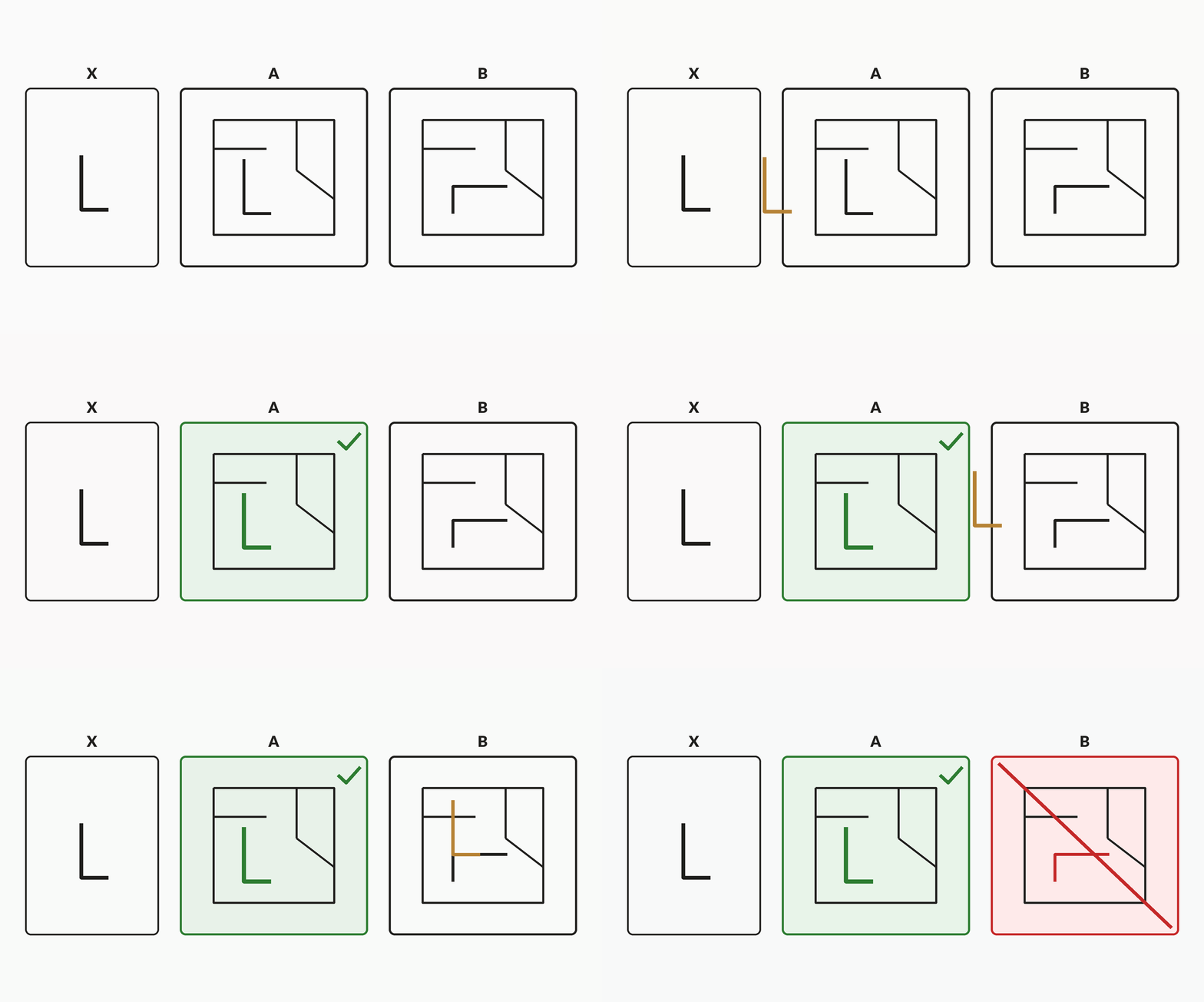
Slide, do not turn
- Name X's armsSay the orientation out loud: for the L-hook, long arm vertical, foot to the right. That sentence is the rule the stem locked.
- Slide a tracingMove a mental copy of X across the option without rotating it. A fit is a match; a fit that needs a tilt is not.
- Reject rotated copiesAn option whose hook is the same L turned 90 degrees is built for the reader who ignored 'rotation is NOT allowed'. Strike it even if every edge of X is there.
- Ignore extra strokesCamouflage lines around a correctly oriented X do not disqualify it. Missing or moved strokes of X do.
L-hook in A, rotated hook in B
Figure (X) is the L-hook (two-unit vertical, one-unit foot to the right). Option A contains that L unrotated among extra strokes. Option B contains the same hook rotated 90 degrees clockwise. Option C is a U — the L plus an extra upward arm. Which option embeds X?
- Stem: rotation is NOT allowedX must keep long arm vertical, foot right
- A contains the unrotated L as a subsetA is a candidate; extra strokes are camouflage
- B contains the L turned 90 degrees clockwisereject — rotated copy, even though every edge of X is present
- C adds an upward arm X does not havereject — not X. Answer: A
Pro tip. If you had to tilt the page to make X fit, you already used the rotation the stem forbade.
Figure (X) is an L-hook, long arm vertical, foot to the right. Rotation is not allowed. An option contains that exact hook turned 90 degrees clockwise, every edge present. That option is
- Correct, because every edge of X is there
- Wrong — a rotated copy is not an embedding when rotation is not allowed
- Correct if the option also has extra camouflage strokes
The stem forbids rotation. A copy that only matches after a 90-degree turn is the standard distractor, extra strokes or not.
3Count unit pieces, then composites, then the whole
The CGL stem is 'How many triangles are there in the given figure?' — or squares, in the same shape of question. The figure is a line drawing, and the answer is never just the smallest pieces you can see at a glance. Every larger triangle (or square) made of those pieces also counts. Skipping the composites is how the unit-only trap is written into the options.
Hold one concrete figure: triangle ABC with two rays from A down to points P and Q that cut BC into three equal parts. The unit triangles are the three with one base gap: ABP, APQ, AQC. The two-unit triangles are the two that span two adjacent gaps: ABQ and APC. The large one is ABC itself. Count the unit pieces first, then each larger composite, then the whole figure: 3 + 2 + 1 = 6. The same order works on a square with both diagonals drawn: four unit triangles around the centre, then four two-unit half-squares, total 8 — there is no larger triangle wrapping the whole square.
The closed form for this split-base family is n(n+1)/2 when n-1 rays cut the base into n parts. For n = 3 that is 6, matching the enumeration. Use the formula after the size classes are listed, not instead of them — a formula you cannot point at in the figure is a guess.
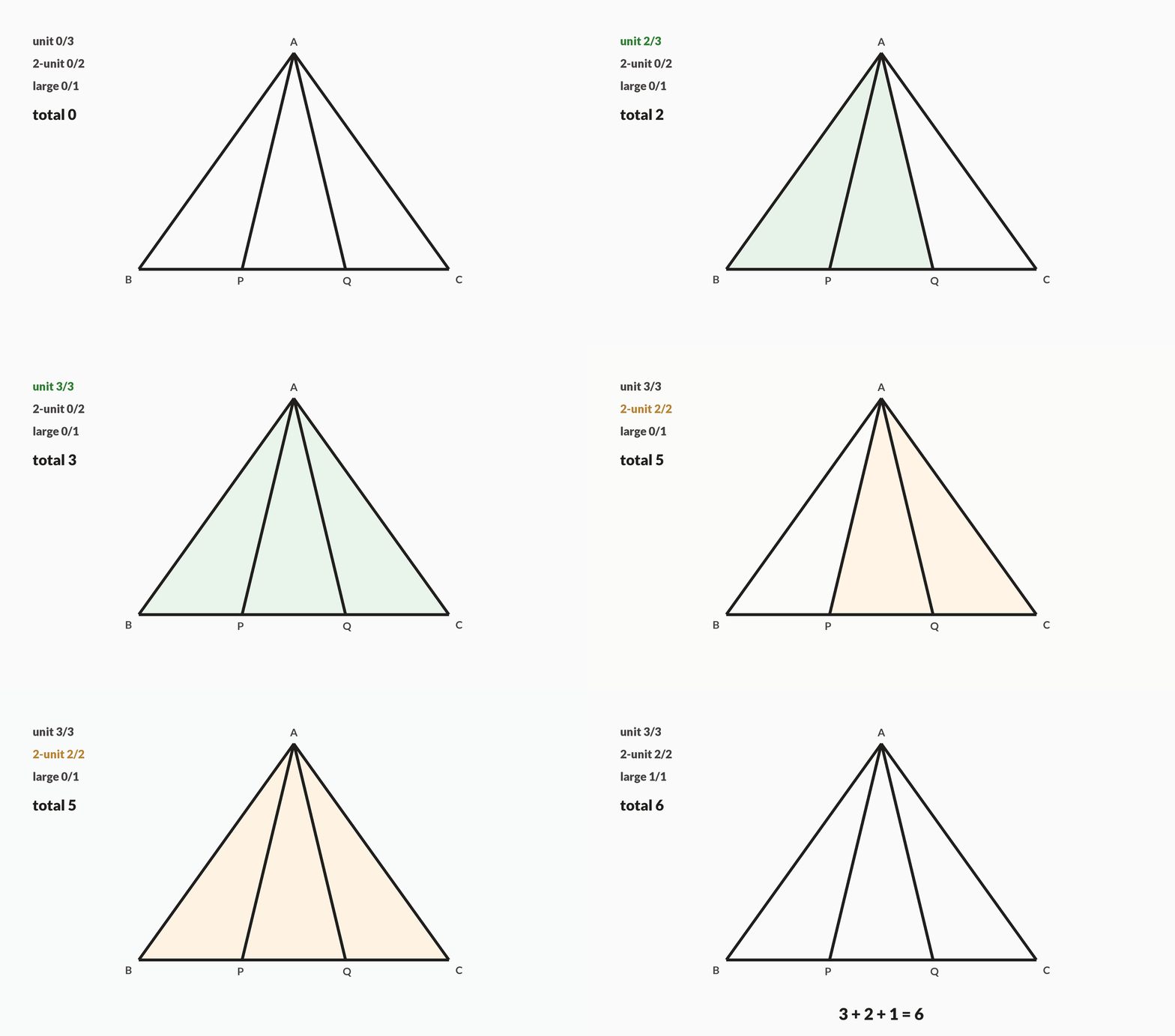
Size classes, then total
- List the unit piecesName every smallest triangle (or square) that uses one cell of the figure. In the split-base triangle that is ABP, APQ, AQC — 3.
- List each larger sizeTwo adjacent units make a 2-unit triangle (ABQ, APC — 2). Keep going until the size that is the whole figure (ABC — 1).
- Add the classes3 + 2 + 1 = 6. Check against n(n+1)/2 with n = 3 only after the list exists.
- Spot the unit-only optionThe options will include 3. That is the unit count, not the answer.
| Size class | Named pieces | Count |
|---|---|---|
| Unit (1 base gap) | ABP, APQ, AQC | 3 |
| 2-unit (2 gaps) | ABQ, APC | 2 |
| Large (whole) | ABC | 1 |
| Total | 3 + 2 + 1, also n(n+1)/2 | 6 |
How many triangles in the split-base figure?
Triangle ABC has two rays from A to points P and Q that cut BC into three equal parts. How many triangles are there in the given figure?
- Unit triangles ABP, APQ, AQC3
- 2-unit triangles ABQ (gaps 1-2) and APC (gaps 2-3)2
- Large triangle ABC1
- Total 3 + 2 + 1; check n(n+1)/2 with n = 36
Pro tip. Write the three size-class rows before you look at the options. Three (units only) will be sitting there on purpose.
A square has both diagonals drawn, meeting at the centre. How many triangles are in the figure?
- 4 — only the unit triangles around the centre
- 8 — four unit triangles plus four two-unit half-squares
- 6 — the units plus two of the half-squares
Four small triangles meet at the centre. Each pair of adjacent small triangles is a larger triangle using one side of the square as base — four of those. The square itself is not a triangle, so the total is 8, not 4.
4Squares in an n-by-n grid
The same CGL stem — 'How many squares are there in the given figure?' — on a grid is a formula once you have seen the size classes. An n \times n grid means n unit squares along each side, so (n+1) grid lines each way. Size-1 squares are the unit cells: n \times n of them. Size-2 squares are 2 \times 2 blocks of unit cells; their top-left corner can sit in (n-1) rows and (n-1) columns, so (n-1)^2 of them. Size-k in general has (n-k+1)^2 positions. Add the classes: 1^2 + 2^2 + \cdots + n^2, which is also n(n+1)(2n+1)/6.
Work the 3-by-3 case that the figure shows. Size 1: 3 \times 3 = 9. Size 2: 2 \times 2 = 4 positions. Size 3: one large square. Total 9 + 4 + 1 = 14, and 1^2 + 2^2 + 3^2 = 14 agrees. Counting only the unit squares is the trap: a 3-by-3 grid holds fourteen squares, not nine. Nine is sitting in the options because it is the number you get if you stop after the unit cells.
The formula does not replace the size-class list on a non-grid figure — a square with extra diagonals is the previous concept's enumeration, not this sum of squares. Reach for 1^2 + \cdots + n^2 only when the drawing is a plain unit grid.
Figure. A 3-by-3 grid of unit squares. Size 1 contributes 9, size 2 contributes 4, size 3 contributes 1. Total 14, not 9.
Classes, then the sum
- Read nCount unit cells along one side. A 3-by-3 grid has n = 3, not 4 — 4 is the number of grid lines.
- Count each size kSize k has (n-k+1)^2 positions. For n = 3: size 1 gives 9, size 2 gives 4, size 3 gives 1.
- Sum, then check the formula9 + 4 + 1 = 14, and 1^2 + 2^2 + 3^2 = 14. The closed form n(n+1)(2n+1)/6 with n = 3 is the same 14.
- Reject the unit-only optionNine is the size-1 count. The stem asked for squares, which includes the four 2-by-2 blocks and the large one.
| Size k | Positions (n-k+1)^2 | Count |
|---|---|---|
| 1 (unit) | (3-1+1)^2 = 3^2 | 9 |
| 2 | (3-2+1)^2 = 2^2 | 4 |
| 3 (whole) | (3-3+1)^2 = 1^2 | 1 |
| Total | 1^2 + 2^2 + 3^2 | 14 |
How many squares in a 3-by-3 grid?
How many squares are there in a 3-by-3 grid of unit squares?
- Size-1 squares: 3 \times 3 unit cells9
- Size-2 squares: (3-2+1)^2 = 2^2 top-left seats4
- Size-3 squares: the whole grid1
- 9 + 4 + 1 and 1^2 + 2^2 + 3^214
Pro tip. Nine is the unit count, not the answer. The four 2-by-2 blocks and the large square are squares too.
A 2-by-2 grid of unit squares (four unit cells) has how many squares?
- 4 — the unit cells only
- 5 — four unit cells plus the large 2-by-2
- 6 — counting some rectangles as squares
Size 1 contributes 2^2 = 4. Size 2 contributes 1^2 = 1. Total 1^2 + 2^2 = 5. Four is the unit-only trap; rectangles that are not squares are not in the count.
5Name the one changing attribute, then pick the missing cell
A missing-figure or pattern-completion item on CGL shows a strip or a 2-by-2 (sometimes 3-by-3) of small frames with one cell blank, and asks you to select the figure that completes the pattern. It looks like a figural series, and it is not the same job as Non-Verbal Reasoning's multi-stream series. There the next frame applies several tracked changes at once. Here the intended rule is usually one changing attribute — a count, a position, or a shading toggle — and the distractors apply a different attribute (most often a rotation) to a frame that otherwise looks busy enough to be right.
The method is to name the one changing attribute before you touch the options. Say it as a sentence with a number in it: 'the inner tick count rises by one each cell, orientation fixed.' Then the blank cell is that sentence applied once more. An option that instead rotates the outer square 90 degrees and keeps the old tick count has answered a rotation question the stem did not ask. If two attributes both seem to move, you are on the Non-Verbal Reasoning series method; come back and check whether one of them is decoration.
This concept does not draw the four-frame exam strip. Approximating those frames with boxes would invent the item. The attack order lives in the steps and in the 'Attributes that complete a pattern' table: name one attribute, predict the missing cell, reject any option that applies a different attribute.
The exam picture is a row or 2-by-2 of small frames with one cell blank — for example three cells showing 1, then 2, then 3 inner ticks, and a question-mark cell. No drawing accompanies this concept. Read the 'Attributes that complete a pattern' table as the figure: one row per attribute, the missing cell continuing that row, and the distractor applying a different row (usually rotation).
Name, predict, reject
- Name one attributeCount, position or shading — pick the one that actually changes across the given cells, and say it in a sentence with a number ('inner ticks: 1, then 2, then 3').
- Predict the blankApply that sentence once more. If the rule was +1 tick with orientation fixed, the missing cell has 4 ticks and the same orientation.
- Reject a different attributeAn option that rotates or reflects the frame, or that keeps the old count, has answered a different question. Strike it even if it 'looks like the set'.
| Named attribute | What the missing cell must do | Typical distractor |
|---|---|---|
| Count (lines, ticks, dots) | Continue the same difference, usually +1 | Rotates the frame, keeps the old count |
| Position of one mark | Advance the mark one step on its path | Moves a different mark, freezes this one |
| Shading toggle | Opposite of the last given cell if period 2 | Copies the last cell's fill |
| Two attributes both moving | You are on a multi-stream series — use Non-Verbal Reasoning | Treating decoration as a second rule |
Inner ticks 1, 2, 3, blank
Three given cells of a four-cell pattern show 1 inner tick, then 2, then 3, all in the same orientation. The options for the blank cell are: (P) 4 ticks, same orientation; (Q) 3 ticks, outer square rotated 90 degrees clockwise; (R) 2 ticks, same orientation. Which completes the pattern?
- Named attribute: inner tick count1, then 2, then 3 — difference +1, orientation fixed
- Apply once more to the blank cell4 ticks, same orientation
- Q rotates the outer square and keeps 3 ticksrejects — different attribute (rotation)
- R steps the count backwardsrejects. Answer: P
Pro tip. If you cannot say the rule in one sentence with a number in it, you are not ready for the options yet.
A four-cell pattern shows 1 inner tick, then 2, then 3, orientation fixed. An option for the blank cell rotates the outer square 90 degrees clockwise and keeps 3 ticks. That option is
- Correct, because rotation is the usual figural rule
- Wrong — the named attribute was tick count, not rotation
- Correct if the ticks also stay in the same seats
The given cells changed count by +1 and did not turn. The blank cell must show 4 ticks in the same orientation. A rotated 3-tick frame answers a different question.
Notes
- Embedded figures (CGL wording): 'Select the option figure in which the given figure (X) is embedded (rotation is NOT allowed).' X must appear in the same orientation; a rotated copy is a trap even when every edge of X is present.
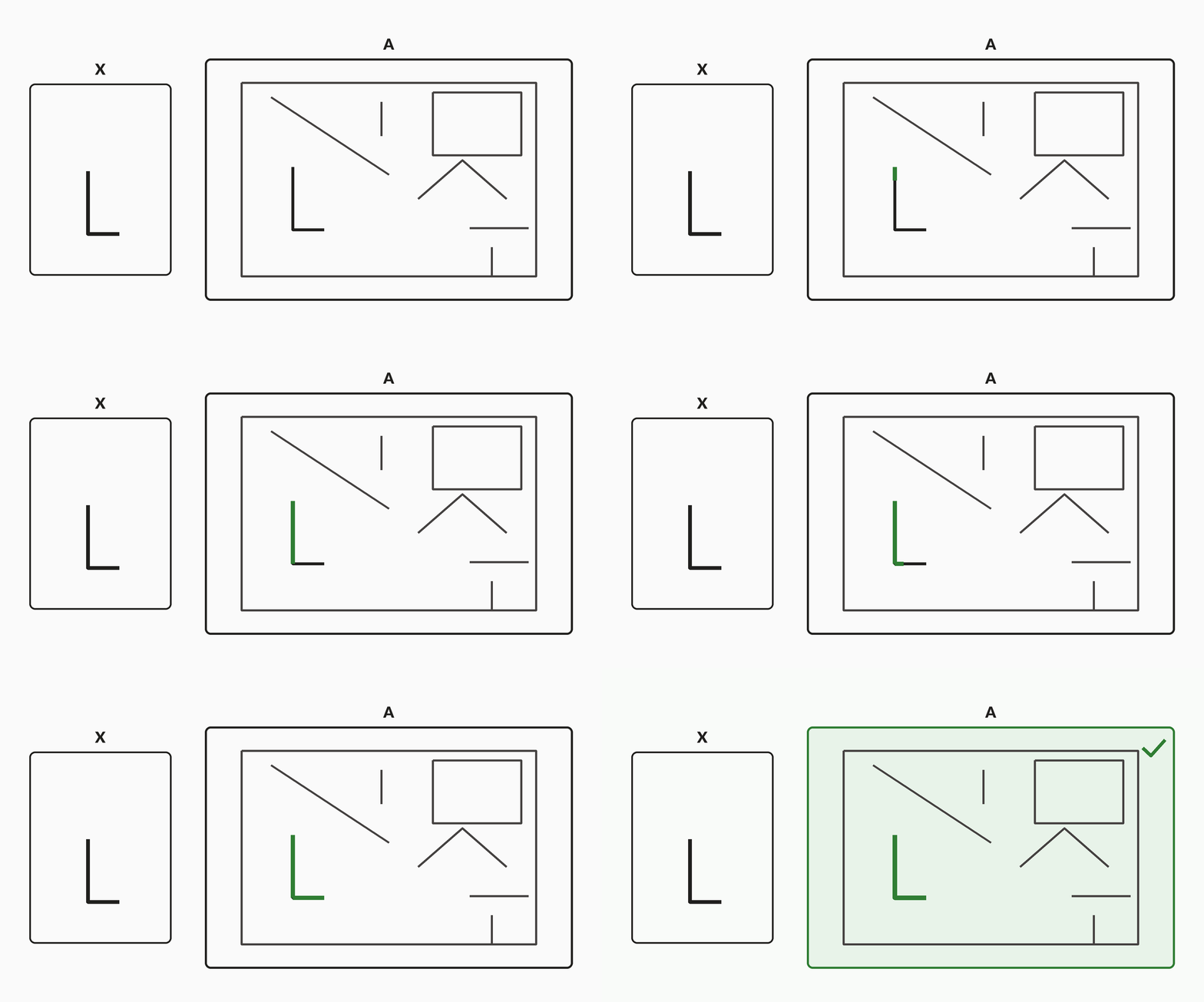
- Hidden X: do not stare at the whole option. Scan the distinctive edges of X — for an L-hook, the corner where the two-unit vertical meets the one-unit right foot — then check both arms. Extra strokes are camouflage, not disqualification.
- Figure counting (CGL wording): 'How many squares/triangles are there in the given figure?' Count unit pieces first, then each larger composite, then the whole figure. Skipping composites is the units-only trap.
- An n-by-n grid of unit squares holds 1^2 + 2^2 + ... + n^2 squares, which is n(n+1)(2n+1)/6. A 3-by-3 grid is 9 + 4 + 1 = 14, not 9.
- Pattern completion: name the one changing attribute (count, position, or shading) and pick the option that continues that attribute. An option that instead rotates or reflects the frame is a different question.
Formulas
- Embedded: X is a subset of the option's strokes, same orientation. Rotation is not allowed.
- Apex-to-base triangles: a large triangle with n-1 rays from the apex that cut the base into n parts contains n(n+1)/2 triangles (n=3 gives 6).
- Square with both diagonals: 4 unit triangles at the centre plus 4 two-unit half-squares = 8.
- Squares in an n \times n unit grid: size-k count is (n-k+1)^2; total = 1^2 + 2^2 + \cdots + n^2 = n(n+1)(2n+1)/6.
- A 3 \times 3 grid: 1^2 + 2^2 + 3^2 = 9 + 4 + 1 = 14.
Exam traps & shortcuts
- For embed, slide a mental tracing of X without turning the page. If it only fits after a tilt, the option is wrong.
- In clutter, hunt X's corner first, then the two arms. Matching the whole silhouette is slower and misses a hidden copy.
- In any count, write three rows — unit, next size, whole — before looking at the options. The options include the unit-only total on purpose.
- For a missing-figure cell, say the rule in one phrase ('inner ticks increase by one') and reject any option that applies a different phrase.
Reference tables
Use these after the size-class list exists, not instead of it. The embed work has no formula — orientation is the rule.
| Figure | What to add | Closed form |
|---|---|---|
| Split-base triangle, n base gaps | Unit + 2-unit + ... + large | n(n+1)/2 (n = 3 gives 6) |
| Square with both diagonals | 4 unit + 4 two-unit half-squares | 8 (no wrapping triangle) |
| n \times n unit grid of squares | Size k contributes (n-k+1)^2 | 1^2 + \cdots + n^2 = n(n+1)(2n+1)/6 |
| 3 \times 3 grid (the worked case) | 9 + 4 + 1 | 14, not 9 |
Recap
Read only this the night before.
- Embed
- X is a subset of the option, same orientation. Rotation is not allowed; a rotated copy is a trap even when every edge of X is present.
- Clutter
- Scan X's edges — for the L-hook, the vertical-meets-foot corner — not the whole option. Extra strokes are camouflage.
- Count
- Unit, then each larger composite, then the whole. The unit-only total is sitting in the options on purpose.
- Grid
- An n-by-n grid holds 1^2 + 2^2 + ... + n^2 squares. A 3-by-3 is 14, not 9.
- Complete
- Name the one changing attribute, predict the blank cell, reject any option that applies a different attribute (usually rotation).
Practise Embedded Figures & Figure Counting
Reading is free and needs no account. Practice, mocks and progress live in the app.
- 16 exam-style questions on this topic, with explanations
- A 5-question practice set that ends the chapter
- Timed mocks scored with the real marking scheme
- Readiness tracked per topic, kept on your device