UPSC CSE IAS · General Intelligence & Reasoning
Coded Inequality
Read a chain of P > Q ≥ R = S < T (or a coded-symbol key) and decide which conclusions definitely follow.
Five concepts, and one question underneath all of them: given comparisons among letters — sometimes written with a private symbol key — which conclusions must be true of those letters? The letters P, Q, R and S (and later T) stand for values on one number line, not for people or sets. You never find the numbers. You only decide what the signs force.
- UPSC CSE IAS
- Medium level
- 5 concepts
- 16 practice questions
1Decode every coded symbol before any conclusion
A coded-inequality key is a private alphabet for the five comparison signs. Each printed symbol — @, #, *, % or & in this topic's key — stands for exactly one of >, ≥, =, < or ≤. The letters P, Q, R and S are not people and not sets: they are four values on one number line, and the signs say which value sits higher.
Before any conclusion, rewrite every coded pair into those five signs. P @ Q under the key '@ means >' is the ordinary claim P > Q, read 'P is strictly greater than Q'. Q # R under '# means ≥' is Q ≥ R, read 'Q is greater than or equal to R'. R * S under '* means =' is R = S: the two letters name the same value. A conclusion still written in @ and # is unread until that rewrite is finished.
This topic's running example starts as the three coded pairs P @ Q, Q # R and R * S. Decoded they are P > Q, Q ≥ R and R = S — the chain the later concepts keep using. Do not start combining or testing conclusions while any symbol is still in the private alphabet. That is the same trap as computing a maths-operations expression before the operator key is applied, and it is how a ≥ is read as a >.
Figure. Copy the key first: @ is >, # is ≥, * is =. Then rewrite P @ Q, Q # R, R * S as P > Q, Q ≥ R, R = S. Do not test a conclusion while any pair is still coded.
Decode then chain
- Copy the keyWrite each printed symbol beside the sign it stands for: @ with >, # with ≥, * with =, % with <, & with ≤. Leave no symbol untranslated.
- Rewrite every pairReplace the symbols in the statements, keeping the letters in place. P @ Q, Q # R, R * S become P > Q, Q ≥ R, R = S.
- StopDo not combine and do not test a conclusion until every pair is in the five ordinary signs.
| Printed symbol | Ordinary sign | Read as |
|---|---|---|
| @ | > | strictly greater than |
| # | ≥ | greater than or equal to |
| * | = | equal to |
| % | < | strictly less than |
| & | ≤ | less than or equal to |
Three coded pairs, one running chain
If @ means >, # means ≥ and * means =, decode P @ Q, Q # R, R * S.
- @ → >, # → ≥, * → =key copied
- P @ QP > Q
- Q # RQ ≥ R
- R * SR = S
- Decoded statementsP > Q, Q ≥ R, R = S
Pro tip. The later concepts will join these three pairs. Combining while @ still sits on the page is how a ≥ is treated as a >.
If @ means > and # means ≥, the statements P @ Q and Q # R decode to
- P > Q ≥ R
- P ≥ Q > R
- P > Q > R
@ is strictly greater-than and # is greater-than-or-equal, so P @ Q is P > Q and Q # R is Q ≥ R. P ≥ Q > R swaps the two signs. P > Q > R hardens # into a strict > and drops the filling where Q equals R.
2Join statements that share a letter
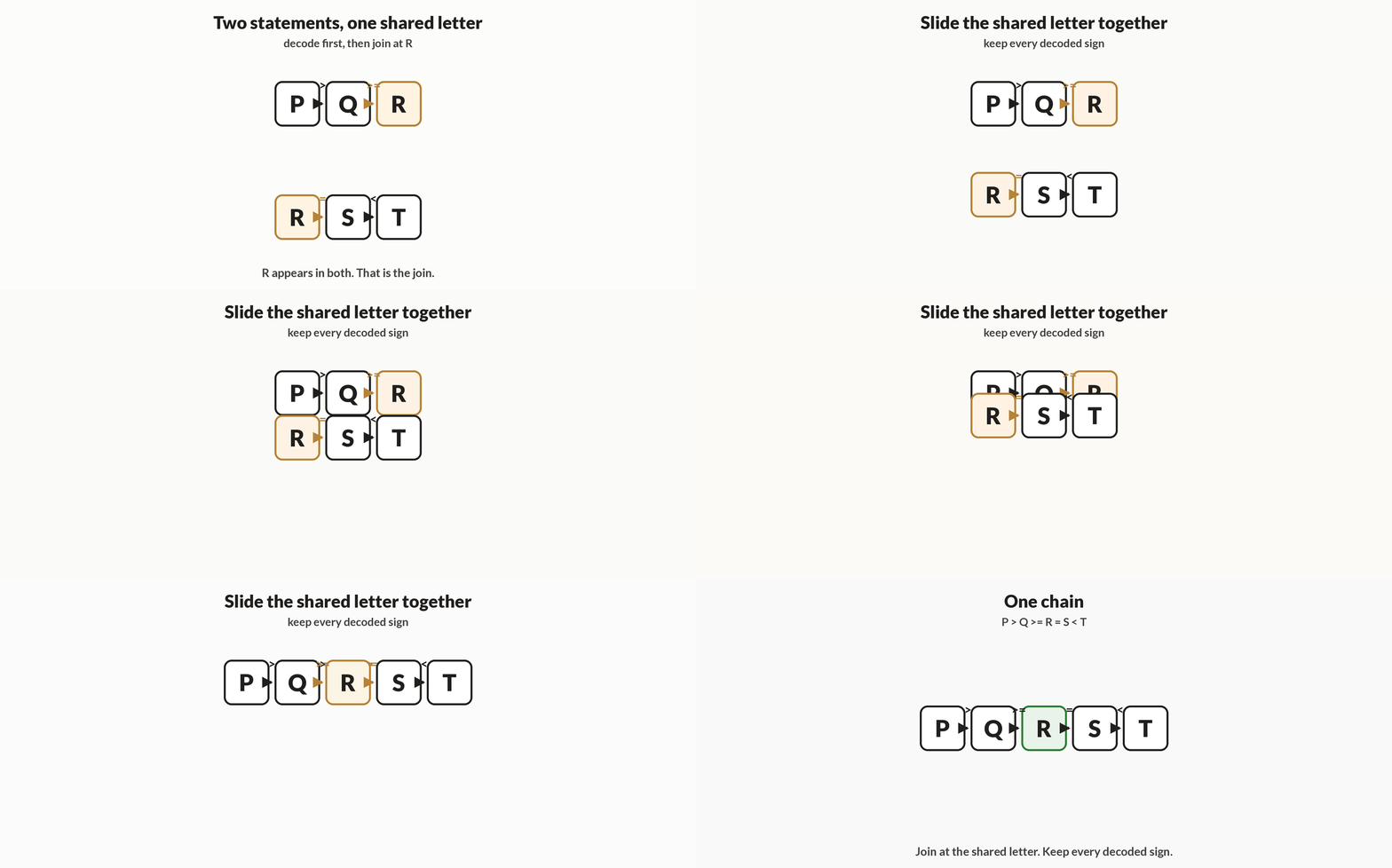
Two true statements that share a letter can be written as one chain. The running decode P > Q, Q ≥ R, R = S shares Q between the first two pairs and R between the last two, so it joins as P > Q ≥ R = S. Later papers add a fifth letter T with S < T, and that joins on S to give P > Q ≥ R = S < T.
Join only at the shared letter, and keep the signs you already decoded. Sliding Q ≥ R onto the end of P > Q does not by itself create a new fact about P and R — that comparison is the next concept. What combining does is put every letter on one line so a path between two letters is visible.
A path that turns around is still one writing, but it is not one directed comparison. P > Q and R > Q share Q and write as P > Q < R: both P and R sit above Q, and that valley does not decide P against R. Combining is bookkeeping, not a licence to compare across a reversal.
Order of attack
- Find the shared letterEach join needs a letter that already appears in both statements. Here R is in Q ≥ R and in R = S, and later S is in R = S and in S < T.
- Write one lineKeep every decoded sign. P > Q, Q ≥ R, R = S, S < T become P > Q ≥ R = S < T.
- Mark any reversalIf the signs turn around — S < T after a falling chain — leave the valley on the line. Do not invent a sign between the letters on opposite sides of it.
Join the running pairs, then add T
Combine P > Q, Q ≥ R, R = S, and then S < T, into one chain.
- P > Q and Q ≥ R share QP > Q ≥ R
- P > Q ≥ R and R = S share RP > Q ≥ R = S
- P > Q ≥ R = S and S < T share SP > Q ≥ R = S < T
- Reversal on the lineS < T after a falling stretch; P against T is not yet decided
Pro tip. The combined writing is not a claim that P is below T, or above T. It is a claim that S sits below both.
Statements: A > B, B = C, C < D. The combined writing is
- A > B = C < D
- A > B = C > D
- A < B = C < D
Keep every decoded sign and join on the shared letters: A > B shares B with B = C, and B = C shares C with C < D. A > B = C > D flips the last sign. A < B = C < D flips the first. The valley at C < D stays on the line; it does not decide A against D.
3A conclusion follows only if every filling agrees
A conclusion follows only when it is true on every filling the chain still allows. A filling is any assignment of numbers to the letters that obeys every sign. On P > Q ≥ R = S you may pick Q strictly above R, or you may pick Q equal to R; both obey Q ≥ R. Whatever you claim about Q and S must survive both of those fillings.
P > S does survive. Even when Q, R and S are the same number, P is still strictly above Q, so P is strictly above S. Q > S does not survive: the filling Q = R = S makes Q equal S, so 'Q is strictly greater than S' is possible, not definite.
The exam options 'only I', 'only II', 'both' and 'neither' are this test applied twice. Possible is not definite. If a path between two letters reverses — P > Q ≥ R = S < T, so P and T both sit above S — then P > T, P = T and P < T are all still allowed, and none of those three conclusions is definite.
Figure. Schematic chain for the running example. P > S is forced; Q > S is not, because Q may still equal R and S.
Try to break it
- Name the pathFind the stretch of the chain that joins the two letters in the conclusion, and copy every sign on that stretch.
- Ask whether a filling kills itIf the path is one-directional and contains a strict >, the left-to-right greater-than is definite. If the path is only ≥ and =, equality of the ends is still allowed, so a strict conclusion is not definite.
- Refuse a reversalIf the signs turn around, all three of >, = and < between those ends are still allowed. None of them follows.
| Conclusion | Forced? |
|---|---|
| P > S | Yes — a strict > sits on a one-way path |
| Q ≥ S | Yes — Q ≥ R and R = S |
| Q > S | No — Q = R = S is still allowed |
| P > T on P > Q ≥ R = S < T | No — the path reverses at S < T |
P > S is forced; Q > S is not
From P > Q ≥ R = S, which of (I) P > S and (II) Q > S follows?
- Path P to S: P > Q ≥ R = Sone-way, contains a strict >
- Filling Q = R = S still has P > QP > S in every filling — I definite
- Path Q to S: Q ≥ R = SQ ≥ S, but Q > S fails when Q = S
- II Q > Spossible, not definite
- Answeronly I follows
Pro tip. The filling that kills II is allowed by ≥. If the chain had been P > Q > R = S, then Q > S would be definite too.
From P > Q ≥ R = S, which conclusion is definite?
- Q > S
- P > S
- P = Q
P > Q ≥ R = S puts a strict greater-than on the path from P to S, so P > S holds even when Q = R = S. Q > S fails on that same filling. P = Q contradicts P > Q, so it is never true.
4Either-or only for a complementary pair
Either-or is a last resort, not a third way of being definite. It fires only when two conclusions use the same two letters, neither conclusion is true in every allowed filling, the two conclusions cannot hold together, and together they cover every filling that is still allowed.
On P > Q ≥ R = S the chain already forces Q ≥ S. Conclusion I 'Q > S' fails on the filling Q = S. Conclusion II 'Q = S' fails on the filling Q > S. They never hold together, and every allowed filling makes exactly one of them true. That pair is complementary, so either I or II follows.
If either conclusion is already definite on its own, either-or is off the table. P > S is definite on the same chain, so pairing it with P = S is not either-or — I follows and II does not. A second trap: P > T and P < T on P > Q ≥ R = S < T look complementary, but P = T is still allowed, so the pair is not exhaustive and the answer is neither.
Picture the running chain P > Q ≥ R = S with Q ≥ S already forced, then two conclusion cards — Q > S and Q = S — neither ticked as definite, together covering every filling that is still allowed. That is the either-or gate; a still chain cannot show the covering.
Gate then pair
- Test each conclusion aloneIf one already holds in every filling, mark that one and stop — not either-or.
- Confirm both are openEach must fail in some allowed filling and succeed in another.
- Check complementaritySame two letters, never true together, and together they cover every remaining filling. Then either-or applies.
| Pair | Exhausts when | Before you mark either-or |
|---|---|---|
| A > B and A = B | A ≥ B is already forced | Neither side may already be definite |
| A < B and A = B | A ≤ B is already forced | Neither side may already be definite |
| A ≥ B and A < B | the relation is otherwise unknown | Neither side may already be definite |
| A > B and A < B | never, while A = B is still allowed | Not a complementary pair |
Q > S versus Q = S is complementary; P > S versus P = S is not
From P > Q ≥ R = S, conclusions: (I) Q > S (II) Q = S. Compare with (I') P > S (II') P = S.
- Chain forces Q ≥ SI Q > S and II Q = S both still open
- I and II exclusive and exhaustiveeither I or II follows
- P > S on the same chainI' definite, so II' never
- I' already definitenot either-or; only I' follows
Pro tip. The gate is the first test. Complementary shape without uncertainty is just 'only I follows'.
From P > Q ≥ R = S, conclusions: (I) Q > S (II) Q = S. Which follows?
- Only I follows
- Only II follows
- Either I or II follows
The chain forces Q ≥ S but neither Q > S nor Q = S on its own. The two conclusions are exclusive and together they cover every allowed filling, so either I or II follows. Only I would require Q > S in every filling, including Q = R = S.
5Flipping a pair reverses the sign
A comparison is the same fact written from the other end, provided you reverse the sign. P > Q is Q < P. Q ≥ S is S ≤ Q. Equals does not change: R = S is S = R. The running chain P > Q ≥ R = S read right to left is S = R ≤ Q < P — every sign flipped, equals kept.
That rewrite is how a conclusion written 'backwards' is tested. S ≤ Q is not a new claim; it is Q ≥ S with the pair flipped, and Q ≥ S is definite, so S ≤ Q follows. Flipping P > Q into Q > P (keeping the sign) is the usual wrong option: that would put Q above P and contradict the chain.
Equals is symmetric and nothing else is. R = S lets you substitute R for S anywhere on the chain. Q ≥ R does not let you write R ≥ Q: the filling Q > R is still allowed, and that filling makes R ≥ Q false.
Figure. The same running chain read both ways. Right to left, every sign reverses and equals stays: S = R ≤ Q < P.
How it works
- Name the pairThe conclusion names two letters. Find them on the chain, in either order.
- Flip the sign> becomes <, ≥ becomes ≤, < becomes >, ≤ becomes ≥. Equals stays equals.
- Test the flipped claimIf the flipped reading is definite on the chain, the original conclusion follows. Do not keep the sign while swapping the letters.
| Written | Flipped | Equals? |
|---|---|---|
| P > Q | Q < P | No — the sign reverses |
| Q ≥ S | S ≤ Q | No — the sign reverses |
| R = S | S = R | Yes — equals is symmetric |
| Q ≥ R | R ≥ Q | No — that is not a flip |
S ≤ Q is the flip of Q ≥ S
From P > Q ≥ R = S, does S ≤ Q follow?
- Path Q to S: Q ≥ R = SQ ≥ S definite
- Flip Q ≥ SS ≤ Q
- S ≤ Q on every fillingfollows
- S ≥ Q (sign not flipped)fails whenever Q > S — does not follow
Pro tip. Read the whole chain backwards as a check: S = R ≤ Q < P. S ≤ Q is sitting on that line.
From P > Q ≥ R = S, which conclusion is the same claim as Q ≥ S?
- S ≥ Q
- S ≤ Q
- S > Q
Flipping Q ≥ S reverses the sign and keeps the letters, giving S ≤ Q, which is definite on the chain. S ≥ Q keeps the sign while swapping the letters, and fails whenever Q > S. S > Q is a strict claim the chain never forces, and it contradicts S ≤ Q on the filling Q = S.
Notes
- Decode the key first: every coded symbol (@, #, *, %, &) stands for one of >, ≥, =, <, ≤. Rewrite every pair into those five signs before combining statements or testing a conclusion.
- Combine statements that share a letter into one chain, keeping the decoded signs. A path that reverses (P > Q < R) is still one writing, but it does not decide P against R.
- A conclusion follows only if it is true on every filling the chain still allows. Possible is not definite: Q ≥ S does not make Q > S follow.
- Either-or fires only for a complementary pair on the same two letters, when neither side is already definite, the two cannot hold together, and together they cover every remaining filling.
- Flipping a pair reverses the sign (P > Q is Q < P). Equals is symmetric (R = S is S = R) and nothing else is.
Formulas
- P > Q if and only if Q < P.
- P \ge Q if and only if Q \le P.
- P = Q if and only if Q = P.
- If P > Q \ge R then P > R (a strict greater-than sits on the path).
- If P \ge Q \ge R then P \ge R, not necessarily P > R.
Exam traps & shortcuts
- Rewrite the whole key in one pass. A leftover coded symbol is how ≥ is read as >.
- Mark every reversal on the combined chain. You may not compare the two letters that sit on opposite sides of a valley.
- Test a conclusion by trying to break it: if one allowed filling makes it false, it does not follow.
- Either-or is a last resort. If one conclusion is already definite, stop — do not reach for the complementary pair.
Reference tables
Every line reconstructs from the concept that owns it. Decode first; then join; then test fillings.
| Situation | What follows |
|---|---|
| Coded symbols still on the page | Rewrite into >, ≥, =, <, ≤ before anything else |
| Statements share a letter | Join into one chain; keep every decoded sign |
| One-way path with a strict > | The left-to-right greater-than is definite |
| One-way path of only ≥ and = | The weak inequality is definite; the strict one is not |
| Path that reverses | Neither end's comparison with the other follows |
| Q ≥ S forced, Q > S and Q = S both open | Either Q > S or Q = S follows |
| Pair written backwards | Reverse the sign; equals stays equals |
Recap
Read only this the night before.
- Decode
- Copy the key, rewrite every pair into >, ≥, =, <, ≤, then stop. A leftover coded symbol is how ≥ is read as >.
- Combine
- Join on the shared letter. A valley such as P > Q < R is one writing, not a comparison of P with R.
- Definite
- Follows only if every allowed filling agrees. On P > Q ≥ R = S, P > S is definite; Q > S is not.
- Either-or
- Same two letters, neither definite, exclusive, exhaustive. Q > S versus Q = S on that chain; P > T versus P < T is not, because P = T is still allowed.
- Flip
- P > Q is Q < P. Q ≥ S is S ≤ Q. Equals is symmetric and nothing else is.
Practise Coded Inequality
Reading is free and needs no account. Practice, mocks and progress live in the app.
- 16 exam-style questions on this topic, with explanations
- A 6-question practice set that ends the chapter
- Timed mocks scored with the real marking scheme
- Readiness tracked per topic, kept on your device