UPSC CSE IAS · UPSC General Studies & Ethics
CSAT Logical & Analytical Reasoning
Covers logical reasoning, analytical ability and decision making and problem solving in the CSAT paper.
Eight concepts for CSAT Paper II reasoning: syllogism validity, seating anchors, blood relations and directions, coding and series, clock angles, and statement–argument / decision traps. Tables and steps carry most of the load; only clock arithmetic earns a ledger.
- UPSC CSE IAS
- Medium level
- 8 concepts
- 6 practice questions
1Syllogism: true in every diagram
A CSAT syllogism asks whether a conclusion must follow from the statements. Translate each premise into a set force — 'All A are B' puts A inside B; 'Some A are B' forces an overlap — then ask whether the conclusion survives every Venn arrangement still allowed by those forces.
The practical attack is to try to make the conclusion false while keeping every premise true. If you can, the conclusion does not definitely follow. 'All roses are flowers' always yields the converse 'Some flowers are roses'; a Some premise about flowers and red does not force any rose to be red.
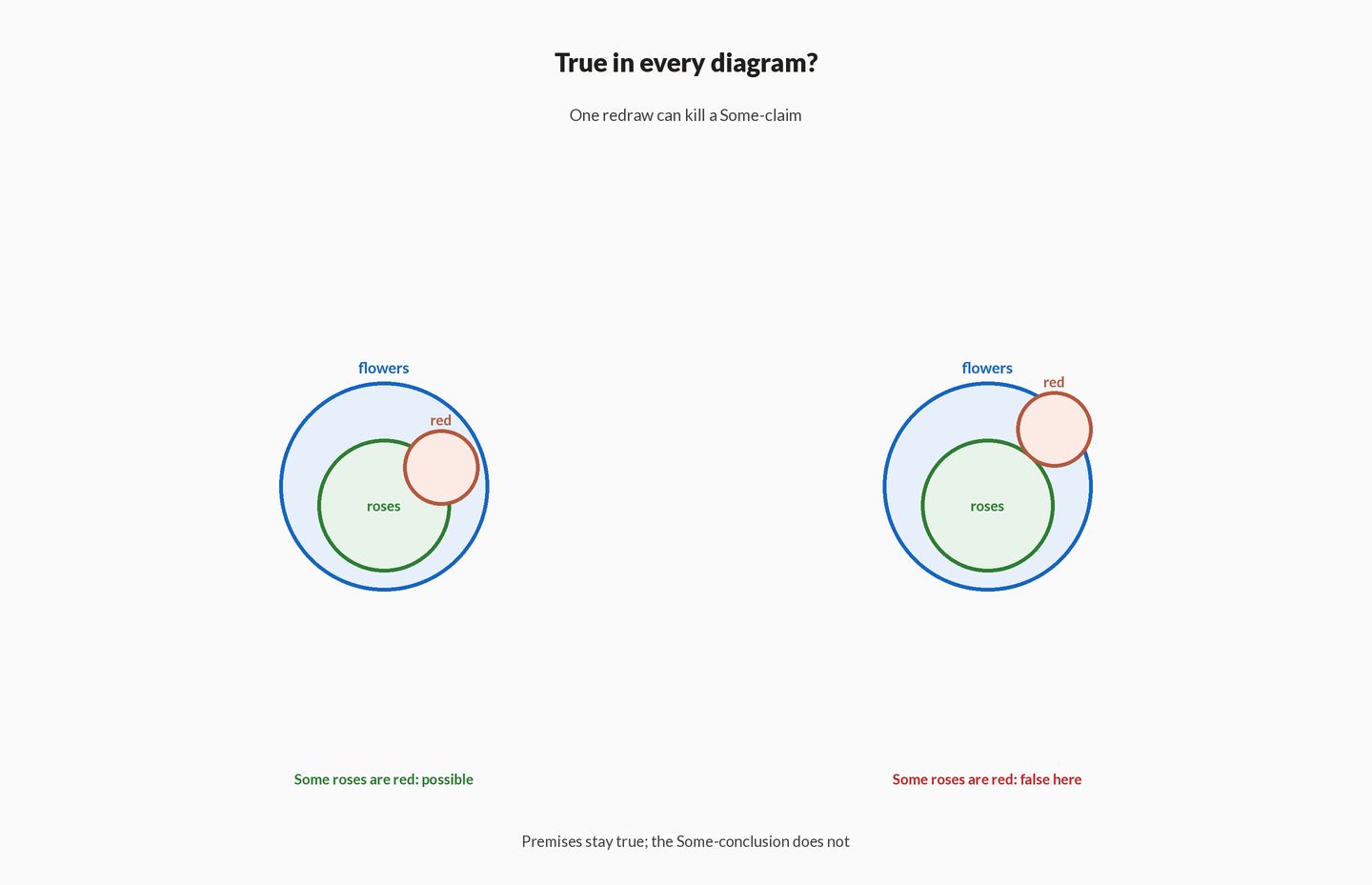
Order of attack
- Force the All / No linesDraw (or name) the nestings and splits that All and No force before placing any Some overlap.
- Place Some lastA Some overlap can sit in more than one region; leave it movable until you test the conclusion.
- Falsify the conclusionRedraw to break the conclusion while every premise stays true. One counter-arrangement kills a 'definitely follows' claim.
| Wording | Force | Still open |
|---|---|---|
| All A are B | A lies inside B | Whether B has members outside A |
| No A is B | A and B share nothing | Nothing about other sets |
| Some A are B | At least one shared member | Whether All A are B also holds |
| Some A are not B | At least one A outside B | Whether the rest of A is inside B |
Statements: All roses are flowers. Some flowers are red. Conclusions: (I) Some roses are red. (II) Some flowers are roses. Which reading is correct?
- Both follow, because flowers that are red must include roses
- Only II follows: all roses are flowers, so some flowers are roses; I can fail if red sits outside the rose subset
- Only I follows: some flowers are red forces those flowers to be roses
All roses ⊂ flowers converts to Some flowers are roses, so II is definite. Some flowers are red need not touch the rose subset, so I fails in a counter-arrangement.
2Possibility and either–or
CSAT options often ask what is possible rather than what is definite. A possibility conclusion is acceptable when at least one arrangement still allowed by the premises makes it true — even if another arrangement makes it false. Definite conclusions demand survival in every arrangement; possibility conclusions demand survival in one.
An either–or pair is usually correct when two mutually exclusive conclusions each fail as definite claims, yet together they cover every remaining case. Do not pick either–or merely because both look tempting in your first sketch.
Figure. Three conclusion strengths: definite (true in every remaining arrangement), possible (true in at least one), either–or (exclusive complementary pair). Circles stay undrawable — this figure teaches the verdict labels only.
How to sort the option
- Name the askRead whether the stem wants 'follows', 'does not follow', or 'may be true' / possibility.
- Test definite firstTry to falsify each conclusion while premises stay true. Survival → definite; one counter → not definite.
- Check either–or coverIf two failed definites are mutually exclusive and every leftover diagram makes exactly one true, the either–or option is the fit.
| Claim type | Passes when | Fails when |
|---|---|---|
| Definitely follows | True in every allowed arrangement | One counter-arrangement exists |
| Possibility / may be true | True in at least one allowed arrangement | False in every allowed arrangement |
| Either–or pair | Both fail as definite, are exclusive, and cover all cases | A third leftover case, or both can be false together |
A conclusion is false in one Venn still allowed by the premises, but true in another. Which CSAT reading fits?
- It definitely follows, because it is true in the sketch you drew first
- It may be true (possibility), but it does not definitely follow
- It is impossible, because any counter-arrangement kills every form of the claim
One counter kills 'definitely follows' but leaves possibility open. The first option confuses a convenient sketch with every-diagram validity; the third collapses possibility into impossibility.
3Seating: fix the tightest clue first
Arrangement puzzles reward order of placement more than clever drawing. Start from the clue that fixes an absolute position — a corner, an end, 'third from the left', or a named facing — then fill immediate-neighbour links before opening any branch.
Branch only when two seats remain legal for the same person. Keep a short fork and kill a branch with the next clue. Starting from a vague 'A is somewhere left of B' multiplies layouts and wastes the CSAT clock.
Figure. Schematic five-seat row: ends and a ranked middle seat are the first pins; relative left/right clues wait until those anchors exist.
Order of attack
- Anchor absolute seatsPlace ends, corners, and ranked seats ('third from left') before any relative left/right string.
- Lock neighboursImmediate-neighbour and 'second to the right' clues attach to already placed people.
- Use negatives late'Not at an end' and 'not next to X' finish the board after forced seats are gone.
- Branch only when forcedFork only when two seats remain legal; eliminate with the next clue rather than drawing every full layout up front.
| Clue shape | Priority | Why |
|---|---|---|
| End / corner / ranked seat | First | Pins an absolute index and shrinks the board |
| Immediate neighbour | Second | Attaches to a pinned person with almost no branching |
| Relative left/right without anchor | Later | Needs an absolute seat before left/right is unique |
| Negative ('not next to') | Last | Eliminates leftovers once forced seats are filled |
Five people sit in a north-facing row. Clues include 'R is at one end', 'Q is third from the left', and 'P is somewhere left of S'. Which clue should you place first?
- P is somewhere left of S, because relative order is the heart of seating
- Q is third from the left (or R at an end) — an absolute seat — before touching the loose left-of clue
- None: draw all 5! permutations and eliminate
Absolute ranks and ends cut the board immediately. A loose left-of clue branches until an anchor exists; enumerating all permutations is the slow path CSAT punishes.
4Blood relations: sketch the tree
Blood-relation stems collapse once the cast is on a page. Use a generation sketch: males marked (+), females marked (−), a marriage link (=) between spouses, siblings on one horizontal level, and a vertical link for each parent–child step.
Never track a long 'mother's brother's only daughter' chain only in words. Rewrite self-reference phrases first — 'only son of my father' is often the speaker when the speaker is male — then walk one kinship edge at a time on the sketch.
Figure. Schematic only: spouses share a generation with an (=) link; both children hang one level down from both parents and stay on one sibling line.
Order of attack
- Place eldersPut the oldest named generation at the top; each parent–child link steps one generation down.
- Mark sex and marriageTag (+) / (−) as soon as the stem says so, and join spouses with (=) on the same generation line.
- Rewrite self-referenceCollapse 'only son of my father' / similar phrases to a named person before walking further edges.
- Name the asked linkRead sister, niece, uncle off the finished sketch — not off the original wording.
| Mark | Means |
|---|---|
| (+) | Male |
| (−) | Female |
| (=) | Married couple, same generation |
| Horizontal link | Siblings |
| Vertical link | Parent → child (one generation) |
In a family-tree sketch, where do a brother and sister sit relative to their parents?
- On the same generation line under the parents, joined as siblings
- One generation above the parents, because siblings are elders
- On opposite sides of a marriage (=) link between them
Siblings share a generation under the same parents. A marriage (=) link is for spouses, not for a brother–sister pair.
5Directions: track cumulative turns
Direction stems are path arithmetic on a compass. Sketch North up, East right; mark the start facing, then apply each turn and each distance in order. Facing after a turn is not the same question as final position relative to the start — answer the ask that was actually set.
Cumulative turns matter: two successive left turns from North leave you facing South; a left then a right can restore the original facing. Keep a running facing mark rather than recomputing from the stem wording at the end.
Figure. Compass sketch only: successive left turns from North go West then South. Distances are not to scale.
Order of attack
- Fix the compassDraw N/E/S/W once; decide whether the stem uses left/right relative to facing or absolute compass moves.
- Update facingAfter each turn, rewrite the facing (N→W on left, N→E on right) before applying the next distance.
- Plot the pathMark each leg on the sketch; read final position as a displacement from start, not as a memory of the wording.
- Match the askConfirm whether the options want facing, distance from start, or direction of the endpoint from the start.
| Facing now | Turn left → | Turn right → |
|---|---|---|
| North | West | East |
| East | North | South |
| South | East | West |
| West | South | North |
A walker faces North, turns left, walks, then turns left again. Which way is the walker facing?
- North — two lefts cancel
- South — each left is a quarter-turn; two lefts reverse the original facing
- East — left from North is East
Left from North is West; left from West is South. Two lefts reverse facing; they do not cancel, and left from North is West not East.
6Coding-decoding and letter series
Letter coding almost always rides on position values A=1, B=2, \ldots, Z=26. Compute the shift (or reverse map) on the first letter, then verify the same rule on every other letter before you predict a missing term. A rule that fits only the first pair is a trap.
The reverse-position of a letter is 27 minus its forward position — A pairs with Z, B with Y, and so on. Number series use the same discipline: name the pattern (common difference, alternating differences, multiply-then-add) and check it across all given terms.
Figure. Letter coding as position arithmetic: verify the shift on the first letter (A→C as +2), then the same rule on every other letter. Reverse maps use 27−n.
Order of attack
- Map to positionsWrite A=1\ldots Z=26 under each letter (or note reverse as 27 - p).
- Guess one ruleConstant shift, +1/-1 alternate, or reverse-letter are the usual CSAT shapes.
- Verify on all pairsReject the rule if any given letter breaks it; only then apply it to the asked letter or next term.
| Tool | Rule | Role |
|---|---|---|
| Forward position | A=1,\ldots,Z=26 | Measure shifts between coded pairs |
| Reverse position | 27 - p (p = forward position) | A↔Z, B↔Y style codes |
| Constant shift | Each letter +k or -k (wrap at Z/A) | Whole-word codes with one k |
| AP n-th term | a_n = a_1 + (n-1)d | Number-series next-term questions |
Same shift on every letter
If in a code each letter of CAT is shifted forward by 2 positions (no wrap needed), what is the code?
- C → position 3; 3+25 → E
- A → 1+23 → C
- T → 20+222 → V
- CAT under +2ECV
Pro tip. Lock k from one letter, then confirm the same k on every other letter before you trust the code.
Using reverse position 27 - p, which letter pairs with M (p=13)?
- L, because reverse steps one letter backward
- N — 27-13=14, and the 14th letter is N
- Z, because every mid-alphabet letter reverses to Z
Reverse of M is 27-13=14, which is N. Stepping one letter backward invents a different rule; mapping everything to Z ignores 27-p.
7Clock angle between hands
The angle between hour and minute hands is \theta = |30H - 5.5M| degrees, where H is the hour as shown (use 0–11) and M is minutes past the hour. The 5.5 already folds in the hour hand's crawl of 0.5° per minute.
If \theta exceeds 180°, take the smaller angle on the face — 360° - \theta. Report that smaller angle unless the stem asks for the reflex. You do not need a drawn dial — plug H and M straight into the absolute-value formula.
Figure. Clock hands as two vectors from a centre (schematic 3:00-ish spread). The sector itself cannot be drawn — compute θ = |30H − 5.5M| in the ledger; the smaller angle is min(θ, 360−θ).
How it works
- Identify H and MH is the hour as shown; M is minutes past the hour.
- Compute |30H - 5.5M|One subtraction; keep the absolute value.
- Take the smaller angleIf the result is over 180°, replace it with 360° minus that result.
Angle at 3:30
What is the angle between the hour and minute hands of a clock at 3:30?
- H=3, M=30; compute 30H30 \times 3 = 90
- 5.5M5.5 \times 30 = 165
- \theta = |90 - 165|75°
- 75 < 180, so smaller angle stands75°
Pro tip. Use \theta = |30H - 5.5M|; if the result exceeds 180, subtract from 360 for the smaller angle.
Using \theta = |30H - 5.5M|, the angle at 2:20 is
- 50°
- 60°
- 110°
|30\times 2 - 5.5\times 20| = |60 - 110| = 50°. Taking |30\times 2 - 6\times 20| = 60° drops the hour hand's minute motion; 110° is the raw difference before absolute value is read as the interior choice.
8Arguments, assumptions, decisions
Statement–argument items ask whether an argument is strong or weak relative to the statement. A strong argument is relevant and directly addresses the issue with a practical or principled reason. A weak argument is ambiguous, trivial, emotionally loaded without substance, or rests on an unstated assumption the statement does not support.
Decision-making and course-of-action stems in CSAT reward options that are ethical, practical, and rule-consistent — not theatrical, illegal, or dependent on facts the passage never gave. Prefer the option that solves the stated problem within the given constraints.
Figure. Strong versus weak arguments relative to the statement: relevance and practical force on the positive side; irrelevance, extremes and vague moralising on the attention side.
How to judge
- Restate the issueIn one line, name what the statement is actually deciding or claiming.
- Score relevanceDoes the argument speak to that issue, or does it change the subject / assume an unsupported fact?
- Prefer workable optionsIn decision stems, keep options that are ethical, practical, and consistent with any stated rule; drop extremes and inventions.
| Tell | Usually strong | Usually weak |
|---|---|---|
| Relevance | Directly addresses the stated issue | Tangential, personal, or changes the question |
| Evidence / principle | Practical consequence or clear principle | Vague prediction, appeal to fear, or circular claim |
| Assumptions | Uses only what the statement allows | Smuggles facts or motives not given |
| Decision options | Ethical, practical, rule-consistent | Illegal, theatrical, or needs missing data |
Statement: 'City X should ban private cars from the central business district on weekdays.' Argument: 'Because my neighbour once parked badly near my house.' How should the argument be rated?
- Strong — any personal parking story proves a CBD ban is needed
- Weak — it is anecdotal, local to one house, and does not address weekday CBD congestion or policy trade-offs
- Strong — personal experience is always the best evidence in CSAT arguments
A single neighbour anecdote is trivial and off-target for a CBD weekday ban. Strong arguments need relevance and a direct, generalisable reason.
Notes
- Syllogisms and Venn diagrams: statements like 'All A are B' translate into set relationships; the conclusion is valid only if it holds in EVERY possible Venn arrangement. Always test 'possibility' cases before accepting a definite conclusion.
- Seating and arrangement puzzles: fix the most constrained condition first (e.g., a person at a corner or immediate-neighbour clues), then branch systematically to eliminate impossible layouts.
- Blood relations and directions: use a family-tree notation (+ for male, - for female, = for couple) and a compass sketch; track cumulative turns for direction problems.
- Coding-decoding and series: identify the pattern (letter shift, position value A=1,\ B=2,\dots, or arithmetic/geometric progression) and verify it across all given terms before predicting the next.
- Statement-argument / assumption: evaluate whether an argument is 'strong' (relevant and directly related) or 'weak' (ambiguous, trivial, or based on assumptions); decision-making questions reward ethical, practical and rule-consistent options.
Formulas
- Number of handshakes / pairings among n people = \binom{n}{2} = \dfrac{n(n-1)}{2}.
- Arithmetic progression n-th term: a_n = a_1 + (n-1)d; useful for number-series questions.
- Letter-position values: A=1, B=2, \ldots, Z=26; reverse position of a letter = 27 - (\text{its position}).
- Clock angle between hour and minute hands: \theta = |30H - 5.5M| degrees.
- Calendar rule: an ordinary year has 1 odd day and a leap year 2 odd days; used to find the day of the week.
Exam traps & shortcuts
- For syllogisms, draw the Venn diagram that tries to MAKE THE CONCLUSION FALSE; if you cannot, the conclusion is valid.
- In seating puzzles, start from the clue that fixes an absolute position (corner/end) to minimise branching.
- For 'possibility' options ('either-or'), they are usually correct when two mutually exclusive conclusions individually fail but together cover all cases.
- In coding-decoding, compute the shift using letter-position values (A=1) and confirm the same rule fits every letter.
Reference tables
Stable identities from this topic. Reconstruct the method in the matching concept, then use this sheet only to check the expression.
| Tool | Expression / peg |
|---|---|
| Clock angle | \theta = |30H - 5.5M|°; if >180, use 360-\theta |
| Letter positions | A=1,\ldots,Z=26; reverse = 27 - p |
| AP n-th term | a_n = a_1 + (n-1)d |
| Pairings / handshakes | \binom{n}{2} = n(n-1)/2 |
| Calendar odd days | Ordinary year 1 odd day; leap year 2 odd days |
| Syllogism test | Try to falsify the conclusion; survival in every diagram ⇒ follows |
Recap
Read only this the night before a CSAT attempt.
- Syllogism
- Definitely follows only if true in every allowed Venn; try to make the conclusion false.
- All → Some converse
- 'All A are B' yields 'Some B are A' as a definite conclusion.
- Possibility
- Possible = true in ≥1 arrangement; either–or needs exclusive cover of all leftovers.
- Seating
- Fix end / corner / ranked seat first; branch only when two seats remain legal.
- Blood tree
- (+) male, (−) female, (=) couple; rewrite self-reference before naming the link.
- Directions
- Update facing after every turn; facing ≠ displacement from start.
- Coding
- A=1\ldots Z=26; lock one shift, verify on every letter; reverse =27-p.
- Clock
- \theta=|30H-5.5M|; smaller angle if over 180°.
- Arguments
- Strong = relevant + direct; decisions = ethical, practical, rule-consistent.
Practise CSAT Logical & Analytical Reasoning
Reading is free and needs no account. Practice, mocks and progress live in the app.
- 6 exam-style questions on this topic, with explanations
- A 5-question practice set that ends the chapter
- Timed mocks scored with the real marking scheme
- Readiness tracked per topic, kept on your device