Deep Learning · Deep Learning
Activations and Optimizers
In Deep Learning because activations and optimizers (ReLU, Adam) shape neural training paths.
Activations shape representation; optimizers shape the path.
- Deep Learning
- Medium level
- 4 concepts
1Common activations
ReLU is the default hidden activation; sigmoid and softmax appear at outputs.
Sigmoid saturates — poor for deep hidden stacks, fine for binary outputs.
Figure. ReLU is zero for negative input, then climbs forever at slope 1 - its gradient never fades on the positive side, which is why it is the default hidden activation. The sigmoid flattens toward 0 and 1 at both ends: in those saturated tails the gradient is nearly zero, starving deep stacks - keep it for outputs that must read as probabilities.
Sigmoid is a fine output activation for a binary classifier and a poor hidden activation deep in a stack. What is the difference?
- The output layer is smaller, so saturating there costs less
- Sigmoid cannot produce negative values, which hidden layers require
- A saturated sigmoid has a near-zero slope, which is harmless at the output but starves every layer below it of gradient
- Sigmoid evaluates more slowly than ReLU, and hidden layers run more often
At the output the squashing is the point, since you want a probability. In the middle of a stack that same flatness multiplies into the backward pass and stalls training beneath it.
2Dying ReLUs
A large negative bias can keep a ReLU unit off for every sample.
If many units die, lower the learning rate or check initialisation.
Figure. A large negative bias can keep a ReLU unit off for every sample. If many units die, lower the learning rate or check initialisation.
A hidden unit emits zero for every row of every batch, epoch after epoch. Why does it never come back?
- ReLU has zero gradient wherever its input is negative, so no update ever arrives to push the unit back into range
- ReLU units are reinitialised only at the very start of training
- The following layer discards zero outputs before they reach it
- Regularisation has driven the unit's weights to exactly zero
The unit is not merely quiet, it is unreachable: with no gradient there is no correction, so the state is self-sustaining. Prevention through the learning rate and initialisation is the only cure.
3SGD
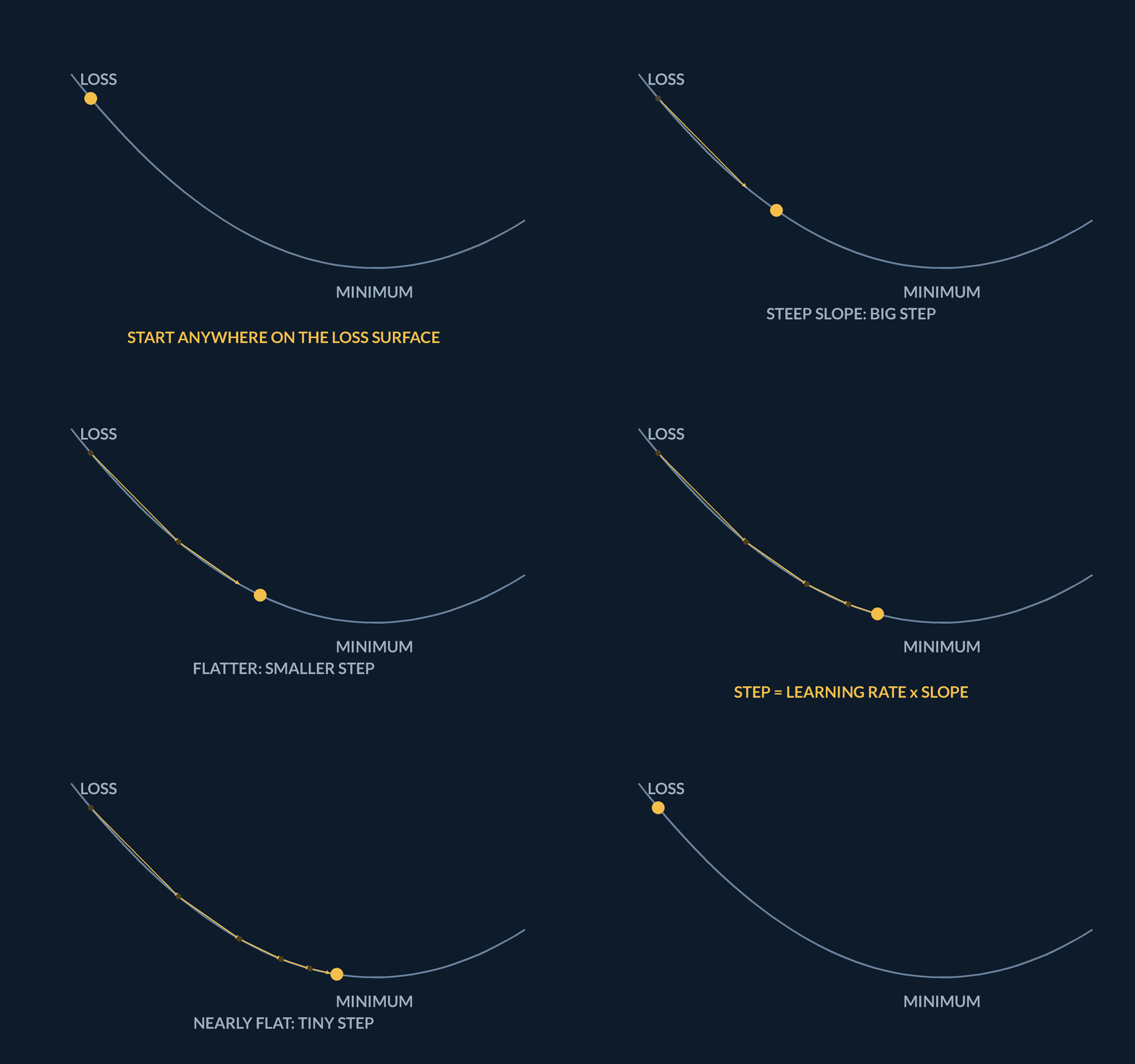
Stochastic gradient descent updates from minibatches with a learning rate.
Too large a rate diverges; too small stalls.
Your loss leaps to a huge value within a few steps and then to infinity. Which knob is the first suspect?
- The batch size, which has been set too small
- The learning rate, which is overshooting the minimum and landing further out on each step
- The epoch count, which has been set too high
- The activation function, which must be saturating
Divergence is the signature of too large a step, not of too much training. A gradient tells you a direction, and only a modest step keeps the promise that direction makes.
4Adam
Adam tracks moment estimates of gradients for adaptive steps.
It is a strong default for small teaching nets; still tune the learning rate.
Figure. Adam tracks moment estimates of gradients and turns them into adaptive steps. It is a strong default for small teaching nets; the learning rate is still chosen by you.
Adam adapts its step size for each parameter. Why is there still a learning rate for you to set?
- It is a legacy argument that has no effect when Adam is used
- It applies only to the bias terms, which Adam does not adapt
- The adaptation rescales a base step, so that base still sets the overall size of every update
- It controls how many gradient moments Adam keeps track of
Per-parameter adaptation handles the relative scaling between weights. The absolute scale is still yours, which is why a badly chosen rate breaks Adam much as it breaks plain SGD.
Notes
- ReLU, sigmoid, SGD and Adam intuition.
- ReLU is the default hidden activation; sigmoid and softmax appear at outputs.
- A large negative bias can keep a ReLU unit off for every sample.
Exam traps & shortcuts
- Keep lab datasets under 2000 rows in the browser runtime.
- Split train and test before fitting any model that sees labels.
Recap
This lesson in brief:
- Common activations
- ReLU is the default hidden activation; sigmoid and softmax appear at outputs.
- Dying ReLUs
- A large negative bias can keep a ReLU unit off for every sample.
- SGD
- Stochastic gradient descent updates from minibatches with a learning rate.
- Adam
- Adam tracks moment estimates of gradients for adaptive steps.
Practise Activations and Optimizers
Reading is free and needs no account. Practice, mocks and progress live in the app.
- A 1-question practice set that ends the chapter
- 4 quick checks with worked explanations
- Timed mocks scored with the real marking scheme
- Readiness tracked per topic, kept on your device