Engineering Mathematics · Linear Algebra
Matrices as Transformations
In Engineering Mathematics because model layers, projections, and feature mixing are matrix actions on vectors, not just rectangular tables to memorize.
A matrix can be read as a compact rule that turns one vector into another. This topic frames matrices as linear transformations so later ML ideas like feature maps and layer weights have a geometric meaning.
- Engineering Mathematics
- Medium level
- 5 concepts
1A matrix is a linear rule
A stockroom clerk keeps one day sheet. Each column is a part, each row is a day, and each entry is the net number of crates that moved: plus means crates came in, minus means crates went out. So in A=\begin{bmatrix}2&-1\\3&4\end{bmatrix}, day 1 reads two crates of part 1 in and one crate of part 2 out — that is what the -1 means. The table is the data: the numbers are not decoration, they are the stored rule.
Applying that stored sheet is a transformation: one list goes in and a different list comes out. Hand it the weight card x=(5,2) — what one crate of each part weighs — and the same sheet returns Ax=(8,23), the net weight moved on each day. Linear means the map respects adding lists and scaling a list — it does not invent a new rule for each input.
The shape of the sheet is a promise about what can be totalled. Two columns take exactly two weights, so when a third part moves there is no weight for it on the card and no column to put it in, and that day cannot be totalled until the sheet itself is widened.

Read a stored day sheet
- Read the sheetColumns are parts and rows are days. Plus is crates in, minus is crates out.
- Apply the same sheetThe weight card goes in through the stored sheet. No new rule is written per input.
- Name the new listOut comes the net weight moved each day. Two day rows give two totals.
The day sheet acting on the weight card
A stockroom day sheet is A=\begin{bmatrix}2&-1\\3&4\end{bmatrix}, with parts down the columns and days across the rows, and the weight card is x=(5,2). Compute the net weight moved each day, Ax.
- Day 1, first row dot x: 2\cdot5 + (-1)\cdot210-2=8
- Day 2, second row dot x: 3\cdot5 + 4\cdot215+8=23
- Ax(8,23)
Pro tip. The answer has two coordinates because the sheet has two day rows.
Let A=\begin{bmatrix}1&2\\0&3\end{bmatrix} and x=(4, -1). What is Ax?
- (2, -3)
- (4, -3)
- (2, 3)
- (6, -3)
Row 1: 1\cdot4+2\cdot(-1)=2. Row 2: 0\cdot4+3\cdot(-1)=-3. So Ax=(2,-3).
2Columns show where basis directions go
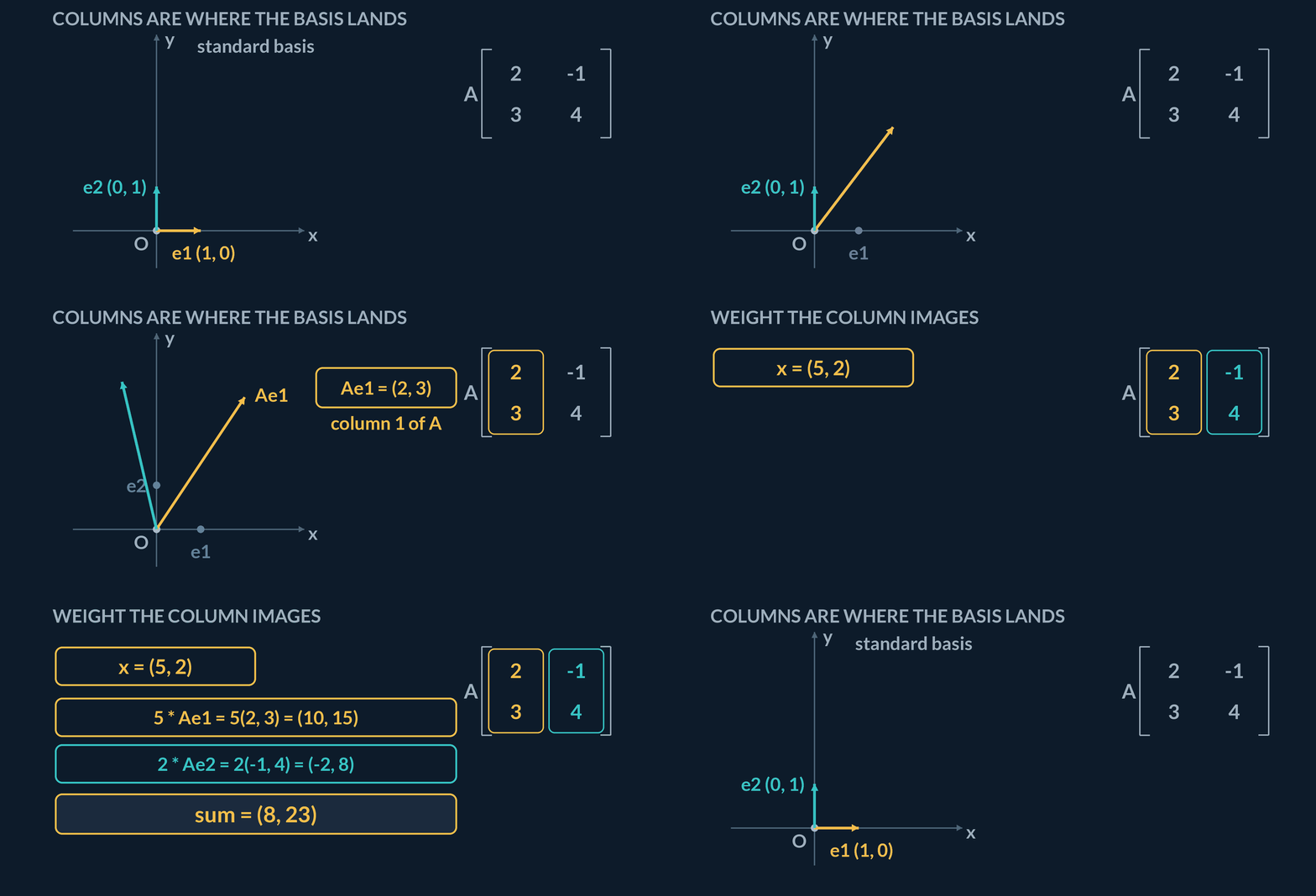
The columns of a matrix are not arbitrary storage positions. Column 1 is where the first basis vector lands, column 2 is where the second basis vector lands, and so on.
Once those basis images are known, every other input follows by linear combination. This is the bridge between the geometric phrase transformation and the arithmetic phrase matrix multiply.
Build from columns
- Read columnsFor A=[a_1\ a_2], the vectors a_1 and a_2 are Ae_1 and Ae_2.
- Weight columnsAn input (x_1,x_2) asks for x_1a_1+x_2a_2.
- AddThe weighted column sum is the same output as row multiplication.
Recover Ax from column images
For A=\begin{bmatrix}2&-1\\3&4\end{bmatrix}, use columns to compute A(5,2).
- Ae_1(2,3)
- Ae_2(-1,4)
- 5Ae_1 + 2Ae_25(2,3)+2(-1,4)
- (10,15)+(-2,8)(8,23)
Pro tip. The column view and row-dot-product view must agree; they are two readings of the same matrix.
For A=\begin{bmatrix}1&2\\0&3\end{bmatrix}, the first column is where e_1 goes. Where does e_1=(1,0) land?
- (1, 0)
- (2, 3)
- (0, 3)
- (1, 2)
Columns of A are the images of the standard basis. The first column (1,0) is Ae_1.
3Matrix composition has an order
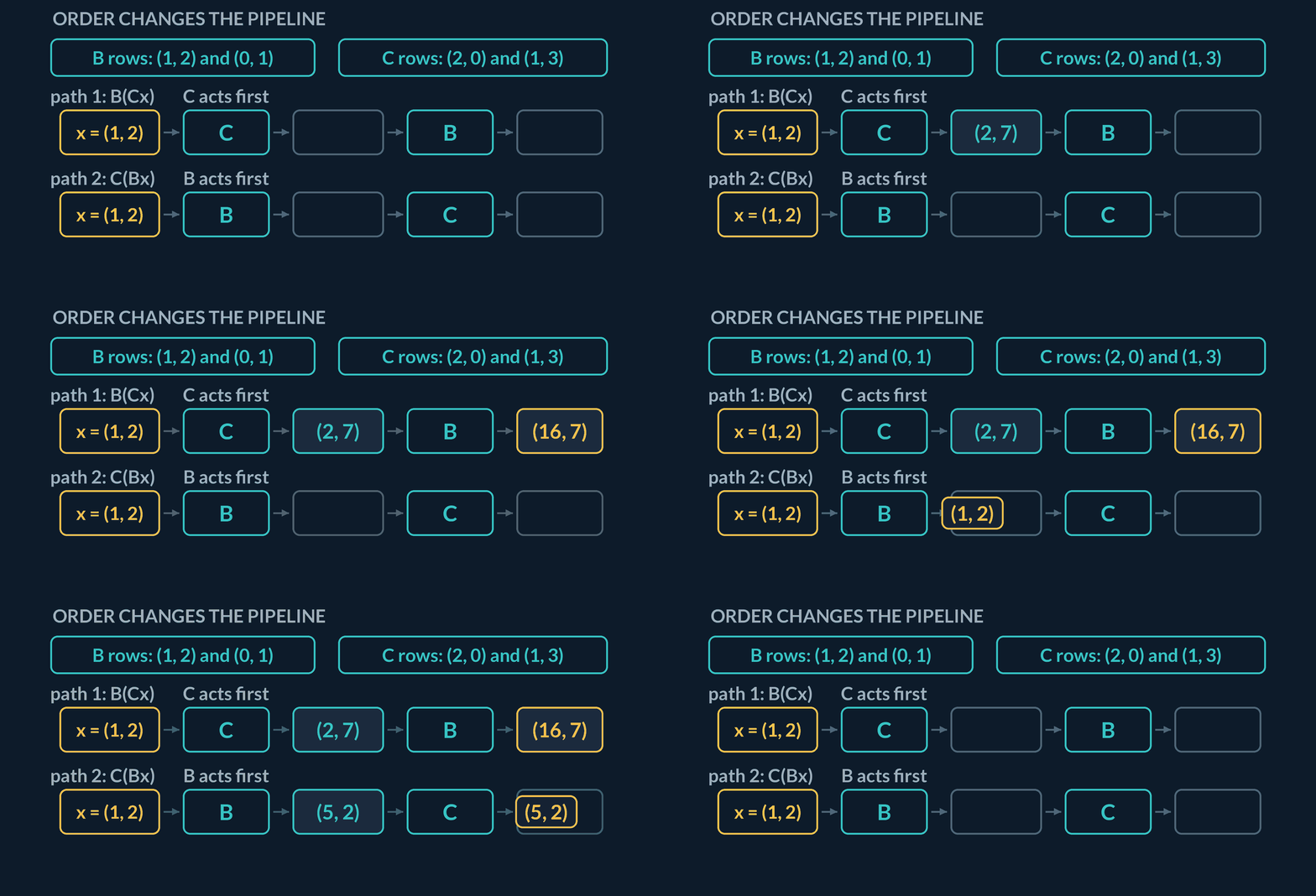
Applying two matrix transformations in sequence is matrix composition. The rightmost transform acts on the vector first, and the next transform acts on that output.
Order usually matters. Two transformations can use the same input and the same two matrices but produce different results when the sequence is reversed.
Read a composition
- Start at the vectorIn BCx, compute Cx before applying B.
- Keep the intermediateThe output of the first transform is the input to the second.
- Compare only like sequencesChanging BC to CB changes the operation unless the matrices commute.
Reverse the order and compare
Let B=\begin{bmatrix}1&2\\0&1\end{bmatrix}, C=\begin{bmatrix}2&0\\1&3\end{bmatrix}, and x=(1,2). Compare B(Cx) with C(Bx).
- Cx=(2\cdot1+0\cdot2,\ 1\cdot1+3\cdot2)(2,7)
- B(Cx)=B(2,7)(2+14,7)=(16,7)
- Bx=(1+4,2)(5,2)
- C(Bx)=C(5,2)(10,5+6)=(10,11)
Pro tip. Composition is a pipeline; reversing the pipeline changes what each stage receives.
Matrices B=\begin{bmatrix}0&1\\1&0\end{bmatrix} and C=\begin{bmatrix}2&0\\0&3\end{bmatrix}. Which claim about BC versus CB is true?
- BC \neq CB in general, so transform order matters
- BC always equals CB for 2\times2 matrices
- Only the first matrix in a product acts on the vector
- Composition ignores matrix order if sizes match
Matrix multiplication is not commutative. Applying scale-then-swap differs from swap-then-scale.
4A batch is a matrix whose rows are feature vectors
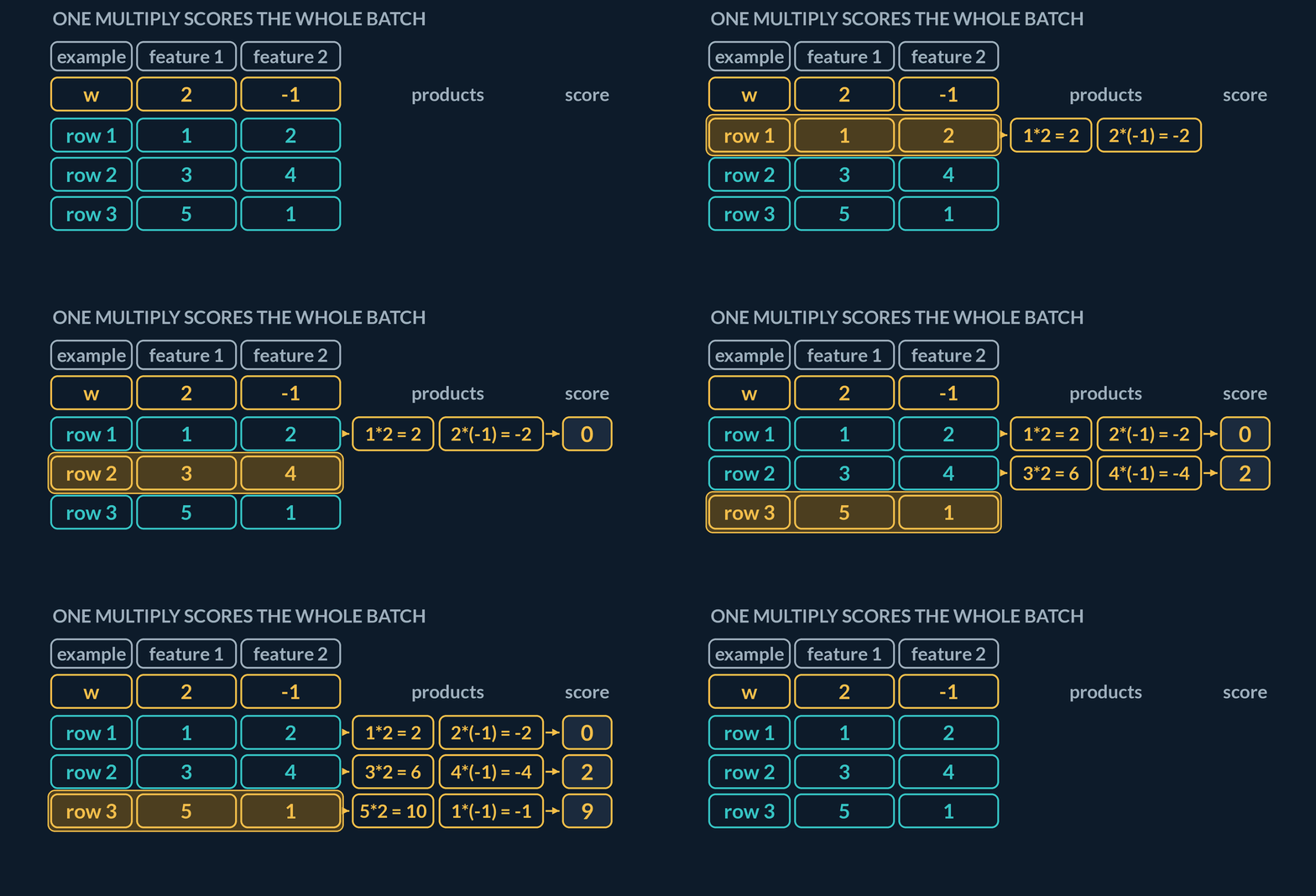
In machine learning, a batch data matrix commonly stores one example per row and one feature per column. Multiplying by a weight vector then computes one dot-product score for each example.
This is matrix multiplication doing repeated vector scoring. The matrix is not merely a table; it is a compact way to run the same linear score over many rows at once.
| example | feature 1 | feature 2 |
|---|---|---|
| row 1 | 1 | 2 |
| row 2 | 3 | 4 |
| row 3 | 5 | 1 |
Three row scores at once
Let the batch rows be (1,2), (3,4), and (5,1), and let w=(2,-1). Compute Xw.
- Row 1 dot w: 1\cdot2 + 2\cdot(-1)2-2=0
- Row 2 dot w: 3\cdot2 + 4\cdot(-1)6-4=2
- Row 3 dot w: 5\cdot2 + 1\cdot(-1)10-1=9
- Xw(0,2,9)
Pro tip. Batch multiplication is just the same dot product repeated down the rows.
Coding lab. Score a batch matrix runs in the app, with checks on your output.
Batch rows are (2, 1), (0, 3), and (4, -1) with weights w=(1, 2). What are the three scores Xw?
- (4, 6, 2)
- (3, 3, 3)
- (4, 6, 3)
- (5, 6, 2)
Scores: 2+2=4, 0+6=6, 4-2=2. So Xw=(4,6,2).
5Matrices mix features into new coordinates
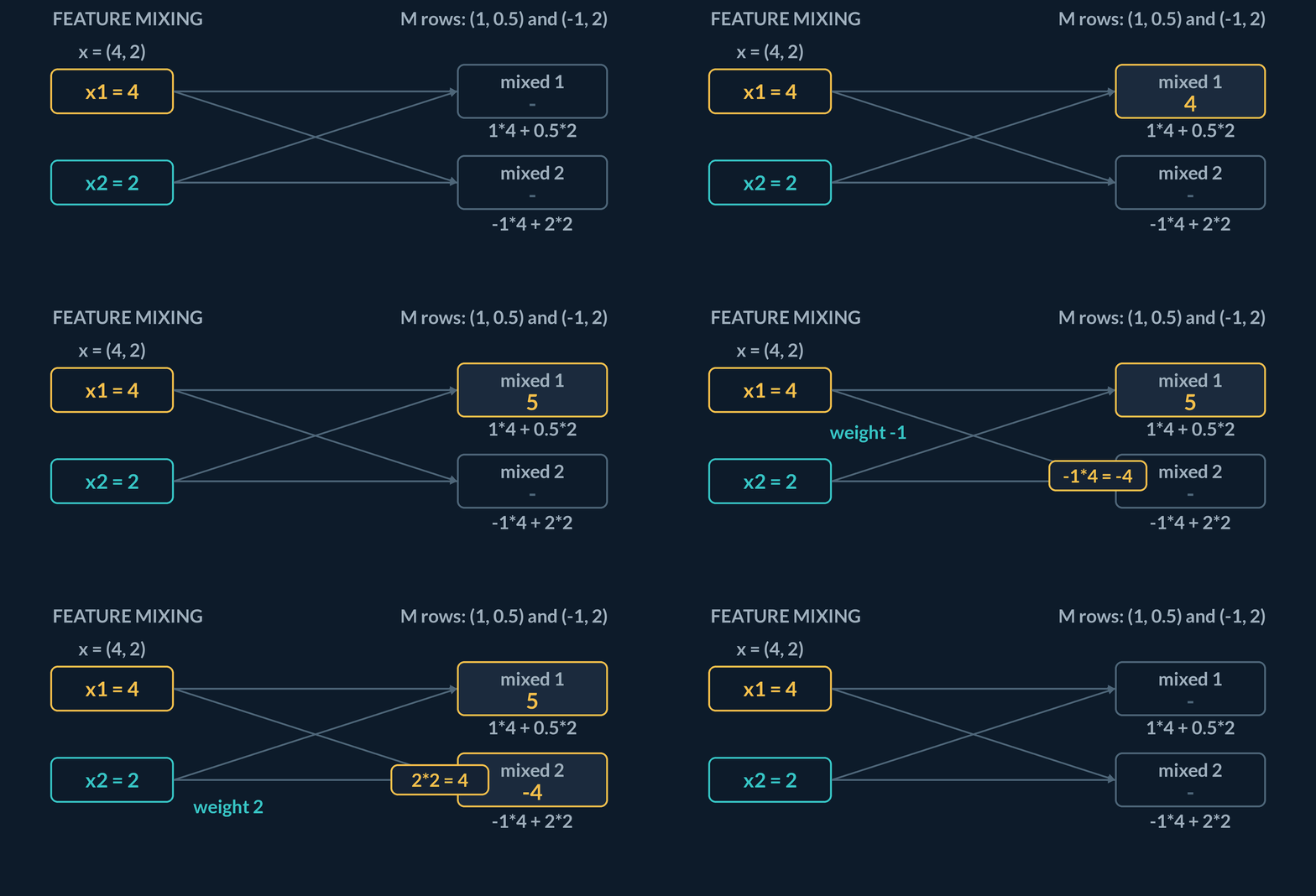
A matrix can also change the number and meaning of coordinates. Two original features can be mixed into two new engineered coordinates, or many features can be compressed into fewer summary coordinates.
The important habit is to name the output coordinates. After multiplication, each new coordinate is a designed combination of the input coordinates, not a mystery number.
Name the output
- Input meaningState what each input coordinate measures.
- Row meaningRead each matrix row as the recipe for one output coordinate.
- Output meaningLabel the resulting coordinate before interpreting it.
Two engineered features from two inputs
A feature mixer uses M=\begin{bmatrix}1&0.5\\-1&2\end{bmatrix} on x=(4,2). Compute the two mixed features.
- First mixed feature: 1\cdot4 + 0.5\cdot24+1=5
- Second mixed feature: -1\cdot4 + 2\cdot2-4+4=0
- Mx(5,0)
Pro tip. Rows define output coordinates; columns define what input positions those recipes consume.
Mixer M=\begin{bmatrix}2&1\\0&-1\end{bmatrix} acts on x=(3, 4). What is Mx?
- (10, -4)
- (6, -4)
- (10, 4)
- (7, -1)
2\cdot3+1\cdot4=10 and 0\cdot3+(-1)\cdot4=-4, so Mx=(10,-4).
Notes
- A matrix maps an input vector to an output vector, provided the inner dimensions match.
- Each column of a matrix shows where one basis direction is sent by the transformation.
Formulas
- If A is m x n and x is in R^n, then A x is in R^m.
- For a matrix A, the j-th column is A e_j, the image of the j-th standard basis vector.
- A batch data matrix X stores examples as rows; X w computes one dot-product score per row.
Exam traps & shortcuts
- Read the columns first when you want intuition about what a matrix does to space.
- Check dimensions before multiplying: the input length must match the number of matrix columns.
- Rows are examples in most ML batches, while columns are features; do not swap those roles mentally.
Recap
Think rule first, table second.
- Meaning
- A matrix stores a linear transformation from one vector space to another.
- Columns
- Each column tells you where one basis direction goes under the transformation.
- Batch
- A batch matrix uses rows as feature vectors, so Xw computes one score per row.
- Order
- In a composition, the rightmost matrix acts first; reversing the order usually changes the output.
Practise Matrices as Transformations
Reading is free and needs no account. Practice, mocks and progress live in the app.
- A 5-question practice set that ends the chapter
- 5 quick checks with worked explanations
- Timed mocks scored with the real marking scheme
- Readiness tracked per topic, kept on your device