Retail Investing · Risk, Allocation & Hygiene
Asset Allocation
Choosing the equity/debt/cash mix before picking products.
5 concepts. Foundation literacy for retail investors.
- Retail Investing
- Easy level
- 5 concepts
- 5 practice questions
1Allocation before products
Asset allocation drives most of a long-term portfolio's risk. Stock tips cannot fix a reckless mix.
Decide the mix, then choose funds or stocks inside it.
Figure. Set these widths first. Funds and stocks are only what gets poured into each slice - no product choice can repair a reckless split.
| Item | Fact |
|---|---|
| Allocation | Equity/debt/cash mix |
| Products | Fill the buckets |
| Order | Mix first |
Before picking individual funds, decide
- Your asset allocation mix
- Only the hottest tip
- Your GMP target
Mix first.
2Goals and risk capacity
Longer horizons and higher capacity for loss support more equity. Near-term goals need more stability.
Risk capacity is money you can lose without derailing life plans; temperament is what you can emotionally bear.
Figure. The horizon sets the mix: a 20-year sleeve has time to recover a bad year, so it can carry mostly growth; a 2-year sleeve cannot, and leans stable whatever your temperament says.
| Item | Fact |
|---|---|
| Long horizon | More equity possible |
| Short goal | More stable assets |
| Capacity vs temperament | Both matter |
A goal only three months away usually needs
- A more stable allocation
- Maximum small-cap equity
- Leveraged options
Short = stable.
3Use bands, not obsessing
Set target weights with bands (for example equity 60% ±5%). Rebalance when you breach bands.
Daily tinkering is not rebalancing — it is noise.
Figure. Equity weight against a 60 target with a 65 band top. Inside the band, leave it alone; 68 is outside, and that breach - not a headline - is what triggers a rebalance.
| Item | Fact |
|---|---|
| Target | Policy weights |
| Band | Allowed drift |
| Rebalance | When outside band |
Rebalancing is best triggered by
- Breaching your allocation bands
- Every viral market meme
- Daily NAV checks
Bands, not memes.
4Glide toward stability when needed
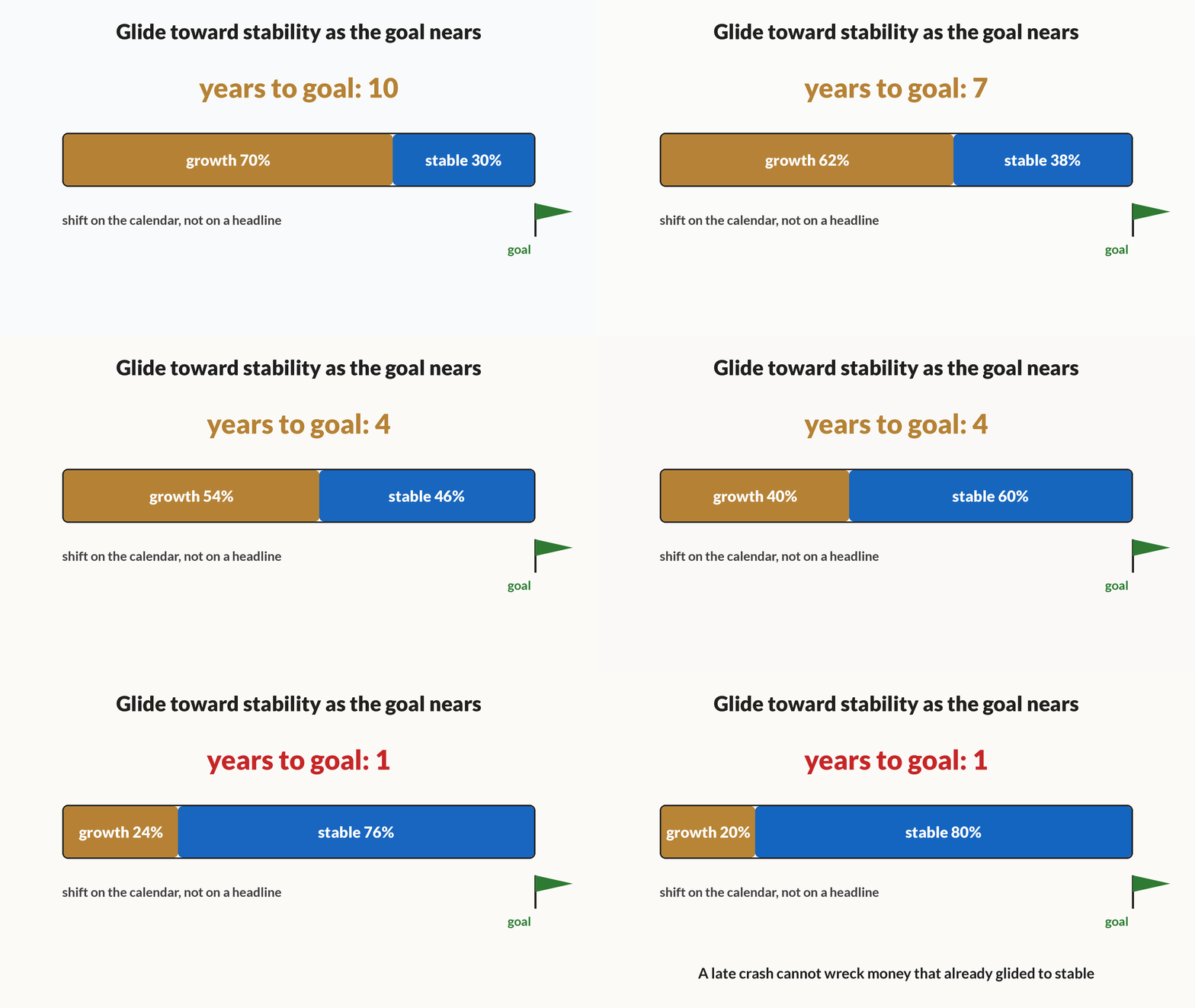
As a goal approaches, reduce risk so a late crash cannot wreck the plan.
This is ordinary planning, not market timing bravado.
| Item | Fact |
|---|---|
| Far goal | Growth OK |
| Near goal | De-risk |
| Tool | Shift to stabler assets |
Two years before a house down payment, a common prudent move is
- Reduce equity risk in that goal's bucket
- Go all-in on futures
- Stop all record-keeping
De-risk near goals.
5There is no universal perfect mix
Internet "age in bonds" rules are starting points, not laws. Your income stability, obligations, and temperament matter.
Write your policy; do not rent someone else's without thought.
Figure. Three investors, same age, three honest mixes. Income stability, obligations and temperament move the split - which is why a viral one-number rule can only ever be a starting point.
| Item | Fact |
|---|---|
| Rules of thumb | Starting points |
| Personalisation | Required |
| Written policy | Beats vibes |
A viral allocation rule should be treated as
- A starting point to adapt
- Mandatory law for every human
- A substitute for goals
Adapt to yourself.
Notes
- Asset allocation drives most of a long-term portfolio's risk. Stock tips cannot fix a reckless mix.
- Longer horizons and higher capacity for loss support more equity. Near-term goals need more stability.
- Set target weights with bands (for example equity 60% ±5%). Rebalance when you breach bands.
- As a goal approaches, reduce risk so a late crash cannot wreck the plan.
- Internet "age in bonds" rules are starting points, not laws. Your income stability, obligations, and temperament matter.
Formulas
- Equity/debt/cash mix
- More equity possible
- Policy weights
Exam traps & shortcuts
- Revise the table pegs before any quiz.
Reference tables
| Peg | Fact |
|---|---|
| 1.Allocation | Equity/debt/cash mix |
| 2.Goals | More equity possible |
| 3.Use | Policy weights |
| 4.Glide | Growth OK |
| 5.There | Starting points |
Recap
Keep these pegs.
- 1.Allocation
- Equity/debt/cash mix
- 2.Goals
- More equity possible
- 3.Use
- Policy weights
- 4.Glide
- Growth OK
- 5.There
- Starting points
Practise Asset Allocation
Reading is free and needs no account. Practice, mocks and progress live in the app.
- 5 exam-style questions on this topic, with explanations
- A 5-question practice set that ends the chapter
- Timed mocks scored with the real marking scheme
- Readiness tracked per topic, kept on your device