Retail Investing · Risk, Allocation & Hygiene
Leverage and F&O Traps
Why beginners lose with futures and options — margin, decay, and payoff asymmetry.
Six concepts. Leverage turns small mistakes into large ones. Master cash investing first. Bars show how premium and decay punish casual option buying.
- Retail Investing
- Medium level
- 6 concepts
- 6 practice questions
1Leverage amplifies
Futures and many option strategies amplify gains and losses versus cash equity.
A "small" futures position can still be large economically.
Figure. Same % move, different pain
| Instrument | Effect |
|---|---|
| Cash equity | ~1x price move |
| Futures | Amplifies P&L vs margin |
| Short-dated options | Can expire worthless |
Leverage means
- P&L moves harder than an unlevered cash position
- Losses are impossible
- SEBI pays drawdowns
Amplifies both ways.
3Margin calls
Futures and short-option risk can demand more margin when markets move against you.
Forced exits ignore your thesis.
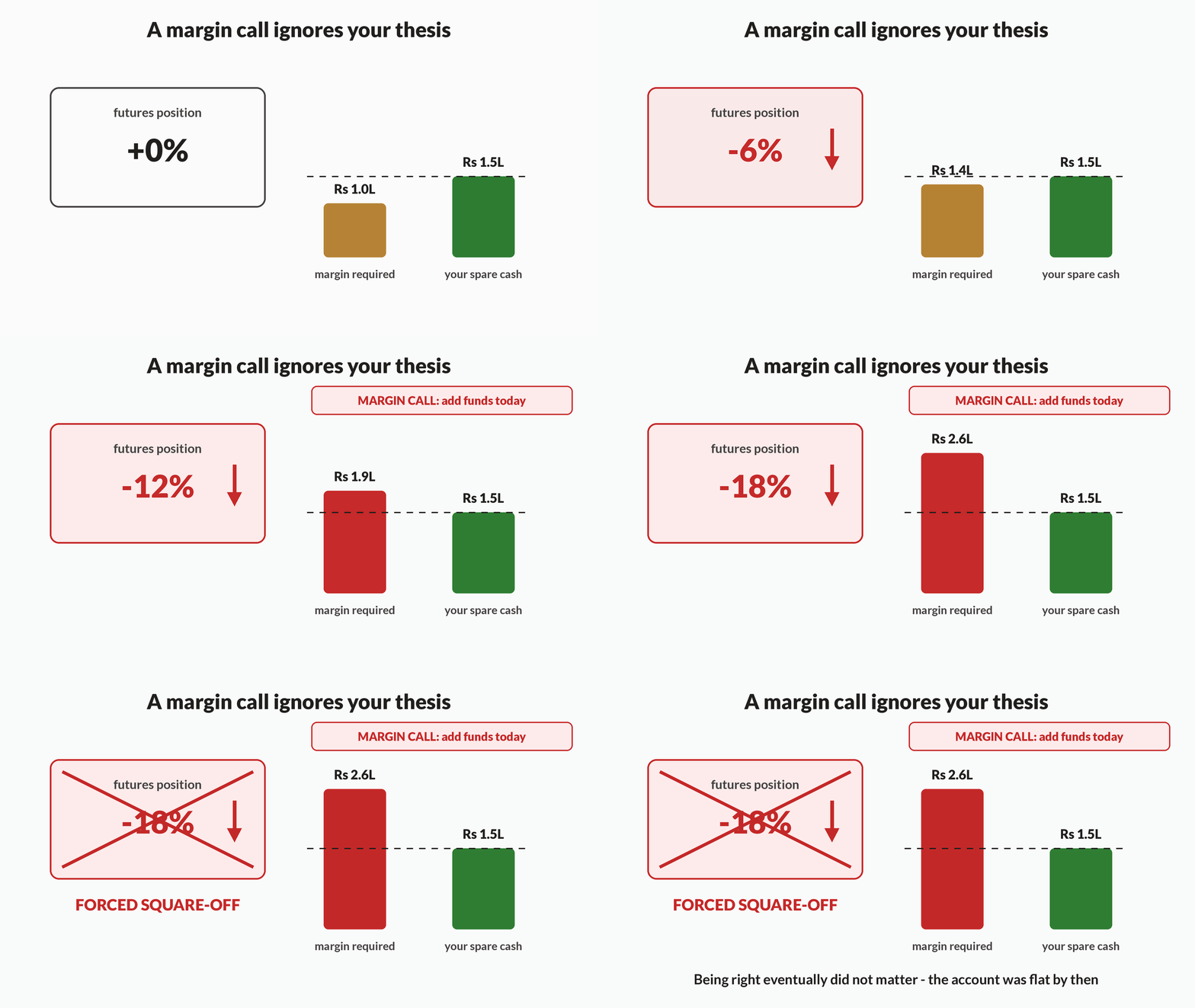
| Event | Effect |
|---|---|
| Adverse move | Margin rises |
| Fail to fund | Forced square-off |
| Tip confidence | Irrelevant to margin |
If you cannot meet a margin call, the usual result is
- Forced square-off of positions
- A free extension forever
- Automatic profit
Margin enforces reality.
4Right direction, wrong time
Options need timing. Spot can move your way after expiry and you still lose.
Cash equity forgives slow correctness better than short-dated options.
Figure. Premium decays even if spot eventually rises later.
| Path | Trap |
|---|---|
| Short-dated OTM call | Needs fast move |
| Thesis takes months | Option already dead |
| Cash shares | Can wait if thesis holds |
A correct long-term bullish view can still lose in short-dated calls because of
- Timing and decay
- SEBI rule against profits
- Demat KYC
Timing matters.
5Cash first
Learn fills, settlement, and unlevered drawdowns before F&O.
Tip-driven F&O is a common ruin path for new retail.
Figure. The order is the protection: fills, settlement and unlevered drawdowns build the reflexes that leverage assumes you already have. The dashed jump - straight from tips to F&O - is the standard retail ruin path.
| Order | Why |
|---|---|
| Cash equity + funds first | Build process |
| F&O later if ever | Leverage after skill |
| Tip F&O never | Ruin pattern |
Beginners should generally
- Avoid tip-driven F&O until cash investing is solid
- Start with maximum weekly options
- Skip KYC for speed
Cash first.
6Decision: flat over clever
If a tip needs futures/options to "work," pass. Clever payoffs are how complexity hides bad odds.
Flat cash or nothing.
Figure. One question filters the whole category: if the idea only works levered and rushed, the payoff structure is doing the persuading, and the answer is pass. Whatever survives unlevered can then face the ordinary checklist - clever payoff diagrams are how complexity hides bad odds.
| Proposal | Response |
|---|---|
| Tip + weekly options | Pass |
| Tip + futures | Pass |
| Unlevered plan SIP | OK |
A WhatsApp tip that only works via weekly options should be
- Ignored
- Maxed with credit card margin
- Shared as financial advice
Ignore tip+F&O.
Notes
- Amplifies gains and losses.
- Can go to zero.
- Forced exits ignore your story.
- Options need speed; theses often do not.
- Cash skills before F&O.
- Pass on tip-driven leverage.
Formulas
- Amplifies gains and losses.
- Can go to zero.
- Forced exits ignore your story.
Exam traps & shortcuts
- If a tip needs secrecy and speed, treat it as a red flag.
Reference tables
| Peg | Fact |
|---|---|
| Leverage | Amplifies gains and losses. |
| Premium | Can go to zero. |
| Margin | Forced exits ignore your story. |
| Timing | Options need speed; theses often do not. |
| Sequence | Cash skills before F&O. |
| Decision | Pass on tip-driven leverage. |
Recap
Keep these pegs.
- Leverage
- Amplifies gains and losses.
- Premium
- Can go to zero.
- Margin
- Forced exits ignore your story.
- Timing
- Options need speed; theses often do not.
- Sequence
- Cash skills before F&O.
- Decision
- Pass on tip-driven leverage.
Practise Leverage and F&O Traps
Reading is free and needs no account. Practice, mocks and progress live in the app.
- 6 exam-style questions on this topic, with explanations
- A 6-question practice set that ends the chapter
- Timed mocks scored with the real marking scheme
- Readiness tracked per topic, kept on your device