Unlock Your Charisma · Hard Conversations
Interrupt Smoothly
Signal, reason, hand the floor back; repair bad cuts; host vs participant roles.
Smooth interruptions protect the group's time and accuracy without stealing the floor permanently. Six concepts cover signal-plus-reason-plus-hand-back, repairing bad cuts, host versus participant roles, fact corrections, tracking your own frequency, and using a name or brief signal instead of volume.
- Unlock Your Charisma
- Medium level
- 6 concepts
1Signal, short reason, hand the floor back
A smooth interrupt has three parts: a signal that you are stepping in, a short reason so it does not feel like a power grab, and a hand-back so the other person can finish. Missing any part makes the same content feel rude.
'Ravi — quick clarification on the figure, then back to you' is the whole shape. Talking over someone with the correct fact but no signal and no hand-back still reads as a cut.
In a Bengaluru sprint review, the hand-back is what separates a facilitator from a hijacker. Even when your point matters, the floor was theirs; give it back on purpose.
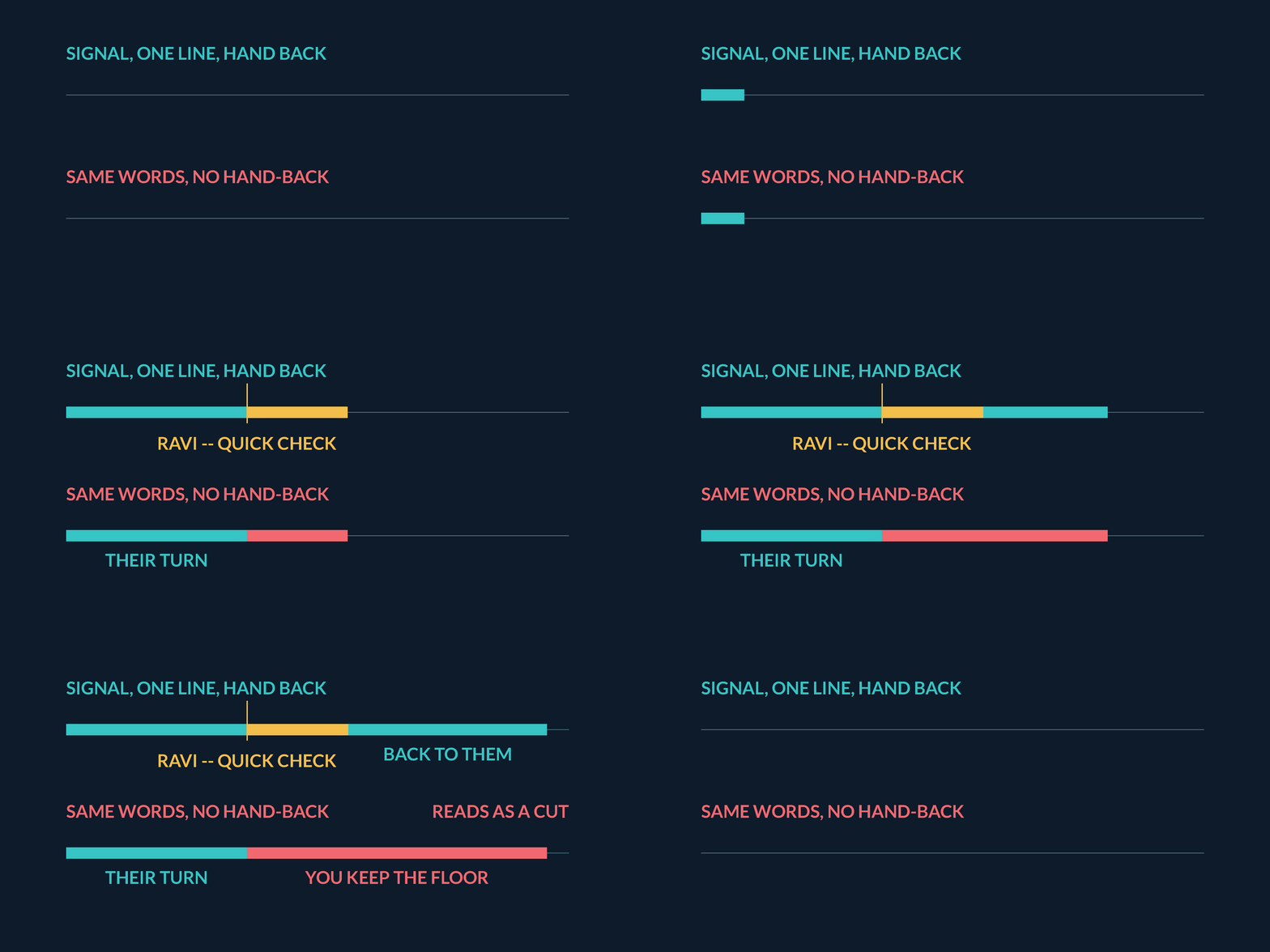
Three-part interrupt
- SignalName or brief cue: 'Quick clarification —' / 'Sorry to jump in —'
- ReasonOne line on why now: wrong figure, time box, decision risk.
- Hand-back'Back to you' / 'Sorry — continue' so the floor is returned, not stolen.
You need to correct a number mid-update. Which interrupt is smoothest?
- Talk over them with the right number and keep speaking
- Ravi — quick fact check, the sheet says 12% not 20% — back to you
- Wait until the meeting ends and never say it
- Say 'wrong' and stare until they stop
It signals, gives a short reason, and hands the floor back. Volume, silence, and blunt shutdowns fail the three-part shape.
2If you cut the wrong person, repair immediately
Bad cuts happen — you misread a pause, you thought they were done, you jumped on the wrong speaker. The charismatic move is not pretending it did not happen; it is repairing in the next breath.
Repair sounds like: 'Sorry, Meera — I cut you off. Please finish.' Then stop talking. A repair that becomes a second speech is not a repair.
In a Mumbai client call, unrepaired cuts linger as status plays. A one-line repair costs almost nothing and usually restores goodwill faster than a perfect interrupt would have.
No diagram — a repair is the next breath: 'Sorry, Meera — I cut you off. Please finish.' Then silence; a repair that becomes a second speech is not a repair. The cut-vs-repair table carries the moves.
| After a bad cut | Do | Avoid |
|---|---|---|
| You spoke over someone mid-point | Sorry — please finish; then wait | Explaining why your cut was justified |
| Two people started at once | Go ahead, Priya — I will come after | Racing to hold the floor |
| You corrected tone, not a fact | Apologise and hand back; save style notes offline | Doubling down in front of the room |
You accidentally talk over a teammate mid-sentence. Best next line?
- Keep going — the point is important
- Sorry, I cut you off — please finish
- Well, you were pausing so it was fair
- Laugh it off and change the topic
Immediate repair plus silence to let them finish. Justifying the cut or ploughing ahead leaves the status wound open.
3Hosts interrupt for time; participants for unblock or fact
Role changes what an interrupt is for. Hosts and facilitators interrupt to protect the agenda and time box. Participants interrupt mainly to unblock a decision or correct a load-bearing fact — not to add every thought that occurs.
A participant who interrupts like a host — redirecting people, cutting tangents — without being asked to facilitate reads as status grabbing. A host who never interrupts lets one speaker burn the meeting.
In a Pune planning meeting, if you are not the host, prefer 'quick fact check' over 'let's move on'. 'Let's move on' is a host line unless the room gave you that job.
No diagram — the difference is licence, not position: hosts interrupt to protect time and agenda, participants to unblock a decision or correct a load-bearing fact. The host-vs-participant table carries the lines.
| Role | Legitimate reason | Sample line |
|---|---|---|
| Host / facilitator | Time, agenda, parking tangents | Good point — let's take that offline so we keep the agenda |
| Participant | Unblock or correct a fact | Quick clarification — the dependency is already merged |
| Participant (avoid) | Preference, style, extra opinions | Save for your turn or after the meeting |
You are a participant, not the facilitator. Which interrupt fits your role?
- Let's move on — we are wasting time
- Quick clarification — the dependency shipped yesterday, so that risk is closed — back to you
- I will redirect the agenda from here
- Cutting a tangent because you personally find it boring
Participants interrupt for facts and unblockers, then hand back. Agenda policing is a host move unless you were given that role.
4Correct the fact; do not punish the speaker
When a wrong number or false dependency is about to become a decision, interrupting is a service — but the tone must correct the fact, not humiliate the person. 'The figure is 12%, not 20%' is enough; 'as usual you have the numbers wrong' is a different conversation.
Bring the source if needed, briefly: 'It is in row four of the sheet we shared.' Then hand back. The goal is a correct decision, not a public win.
In a Hyderabad leadership review, fact corrections that stay short are welcomed; fact corrections that become lectures get remembered as status plays even when the number was right.
No diagram — the correction is one sentence with a source: 'the sheet shows 12%, not 20% — back to you.' Correct the fact, skip the lecture. The fact-correction table carries the frames.
| Situation | Frame |
|---|---|
| Wrong metric in a decision | Quick clarification — the sheet shows 12%, not 20%. Back to you. |
| False dependency claim | Small correction — that API already shipped in Tuesday's release. |
| You are unsure | Can we pause one second to confirm the number before we lock this? |
A wrong percentage is about to lock a go-live decision. Best interrupt?
- As usual, your numbers are messy.
- Quick clarification — the sheet shows 12%, not 20%. Back to you.
- Stay silent to avoid awkwardness
- Wait, then send a long post-meeting mail naming their mistake
Correct the fact briefly and hand back. Humiliation, silence, and later mail all fail the moment when the decision is forming.
5Track your own interrupt frequency
Chronic interrupting is a reputation problem even when each interrupt was locally justified. People remember the pattern of cuts more than the brilliance of your points.
A simple personal rule: if you have interrupted twice in one meeting, stop for the rest unless a safety or decision-breaking fact appears. Put remaining thoughts in chat or after the meeting.
In a Noida shared team, the person who 'always has a quick clarification' becomes background noise. Charisma includes scarcity — fewer, sharper interrupts land; constant ones do not.
No diagram — the guardrail is a count you keep in your head: after two interrupts in one meeting, the bar rises to safety or a decision-breaking fact only. The frequency table carries the thresholds.
| Count in this meeting | Default move |
|---|---|
| Zero so far | Interrupt if fact or unblock truly needs it now |
| One already | Raise the bar — only decision-breaking facts |
| Two already | Park further points in chat or after, unless safety-critical |
You have already interrupted twice with useful clarifications. A third non-critical preference occurs to you. What should you do?
- Interrupt again — useful is useful
- Park it in chat or after the meeting
- Sigh loudly until someone asks you
- Talk to a neighbour while the speaker continues
Frequency is part of reputation. After two interrupts, park non-critical points rather than cutting again.
6Use a name or brief signal — not volume
Winning an interrupt by being louder trains the room to associate you with force. A name plus a short cue — 'Asha — quick clarification' — or a visible raised hand on video gets attention without a volume fight.
On noisy hybrid calls common in Indian offices, mute discipline matters: unmute, signal, speak one line, hand back, remute if needed. Holding unmute while overlapping someone is still a cut.
If two people start together, yield once on purpose: 'Go ahead, Asha.' Yielding once often earns you a cleaner turn next — and marks you as someone who can share the floor.
No diagram — the signal is a name and a short cue, not force: 'Asha — quick clarification', a raised hand on video, one deliberate yield when two people start together. The attention table carries the channel signals.
| Channel | Signal |
|---|---|
| In-person | Name + 'quick clarification', open palm briefly |
| Video call | Raised hand / chat 'fact check', then unmute for one line |
| Two start at once | Yield: 'Go ahead — I will come right after' |
On a hybrid call, you need a quick fact check. Best approach?
- Hold unmute and talk louder than the speaker
- Use their name or raised-hand cue, one-line clarification, hand back
- Type a sarcastic comment in chat
- Start a side conversation with someone next to you
Name or raised-hand signals get attention without a volume fight. Louder overlap, sarcasm, and side talk all tax the room.
Notes
- Smooth interrupts have a signal, a short reason, and a hand-back.
- Hosts interrupt to keep time; participants interrupt to unblock or correct a fact.
- If you cut the wrong person, repair immediately and give the floor back.
- Chronic interrupting is a reputation problem — track your own frequency.
- Raised hand or "quick clarification" works better than talking over volume.
Formulas
- Signal + reason + hand-back
- Repair bad cuts
- Host vs participant
Exam traps & shortcuts
- Use their name: "Ravi — quick fact check, then back to you."
- If you interrupt twice in one meeting, stop for the rest.
Reference tables
Each row is an interrupt moment, its load-bearing move, and the habit it replaces.
| Moment | Load-bearing move | Replaces |
|---|---|---|
| Need to step in | Signal + reason + hand-back | Talking over without return |
| Bad cut | Sorry — please finish | Justifying why the cut was fair |
| Role clarity | Host for time; participant for fact/unblock | Participants policing the agenda |
| Wrong number | Correct the fact, spare the person | Public humiliation with the right number |
| Urge to jump in again | Track frequency; park after two | Chronic 'quick clarifications' |
| Getting attention | Name or raised hand | Winning by volume |
Recap
Six lines that keep interrupts useful and likable.
- Signal, reason, hand-back
- Step in with a cue, one-line why, and an explicit return of the floor.
- Repair bad cuts
- Sorry — please finish. Then stop talking.
- Host vs participant
- Hosts protect time; participants correct facts or unblock — then hand back.
- Correct the fact
- Fix the number; do not punish the speaker.
- Track frequency
- After two interrupts, park the rest unless safety-critical.
- Name, not volume
- Use a name or raised hand; do not win by being louder.
Practise Interrupt Smoothly
Reading is free and needs no account. Practice, mocks and progress live in the app.
- A 5-question practice set that ends the chapter
- 6 quick checks with worked explanations
- Timed mocks scored with the real marking scheme
- Readiness tracked per topic, kept on your device