Unlock Your Charisma · Presence
Body Language
Open stance, gestures that land, and video-frame presence that matches your words.
Body language is the part of presence people read when they are not listening to your words — stance, gesture, nod, frame, and whether your hands agree with your sentence. Six concepts cover open stance, gestures that land, the difference between nodding and agreeing, video-frame presence, mismatch with words, and still-hands control, all in the rooms and video standups where Indian professionals actually practise.
- Unlock Your Charisma
- Easy level
- 6 concepts
1Open stance: uncross the signal that you are closed
An open stance is not a yoga pose — it is the absence of barriers between you and the room. Crossed arms over the chest, a bag hugged to the torso, or a laptop held like a shield all read as closed even when your words are friendly. Hands visible, torso angled toward the speaker or camera, and space in front of you read as available.
In a Chennai corridor conversation, turning your shoulders fully toward the other person for the exchange — instead of keeping your body pointed down the hallway ready to leave — is the difference between a real conversation and a brush-off. You can still hold a notebook; you do not need to armour yourself with it.
Closed stance is sometimes comfort, not hostility. The fix is still the same: notice the barrier, drop it for the length of the exchange, and put it back later if you need to. Presence is temporary availability, not permanent performance.
Figure. Two seatings of the same corridor conversation, seen from above. On the left the torso points at the exit and the bag sits between the two faces — friendly words over a closed body. On the right the shoulders turn to face them and the bag moves aside; nothing else changed.
| Signal | Closed habit | Open alternative |
|---|---|---|
| Arms | Crossed tight over chest | Hands visible, resting or lightly gesturing |
| Torso | Angled toward the exit | Shoulders toward the person or camera |
| Object barrier | Laptop or bag held as a shield | Object on the table, not between faces |
A colleague stops you for a two-minute corridor sync. Which stance reads as open?
- Keep walking sideways with arms crossed, bag hugged to your chest
- Stop, turn shoulders toward them, hands visible, bag at your side
- Stay pointed down the hall and answer over your shoulder
- Hold your laptop lid between your faces while they talk
Turning toward them with hands visible removes the exit-and-barrier signals. Sideways walking, over-the-shoulder answers, and laptop shields all read as closed.
2Gestures that land: one beat, then still
Useful gestures underline a word; nervous gestures decorate every word. The landing pattern is simple: one clear gesture on the key phrase — a small open-hand on 'three options', a brief point to the slide on 'this risk' — then return to still. Continuous hand motion makes the room work harder to find the point.
In a Bengaluru demo, marking 'first / second / third' with three small counts helps the structure land; flapping through the whole paragraph does not. Keep gestures inside the torso frame — wild arcs toward someone else's face or off-camera read as agitation, not emphasis.
If you do not naturally gesture, do not invent a choreography. A still baseline with occasional underline beats is more charismatic than forced expressiveness.
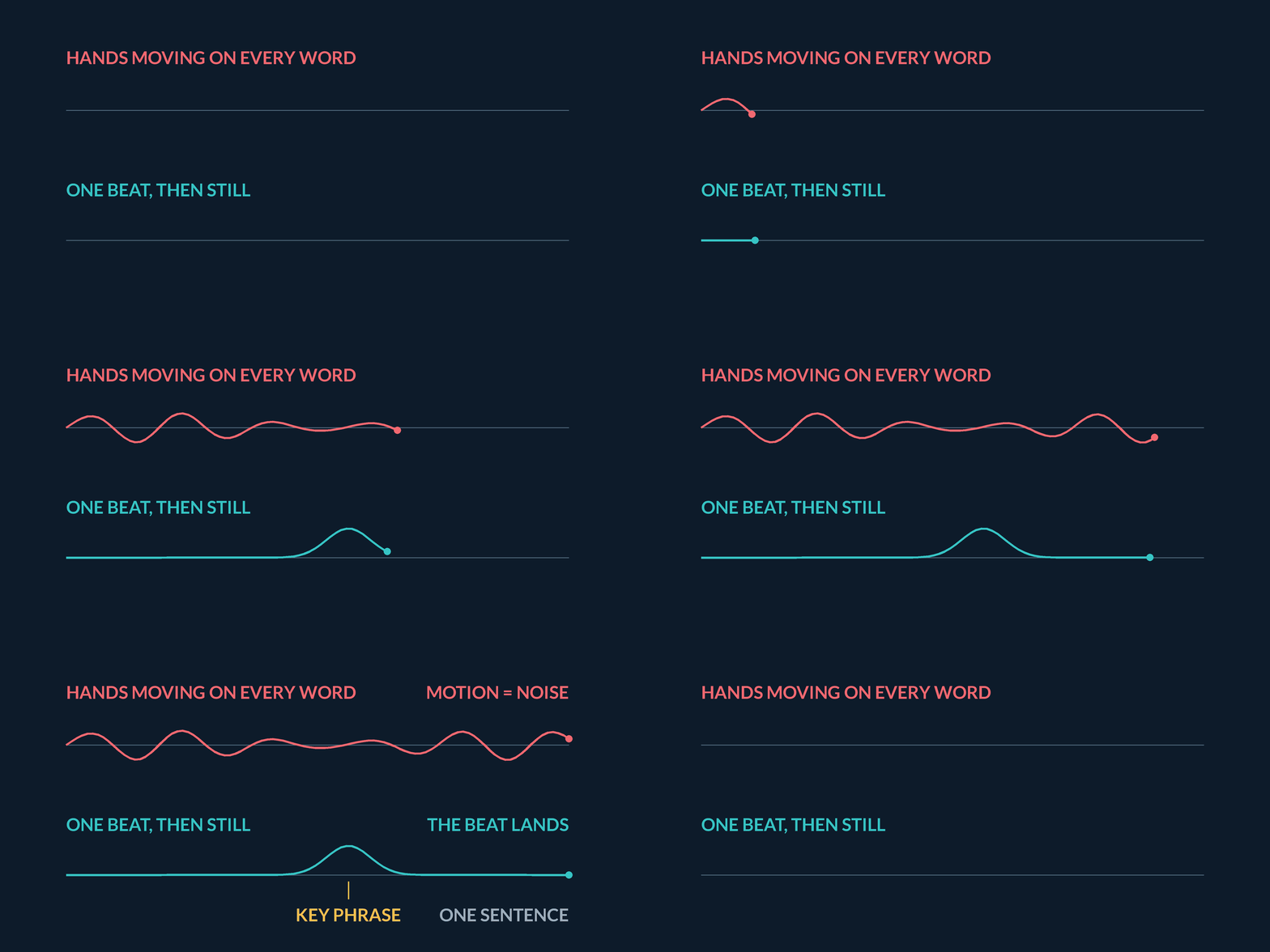
A gesture that lands
- Pick the key phraseOnly the word or number that carries the structure — first, risk, ask — earns a gesture.
- One clear beatA small open hand, a count, or a brief point to the shared artefact — inside your torso frame.
- Return to stillHands rest again so the next sentence is not competing with motion.
Explaining three rollout phases in a standup, which gesture pattern helps most?
- Continuous hand flapping through every sentence
- A small count on 'phase one / two / three', then still between them
- Pointing a finger at each person in the room while speaking
- No structure in words, but big theatrical arcs for energy
Underline-then-still makes the structure visible without noise. Continuous flapping, pointing at people, and theatrical arcs without structure all compete with the message.
3Nodding is listening, not agreeing
In many Indian meeting rooms, a nod means 'I hear you' — and speakers often misread it as 'I agree'. That mismatch is expensive: a room full of polite nods can ship a decision nobody actually endorsed. Your job is to use the nod for listening, and to use words when you mean agreement.
Listening nod: small, intermittent, while they speak. Agreement: a spoken line — 'I agree with the approach' or 'Yes, let's do that'. If you only nod, assume you have signalled attention, not consent.
When you are the speaker, do not treat nods as a vote. After a proposal in a Hyderabad planning call, ask for a verbal confirm from the decision owner: 'Anika, are we good to lock Friday?' Silence-plus-nods is not a lock.
No diagram — a nod has no geometry to draw: the distinction is what the signal means. Picture a room of small polite nods: that is attention, not consent; agreement only exists once someone says it. The nod-vs-agreement table carries the mapping.
| Signal | What it means | What to do instead if you need more |
|---|---|---|
| Small listening nod | I am following | Nothing — this is attention, not a decision |
| Spoken agreement | I endorse this | Say 'I agree' / 'Yes, let's lock that' |
| Need a decision | Nods are not enough | Ask the owner: are we good to lock [X]? |
You propose a Friday launch and the room nods quietly. What should you treat that as?
- Unanimous approval — ship it
- Listening signals — ask the decision owner for a verbal lock
- Proof that nobody has concerns
- A cue to stop talking and leave
Nods are attention, not consent. A verbal lock from the owner is what turns listening into a decision; assuming approval from nods is the expensive misread.
4Video-frame presence: face, light, and stillness
On video, body language collapses into a rectangle. The load-bearing cues are whether your face is lit and centred, whether you stay mostly still when not gesturing, and whether you look toward the camera for greetings and asks. A dark half-face drifting in and out of frame while you swivel in a chair spends presence on distraction.
Before a Bengaluru-to-London standup, put the light in front of you, raise the camera to eye level, and plant your chair so small rockings do not become the show. When you speak a key ask, glance at the lens — that is the video equivalent of eye contact.
Multitasking tells on camera more than in a room: typing with loud keys, phone-checking with eyes down, or eating mid-turn all enlarge into the only thing people see.
Figure. Two video tiles. In the left tile the face sits half out of frame — on video, that is the whole story the room sees. In the right tile the face is centred in the upper third with the lens at eye level; presence on camera is mostly this geometry plus stillness.
| Cue | Present | Distracting |
|---|---|---|
| Face and light | Face lit and roughly centred | Backlit silhouette or half out of frame |
| Stillness | Stable seat; gesture, then rest | Constant swivel or pacing in frame |
| Attention | Lens glance on greeting and asks | Eyes down on a second screen the whole turn |
Which setup best supports video-frame presence on a client call?
- Laptop on your lap in a dark room, swiveling while you speak
- Eye-level camera, face lit, stable seat, lens glance on the ask
- Eating lunch on camera with eyes on a second monitor
- Pacing around the room so the camera shows ceiling and wall
Lit centred face, stillness, and a lens glance on the ask are the rectangle's load-bearing cues. Dark swivel shots, eating, and pacing all spend the frame on distraction.
5When body and words disagree, people believe the body
Mismatch is when your sentence says yes and your body says no — 'I'm excited about this partnership' said while leaning back, arms crossed, eyes on the phone. Listeners resolve the conflict by trusting the body, and your words start to sound like politeness rather than truth.
The fix is alignment, not bigger acting. If you are cautious, say so with an open posture: 'I support exploring this, and I want one more week on the risk' while facing them, hands visible. Honest caution with aligned body beats fake enthusiasm with a closed body.
In a Pune vendor negotiation, smiling through 'we have no concerns' while tightly gripping a pen often triggers more probing, not less. Align the signal you can control — stance and attention — with the claim you are making.
No diagram — the mismatch is between two channels, words and body, not between two positions in space. Picture 'I'm excited' delivered with crossed arms and eyes on a phone: listeners believe the arms. The mismatch-vs-alignment table carries the pairs.
| Words | Mismatching body | Aligned body |
|---|---|---|
| I'm on board | Arms crossed, angled away, phone out | Facing them, hands visible, phone away |
| I have a concern | Forced grin, rapid nodding | Steady face, one clear gesture on the concern |
| I'm listening | Eyes on Slack the whole turn | Eyes on speaker; notes only in short breaks |
You need to say you support a plan with one reservation. Which delivery is aligned?
- 'Fully support, no concerns' while arms crossed and eyes on your phone
- 'I support the plan, and I want one week on the migration risk' while facing them with hands visible
- Silent nod with a forced smile and no words
- 'Whatever you want' while packing your bag to leave
Honest content plus open attention aligns word and body. Fake full support with closed cues, wordless forced smiles, and exit-ready deferral all create mismatch.
6Still hands: park the fidget without freezing
Fidgets — pen clicking, ring spinning, sticky-note shredding, camera-cable tugging — steal attention from your sentence. The goal is not statue-stillness; it is a default rest position for your hands so motion is intentional when it happens.
Pick a park: hands loosely clasped on the table, one hand on a notebook, or resting on your lap below frame on video. When you need a gesture, leave the park, land the beat, and return. In a Mumbai interview panel, a quiet park is invisible; a clicking pen is the clip everyone remembers.
If adrenaline needs an outlet, move it out of the channel people watch — press a foot into the floor, slow your exhale — rather than into an object that clicks, spins, or tears.
Figure. A clicking pen is the clip a Mumbai panel remembers. The park is a default rest — table clasp, notebook, or lap below frame — left only to land one gesture, then returned to. Adrenaline goes to a foot or a slower breath, not into shared audio.
Parking the fidget
- Choose a restTable clasp, notebook, or below-frame lap rest — one default you can return to.
- Gesture on purposeLeave the rest only for a key phrase, then come back.
- Move adrenaline elsewhereFoot pressure or a slower breath — not a clicking pen in the shared audio.
You notice you are clicking a pen through a stakeholder update. What is the best fix mid-meeting?
- Click faster so you finish the nervous energy sooner
- Park the pen, rest your hands, and gesture only on key phrases
- Switch to shredding a sticky note instead
- Apologise at length for being fidgety and lose the thread
A quiet park plus intentional gestures removes the distraction without making fidgeting the topic. Faster clicking, replacement fidgets, and apology tours all keep attention on the nervous channel.
Notes
- Body language is read faster than content; mismatch between words and posture kills trust.
- Open stance — uncrossed arms, facing the speaker — signals availability without performing.
- Gestures that land mark key words; fidgeting marks anxiety.
- Nodding means "I hear you"; it is not automatic agreement — say the agree/disagree out loud.
- On video, frame, light, and stillness are your body language.
Formulas
- Open stance
- Gesture the key word
- Words match posture
Exam traps & shortcuts
- If you catch yourself crossed-arms, uncross and lean slightly in.
- On calls, sit so shoulders and hands can show.
Reference tables
Each row is a presence moment, the load-bearing cue, and the habit it replaces.
| Moment | Load-bearing cue | Replaces |
|---|---|---|
| Stance | Shoulders toward them, hands visible, no object shield | Crossed arms, exit-angled torso, laptop barrier |
| Gesture | One beat on the key phrase, then still | Decorating every word with motion |
| Nod | Listening only — agreement needs words | Treating nods as a decision |
| Video frame | Lit centred face, stable seat, lens glance on asks | Backlit swivel and second-screen eyes |
| Word–body match | Open attention aligned with the claim you make | Enthusiastic words with closed body |
| Hands | Default park; gesture on purpose | Pen clicks and constant shredding |
Recap
Six cues that keep body language from arguing with your words.
- Open the stance
- Hands visible, shoulders toward them — drop the shield for the length of the exchange.
- Underline, then still
- One gesture on the key phrase; continuous motion is noise.
- Nod ≠ agree
- Nods are listening; agreement and decisions need spoken lines.
- Own the rectangle
- Lit face, stable seat, lens glance on greetings and asks.
- Align the signal
- When words and body conflict, people believe the body — match them.
- Park the fidget
- Rest hands by default; leave the park only for intentional beats.
Practise Body Language
Reading is free and needs no account. Practice, mocks and progress live in the app.
- A 5-question practice set that ends the chapter
- 6 quick checks with worked explanations
- Timed mocks scored with the real marking scheme
- Readiness tracked per topic, kept on your device