Unlock Your Charisma · Presence
Confidence Wins
Own your ideas without apology openers, hold silence, and recover after a stumble.
Confidence in a meeting is less a personality trait than a set of recoverable habits — how you sit, how you claim an idea, how you open without apologising, how you hold silence, how you recover after a stumble, and how you walk in with one prepared line. Six concepts turn those habits into frames you can run under pressure in Indian workplace rooms and video standups.
- Unlock Your Charisma
- Easy level
- 6 concepts
1Posture as a cue: sit like you mean to stay
Before you speak, posture already votes. Collapsed shoulders, a half-turned chair, and a laptop lid as a shield read as temporary presence; a stable seat, open chest, and both feet grounded read as someone who intends to contribute. You do not need military stiffness — you need a baseline that does not apologise with the body.
In a Bengaluru conference room, slide the chair fully under the table, keep the screen low enough that your face stays visible, and resist the perpetual lean toward the nearest ally. On video, the same cue is frame height: camera near eye level, not looking up your chin from a laptop on your lap.
The point is not aesthetics. A body that looks ready to leave makes even a good idea sound provisional; a body that looks settled makes the same idea sound owned.
No diagram — the cue is a bundle of body habits, not one drawable pose. Picture the difference between a chair pulled fully under the table and a body perched half-turned toward the door: the first says staying, the second says provisional. The cue table carries the mapping.
| Cue | Settled | Provisional |
|---|---|---|
| Seat | Chair fully in, weight centred | Perched on the edge, half-turned to leave |
| Torso | Upright-enough, shoulders open | Collapsed into the laptop |
| Video frame | Camera near eye level, face visible | Up-the-nose laptop-on-lap shot |
Joining a Hyderabad design review, which posture best supports a confident presence before you speak?
- Perching on the chair edge, half-turned toward the door, laptop lid high
- Sitting fully in, screen low enough that your face stays visible, weight centred
- Slouching deep with arms crossed over the chest the whole meeting
- Standing behind someone else's chair and leaning over their shoulder
A settled seat with a visible face reads as intending to stay and contribute. Perching, slouching-closed, and hovering behind someone else all signal provisional presence.
2Claim ownership of ideas without hedging them to death
An idea dies twice when you refuse to own it: once in the wording, and again when someone else restates it more firmly and gets credit. Confidence here is grammatical — 'I recommend we ship the simplified checkout' owns the claim; 'I was just thinking maybe we could possibly consider...' rents it.
Owning is not arrogance. You can still invite challenge: 'I recommend we ship the simplified checkout — push back if the risk on support load looks too high.' The recommendation stays clear; the invitation to disagree is a separate clause, not a fog over the whole sentence.
In a Chennai sprint planning room, the habit of prefacing every view with 'this may be stupid but' trains the room to treat your points as optional. Drop the disclaimer; keep the content and, if needed, the explicit invite to challenge.
No diagram — ownership is grammar, not geometry: 'I recommend we ship' against 'I was just thinking maybe'. The owning-vs-hedging table carries the frames.
| Intent | Owned frame | Hedged habit |
|---|---|---|
| Recommend | I recommend we [action] | I was just thinking maybe we could... |
| Flag a risk | The risk I see is [X] | This might be nothing, but... |
| Invite challenge | I recommend X — push back if Y | Idk, whatever you all think is fine |
You believe the team should delay a feature for a security review. Which line owns the idea cleanly?
- This may be stupid, but maybe we could possibly wait?
- I recommend we delay the release until the security review lands — push back if the date is immovable.
- Whatever the group decides is fine with me.
- I don't know, someone else should decide.
It states a clear recommendation and separately invites challenge. Softened fog, deferral, and handing the decision away all refuse ownership.
3Stop apologising openers: drop the pre-emptive sorry
Many sharp contributors open with a sorry that has nothing to apologise for — 'Sorry, just one thought', 'Sorry if this is basic', 'Sorry to bother you all'. The sorry is meant as politeness; it lands as a discount on the upcoming point before anyone has heard it.
Replace the apology with a purpose opener: 'One thought on the timeline', 'A basic check before we proceed', 'Quick question on ownership'. You still sound considerate; you no longer sound like you are trespassing in a meeting you were invited to.
Reserve sorry for actual harms — being late, interrupting wrongly, missing a commitment. In a Pune client review, 'Sorry, maybe a dumb question' before a clarifying ask teaches the room to undervalue questions that often save the project.
No diagram — an opener is a choice of words, not a shape. Hear the two side by side: 'Sorry, just one thought' discounts the point before anyone hears it; 'One thought on the timeline' delivers it. The replacement table carries the swaps.
| Habit | Replace with | Keep sorry for |
|---|---|---|
| Sorry, just one thought | One thought on [topic] | Actually interrupting someone mid-sentence by mistake |
| Sorry if this is basic | A basic check — are we assuming X? | Repeating a question already answered because you were not listening |
| Sorry to bother you | Quick question on [ownership / timeline] | Ping at 11pm when it could wait till morning |
You want to ask whether a milestone includes QA buffer. Which opener avoids the pre-emptive sorry?
- Sorry if this is basic, but does the milestone include QA buffer?
- A basic check — does this milestone include QA buffer?
- Sorry to bother everyone with this...
- Sorry, just wondering, ignore me if not useful...
It opens with purpose instead of a discount. The other three all pre-apologise for a normal clarifying ask.
4Handle silence: do not fill every gap
Silence after you speak is often processing, not rejection. The anxious habit is to rush a softener into the gap — 'unless that doesn't make sense', 'but maybe I'm wrong' — which trains the room to treat your point as unfinished and optional.
The confident move is to finish the sentence cleanly and wait two or three beats before adding anything. In a Mumbai leadership review, that wait is where someone else builds on your idea; filling it yourself with a hedge is where your idea shrinks.
If silence continues past a natural pause and you need a next move, ask a directed question rather than undoing your point: 'Does that timeline work on your side, Anika?' keeps ownership while inviting a response.
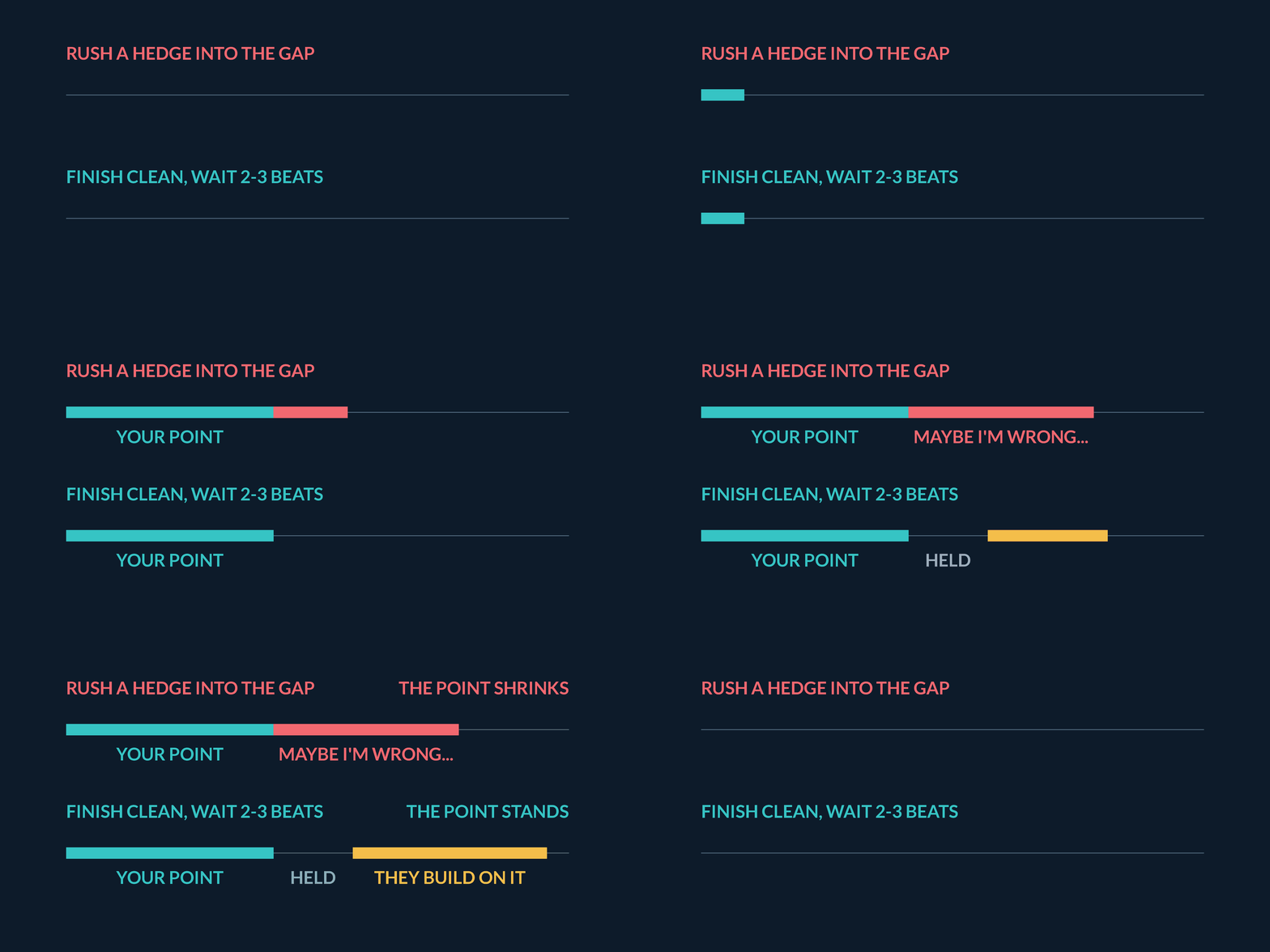
Sitting with silence
- Finish cleanlyEnd on the point — no trailing 'so yeah' or 'if that makes sense' that reopens the sentence.
- Wait a few beatsLet the room process. Do not rush a hedge into the gap.
- If needed, direct the next turnAsk a named person a concrete question rather than apologising for what you just said.
You recommend a rollout order and the room goes quiet for a few seconds. What should you do?
- Immediately add 'unless that sounds stupid, we can ignore it'
- Hold the silence for a few beats; if needed, ask a named person whether the order works for them
- Laugh nervously and change the topic
- Repeat the whole recommendation softer and longer
Waiting preserves ownership; a directed question restarts the turn without undoing the point. Hedging, nervous topic-changes, and softer repeats all spend the silence on self-doubt.
5Recovery after a stumble: reset in one line
Everyone blanks, mis-says a number, or loses a thread. Confidence is visible in the recovery, not in never stumbling. The weak recovery narrates the failure — 'Ugh, I'm so bad at this, let me start over from the beginning, sorry everyone' — and makes the stumble the new topic.
The strong recovery is one short reset line, then the content: 'Let me restart that' / 'Wrong number — the figure is 12%, not 20%' / 'I lost the thread — the risk I meant was rollback time.' Then continue. No autobiography of how flustered you feel.
In a Delhi client demo, a clean reset often disappears in thirty seconds; a two-minute apology tour is what people remember. Treat the stumble as a cut, not a confession.
No diagram — a recovery is one spoken line. Picture the cut: 'Wrong number — the figure is 12%', then straight back to the content, with no autobiography of how flustered you feel. The recovery table carries the reset lines.
| Stumble | Reset line | Avoid |
|---|---|---|
| Lost your thread | I lost the thread — the point was [X] | Long apology about being nervous |
| Wrong figure | Correction — the number is [Y] | I'm terrible with numbers, ignore me |
| Blanked on a name | Give me one second — [name], yes | Narrating how embarrassed you are |
Mid-update you realise you said the wrong launch date. What is the best recovery?
- I'm so sorry, I'm awful at this, let me explain why I messed up...
- Correction — the launch date is the 18th, not the 11th. Continuing from the rollout risks...
- Pretend it did not happen and hope nobody noticed
- Stop speaking for the rest of the meeting
A one-line correction plus continuation resets without making the stumble the topic. Apology tours, silent pretending, and withdrawing all enlarge the error.
6Prepare one line before you enter the room
Walking into a meeting with zero prepared speech is how smart people freeze when the first question lands on them. You do not need a monologue — you need one line you can say even under adrenaline: your status, your ask, or your view on the decision the meeting exists to make.
Before a Hyderabad steering call, write (literally, in notes) one sentence: 'Payments is amber — blocked on bank certification, need a decision on the fallback by Friday.' That line is an anchor. From it you can expand; without it, you invent under pressure and often apologise instead.
If you are mostly listening, prepare one useful contribution anyway — a risk, a dependency, or a clarifying question — so when a pause opens you are not scrambling for something that sounds smart.
Figure. Before a Hyderabad steering call, write one sentence you could say cold: 'Payments is amber — blocked on bank certification, need a decision on the fallback by Friday.' Name the meeting's job, write that line, then expand. Without it you invent under pressure and often apologise instead.
The one-line prep
- Name the meeting's jobWhat decision, update, or unblock is this room for?
- Write one sentenceYour status, ask, or view in a single line you could say cold.
- Optional backupOne risk or clarifying question if you are mostly in listening mode.
You have two minutes before a launch readiness call. What is the highest-leverage prep?
- Rereading the entire Slack history from the last month
- Writing one sentence that states your status and any ask you need from the room
- Planning a ten-minute speech in case you are called on
- Deciding you will stay silent unless forced to speak
One prepared line is an anchor under pressure. Full-history rereads and ten-minute speeches over-prep; pre-deciding silence under-preps.
Notes
- Confidence is a set of recoverable behaviours, not a personality transplant.
- Drop apology openers that shrink the idea before anyone hears it.
- Silence after a clear point is thinking space, not failure.
- A stumble is fixed by a short recovery line, not a long self-critique.
- Posture and breath are the fastest levers when nerves spike.
Formulas
- Claim the idea
- Hold the silence
- Recover in one line
Exam traps & shortcuts
- Replace "I might be wrong but" with the point itself.
- If you blank, say "give me one second" and breathe.
Reference tables
Each row is a pressure moment, the load-bearing move, and the habit it replaces.
| Moment | Load-bearing move | Replaces |
|---|---|---|
| Before speaking | Settled seat, face visible, camera at eye level | Perching, laptop-as-shield, up-the-nose frame |
| Stating a view | I recommend X — push back if Y | I was just thinking maybe... |
| Opening a point | One thought on [topic] | Sorry, just a quick maybe-dumb thought |
| Silence after you speak | Wait a few beats; then a directed question if needed | Rushing a hedge into the gap |
| After a stumble | One reset line, then continue | Apology tour about how nervous you are |
| Before the meeting | One written status/ask/view line | Walking in with nothing to say under pressure |
Recap
Six lines that keep confidence recoverable under pressure.
- Settle the body
- Chair in, face visible — a body ready to leave makes ideas sound provisional.
- Own the claim
- I recommend X; invite challenge in a second clause, not as fog over the first.
- Purpose, not sorry
- Open with what the point is about; reserve sorry for real harms.
- Hold the silence
- Finish cleanly and wait — do not fill the gap with a hedge.
- Reset in one line
- Correction — then continue. No autobiography of the stumble.
- Bring one sentence
- Walk in with a written status, ask, or view you can say cold.
Practise Confidence Wins
Reading is free and needs no account. Practice, mocks and progress live in the app.
- A 5-question practice set that ends the chapter
- 6 quick checks with worked explanations
- Timed mocks scored with the real marking scheme
- Readiness tracked per topic, kept on your device