Artificial Intelligence · AI Foundations
Tic-Tac-Toe with Minimax
In AI because a playable tic-tac-toe program is the Game Playing and Minimax backup implemented on a 3×3 board — an agent that returns a move, not a lecture that names MAX and MIN.
Game Playing and Minimax already backed utilities up a two-ply club tree: MAX takes the largest child, MIN the smallest, and the pretty 9 is not a plan. This lesson is that backup on a board you can mark. X is MAX, O is MIN, a line of three scores +1 or −1 from X's point of view, and the program's job is to return a cell. The campus leftover is a 3×3 with four marks already down: X to move, and the centre is the only first mark that forces a win on the next ply.
- Artificial Intelligence
- Medium level
- 6 concepts
1The same backup, a board instead of a club tree
Tic-tac-toe is a two-player, perfect-information, zero-sum game on nine cells. X writes first. A player who places three of their marks in a row, column or diagonal wins. A full board with no line is a draw. Game Playing and Minimax already said what 'optimal' means here: a move that maximises the worst-case utility against an opponent who minimises it. This lesson does not retell that backup. It implements it.
What changes is the object the recursion sees. The club tree had four printed leaves. A tic-tac-toe position has a set of empty cells, and each empty cell is a legal action. The leaves are positions where someone has three-in-a-row or the board is full. The numbers on those leaves are +1, 0 and −1, not the club's 3, 5, 2 and 9.
| Piece | Club tree | Tic-tac-toe |
|---|---|---|
| MAX / MIN | you / them | X / O |
| Action | left or right | an empty cell |
| Leaf utility | 3, 5, 2, 9 | +1, 0, −1 for X |
2Nine cells and a finished-line test
Store the board as a list of nine entries, row-major: indices 0, 1, 2 are the top row. Each entry is X, O, or empty. A legal move is an index whose entry is empty. The eight winning triples are the three rows, the three columns, and the two diagonals. `winner` returns X or O when one of those triples is uniform and non-empty, and None otherwise.
Call `winner` before you generate moves. A position that already contains a line is a leaf, even if empty cells remain. Generating a move from a finished board is the bug that lets a program 'play on' after the match is over and then back up a nonsense score.
Figure. The campus leftover, cells numbered 0 to 8. X holds 0 and 1; O holds 2 and 3. Cell 4 is sage because it is the move minimax will pick. Roles mark O's marks and that empty centre — they are not a strength scale.
| Kind | Index triples |
|---|---|
| Rows | 0–1–2, 3–4–5, 6–7–8 |
| Columns | 0–3–6, 1–4–7, 2–5–8 |
| Diagonals | 0–4–8, 2–4–6 |
3Plus one, zero, minus one
Utility is always written from X's point of view, the same convention as the club tree. An X line is +1. An O line is -1. A full board with no line is 0. Those three numbers are the only leaves. There is no 'X has two in a row' bonus inside this program — that would be an evaluation function, which Alpha-Beta Pruning named as a cutoff guess, and this board is small enough to finish.
The empty board's backed-up value is 0. Perfect play draws. That is a fact about tic-tac-toe, not a defect in the listing. The campus leftover is not empty: X already has two on the top row, O has blocked the third cell of that row, and the centre is still free. From there the backed-up value is +1 if both sides play the backup.
| Finished position | Utility |
|---|---|
| X has a line | +1 |
| O has a line | -1 |
| Board full, no line | 0 |
A classmate adds +0.2 to any position where X has two-in-a-row with the third cell empty, 'so the program prefers threats'. What contract did they break?
- None — that is still minimax
- They replaced a finished-leaf utility with an evaluation guess on a tree this program can finish
- They used the wrong sign for O
- They forgot that draws score 0
Minimax on this board reaches every leaf. A threat bonus is an evaluation function, the cutoff device from the alpha-beta lesson. It can change which move is picked even when the true leaf values are available.
4Centre now, win on the next ply
On the campus leftover X is to move. Minimax tries every empty cell, lets O answer, and backs up. The unique first move with value +1 is cell 4, the centre. That mark does not win immediately — there is no X line yet. It creates two threats that O cannot kill together.
Whatever empty cell O takes next, X has a winning reply on the following ply: after O plays 5, 6 or 8, X completes the middle column at 7; after O plays 7, X completes the main diagonal at 8. That is the club-tree lesson in marks: MAX does not need the pretty cell if MIN would refuse it; here every MIN reply still leaves a MAX win, so the root value is +1.
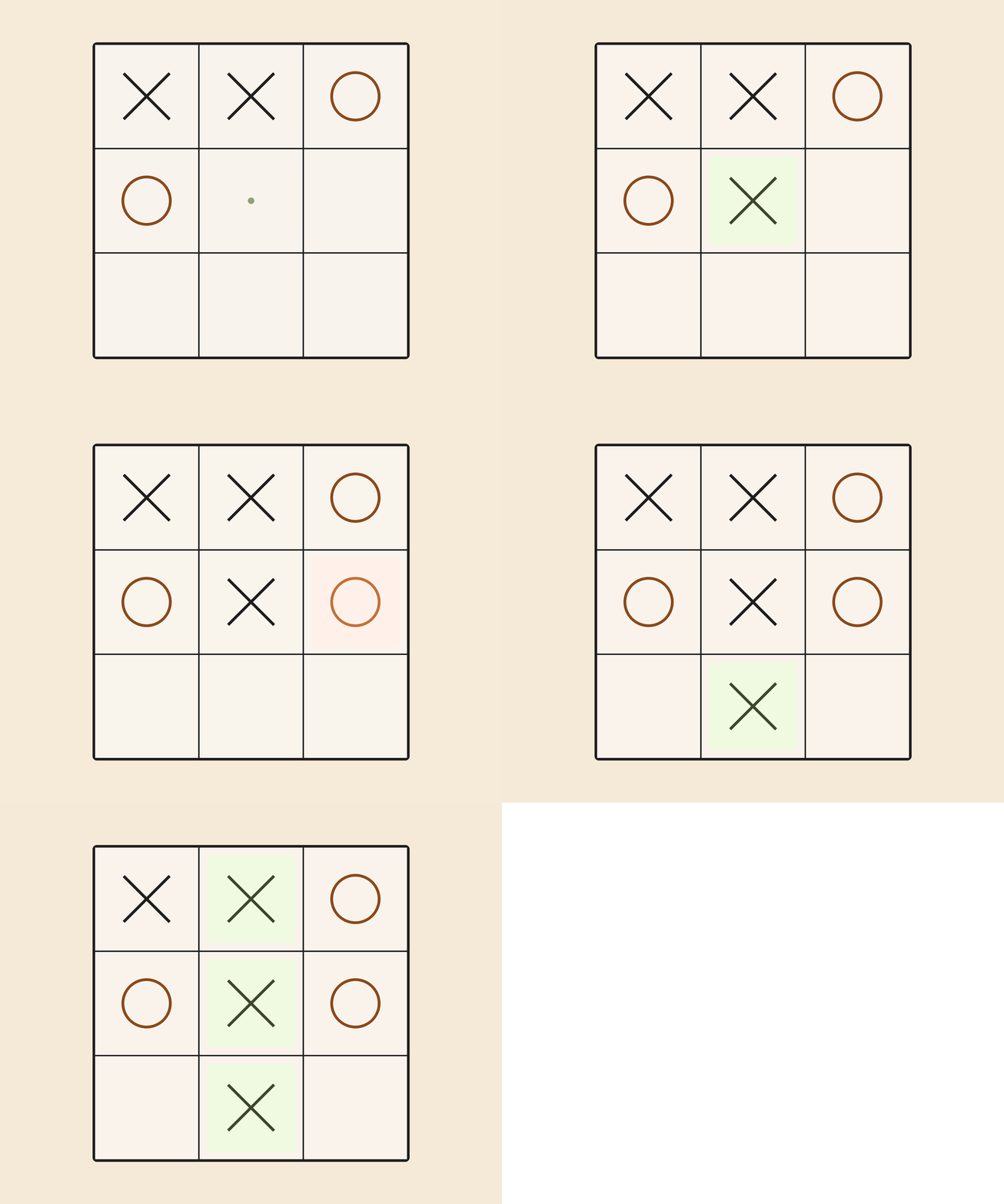
X plays 4; O's four replies
Board: X X O / O . . / . . . with X to move. After X writes the centre, list O's four empty cells and X's winning reply.
- X at 4: board X X O / O X . / . . .no line yet
- O at 5, 6 or 8X at 7 completes 1–4–7
- O at 7X at 8 completes 0–4–8
- root value+1, action 4
Pro tip. Cell 4 is not an immediate win and is still the only first move that forces one. A mark on 5, 6, 7 or 8 lets O interfere. The program has to look two ply past the pretty empty cells to see that.
5A function that returns a cell
The listing is the backup from Game Playing and Minimax with a board argument. `winner` is the line test. `minimax` returns a pair (score, move). MAX walks empty cells and keeps the child with the largest score; MIN keeps the smallest. A finished position returns (utility, None) because there is no move to publish. The caller at the root prints the move half of the pair.
On the campus leftover the printed move is 4 and the printed score is 1. On an empty board the score is 0 and the move is some legal first cell — often 0 in this left-to-right scan — because every opening draws against perfect play.
Figure. winner or a full board returns (utility, None) before any empty cell is tried. minimax returns the pair (score, move); a score alone cannot tell the caller which cell to mark. On the campus leftover the printed pair is (1, 4).
What the listing does
- Leaf firstwinner or a full board returns (utility, None) before any empty cell is tried.
- X max, O minEach empty cell is written, scored by the opponent's turn, then cleared.
- Return bothThe pair is (score, move). A score alone cannot tell the caller which cell to mark.
Minimax on a 3×3
LINES = ((0, 1, 2), (3, 4, 5), (6, 7, 8),
         (0, 3, 6), (1, 4, 7), (2, 5, 8),
         (0, 4, 8), (2, 4, 6))

def winner(board):
    for i, j, k in LINES:
        if board[i] and board[i] == board[j] == board[k]:
            return board[i]
    return None

def minimax(board, player):
    w = winner(board)
    if w == 'X':
        return 1, None
    if w == 'O':
        return -1, None
    empties = [i for i, c in enumerate(board) if c is None]
    if not empties:
        return 0, None
    best_move = empties[0]
    if player == 'X':
        best = -2
        for i in empties:
            board[i] = 'X'
            val, _ = minimax(board, 'O')
            board[i] = None
            if val > best:
                best, best_move = val, i
        return best, best_move
    best = 2
    for i in empties:
        board[i] = 'O'
        val, _ = minimax(board, 'X')
        board[i] = None
        if val < best:
            best, best_move = val, i
    return best, best_move
Coding lab. Pick the centre on the leftover runs in the app, with checks on your output.
6What this program does not do
A playable loop is: show the board, if it is X's turn call minimax and mark that cell, if it is O's turn read a cell from a human, then repeat until `winner` or a full board. That loop is plumbing. It does not change the backup.
Three things this program refuses. It does not prune: Alpha-Beta Pruning cuts branches the backup will never need, and on 3×3 the extra code is optional. It does not evaluate unfinished positions: the tree fits in memory. It does not learn. A policy trained on self-play is the reinforcement-learning course, and it is a different object — a move distribution, not a backed-up leaf. Cross-link the theory lesson when you need the guarantee; stay here when you need a cell to mark.
| Need | Stay here | Go elsewhere |
|---|---|---|
| A legal X move on 3×3 | minimax as listed | — |
| The same backup, fewer nodes | — | Alpha-Beta Pruning |
| A move from play, not from leaves | — | the RL course |
The empty-board minimax score is 0. A classmate concludes the program is broken because 'X should win'. What is wrong?
- They treated a draw under perfect play as a defect. The empty board's value is 0
- They forgot to run alpha-beta
- They used the wrong utility for a draw
- They should have given X a threat bonus
Tic-tac-toe draws if both sides play the backup. A 0 at the empty root is the guarantee, not a bug. Alpha-beta would return the same 0 faster. A threat bonus would invent a different game.
Notes
- The board is nine cells; X is MAX, O is MIN, and a finished line scores +1, 0 or −1 from X's point of view.
- Minimax recurses on every empty cell and returns a score and a move; the theory lesson already named the backup.
- The empty-board value is 0 — perfect play draws. A leftover position can still be a forced win.
Exam traps & shortcuts
- Return (score, move) together. A function that returns only the score cannot tell the caller which cell to mark.
- Test for a finished line before generating moves. A board that is already won must not keep playing.
- Alpha-beta is the next speed-up, not a different game. This program is correct without it and slower on larger boards.
Recap
Next: knowledge and logic.
- Same backup
- X is MAX, O is MIN. Game Playing and Minimax already named the rule; this lesson marks a cell.
- Encoding
- Nine entries, eight lines. Test for a winner before generating moves.
- Leaves
- +1 / 0 / −1 for X. No threat bonus — the tree finishes.
- Campus leftover
- X X O / O . . / . . . — play 4, value +1. Every O reply leaves X a win next ply.
- Not this program
- Alpha-beta is a speed-up. Learning a policy is the RL course. Empty-board value 0 is correct.
Practise Tic-Tac-Toe with Minimax
Reading is free and needs no account. Practice, mocks and progress live in the app.
- 2 quick checks with worked explanations
- Timed mocks scored with the real marking scheme
- Readiness tracked per topic, kept on your device