Artificial Intelligence · AI Foundations
Sudoku by Backtracking
In AI because a Sudoku grid is a CSP whose search is the same choose–try–undo loop as graph colouring, pointed at cells, rows, columns and boxes.
Graph Colouring as Search assigned colours to vertices under 'neighbours differ'. A Sudoku board is the same job with a louder constraint set: each empty cell is a variable, each digit in 1..n² is a candidate, and a digit may appear once in its row, once in its column, and once in its box. This lesson fills a 4×4 board — two-by-two boxes, digits 1 to 4 — so every cell fits on the page. The 9×9 newspaper puzzle is the same recursion with n = 3.
- Artificial Intelligence
- Medium level
- 6 concepts
1A board is a partial assignment
A Sudoku state is a grid with some cells filled and some empty. The filled cells are the assignment so far. The empty cells are the remaining variables. A digit is legal in a cell when it does not already appear in that cell's row, or column, or box. The goal test is 'no empty cells left' — every variable has a value, and every placement was legal when it was written, so the finished grid is a solution.
The campus running board is 4×4 with eight givens. Boxes are the four 2×2 corners. Digits run from 1 to 4. A 9×9 board is the same story with 3×3 boxes and digits 1 to 9. Nothing about the search changes except the size of a box and the length of a domain.
Figure. The campus 4×4. Givens are the numbered cells. Dots are empty variables. Terracotta marks the empties — they are the work, not errors. Box boundaries are the four 2×2 corners; the renderer does not draw a heavy box line, so read them as top-left 1 and 4, top-right 4 and 1, and so on.
| CSP piece | On Sudoku |
|---|---|
| Variable | One empty cell |
| Domain | Digits not yet in its row, column or box |
| Constraints | Unique in row, unique in column, unique in box |
| Goal | Every cell filled |
2Pick the emptiest cell
Any empty cell is a legal next variable. The cheap habit from Graph Colouring as Search is to pick the cell whose domain is smallest — fewest legal digits right now. A cell with one legal digit is a forced write. A cell with four legal digits is a guess that may have to be undone. Trying the forced write first shrinks other domains before you guess.
On the campus board the first empty cell, row 0 column 1, has only one legal digit: 2. Row 0 already holds 1 and 4, its box already holds 1, and column 1 already holds 4 and 3 — the only survivor is 2. Scanning empties in reading order happens to find that cell first; on a 9×9 board, reading order is a worse heuristic than 'fewest candidates'.
| Check | Digits already there | Still allowed |
|---|---|---|
| Row 0 | 1, 4 | 2, 3 |
| Column 1 | 4, 3 | 1, 2 |
| Top-left box | 1, 4 | 2, 3 |
| Intersection | — | 2 |
3Write, recurse, clear
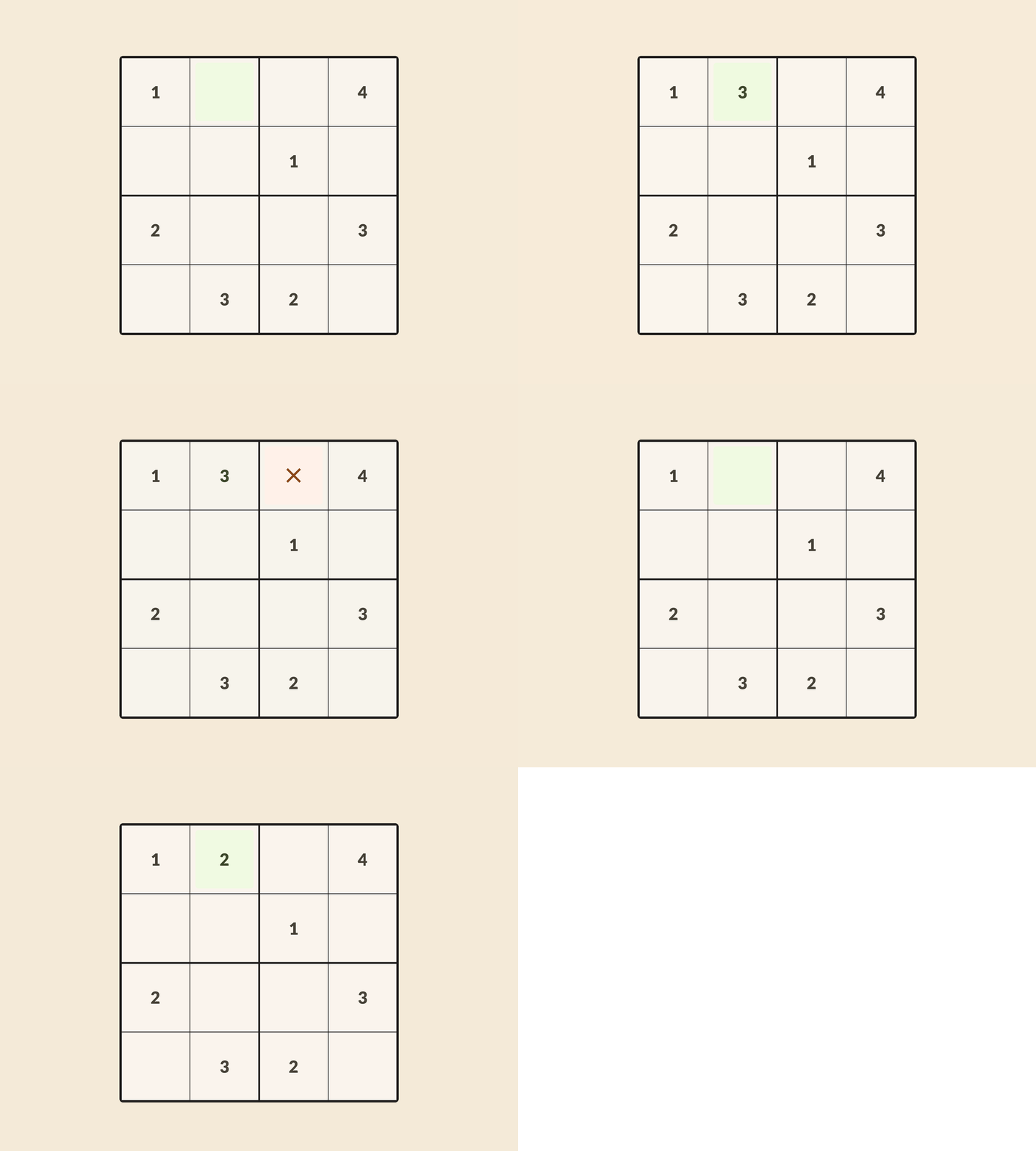
The loop is the colouring loop with a grid instead of a map. Find an empty cell. For each legal digit, write it, recurse, and if the recursive call fails, clear the cell and try the next digit. If no digit works, return failure so the caller can undo its own write. Depth-First Search and Iterative Deepening called this the current path as the current partial assignment. The board is that path.
Clearing the cell is the undo. A version that copies the whole grid on every try is correct and slower; a version that writes in place and clears on the way back is the one you implement. Do not skip the clear. A leftover digit from a dead branch is a false given, and every later legality check will treat it as a fact.
One cell
- Find emptyScan for a zero, or pick the cell with the fewest legal digits.
- Try a digitIf it is missing from the row, column and box, write it and recurse.
- Clear on failPut a zero back. A leftover digit from a dead branch becomes a fake given.
A recursive call has just failed after writing 3 in an empty cell. What must the solver do before trying 4 in that same cell?
- Leave the 3 — a later cell might need it
- Clear the cell back to empty, then try 4
- Restart the whole board from the givens
- Switch to BFS, because backtracking is stuck
Undo is local. The 3 is the failed choice for this cell, not a given. Restarting from scratch throws away the prefix that is still legal. BFS would also work and would use far more memory on a 9×9 board.
4Filling the campus 4×4
Scan empties in reading order and write the first legal digit. Row 0 column 1 accepts only 2. Row 0 column 2 then accepts only 3, and the first row is 1, 2, 3, 4. Row 1 column 0 accepts only 3. Each of those writes is forced — the domain had one digit. The remaining empties fill the same way on this board: the puzzle was built to have one solution, so a legal walk never has to undo.
A harder 4×4, or any 9×9 that is not a 'gentle' puzzle, will guess and undo. The ledger below is the forced prefix, not a claim that Sudoku never backtracks.
Figure. The unique completion. Sage cells were empty on the start board and are now filled. Neutral cells are the original givens. Read rows 1 2 3 4, then 3 4 1 2, then 2 1 4 3, then 4 3 2 1.
Forced prefix on the campus board
Board as drawn: row 0 is 1, empty, empty, 4. Write the first legal digit in reading order for the first three empties.
- cell (0, 1): row∩col∩box{2} — write 2
- cell (0, 2): row now {1,2,4}, box {1,2,4}, col {1,2}{3} — write 3
- cell (1, 0): row {4,1}, col {1,2}, box {1,2,4}{3} — write 3
- finished grid after the same rule on every empty1 2 3 4 / 3 4 1 2 / 2 1 4 3 / 4 3 2 1
Pro tip. The three intersections each left one digit. That is the colouring lesson's forward check, done by recomputing legality at the cell instead of storing a domain set. Same inference, cheaper bookkeeping on a tiny grid.
5A solver that does not care about 4 or 9
The listing takes a square board of side n^2 with n \times n boxes. For the campus board n = 2. For a newspaper Sudoku n = 3. `find_empty` returns the first zero. `legal` checks the three uniqueness constraints. `solve` writes a candidate, recurses, and clears on failure. When `find_empty` returns None the board is full and the call returns True.
This is the Python-lab Sudoku experiment. It is not a dancing-links solver and it is not a SAT encoding. It is the colouring search pointed at a grid.
Figure. The listing takes a board of side n² with n × n boxes: n = 2 on the campus board, n = 3 on a newspaper Sudoku. A digit dies if it already sits in the row, the column, or the n×n box. solve writes a candidate, recurses, and clears the cell back to 0 on failure.
What the listing does
- LegalA digit dies if it already sits in the row, the column, or the n×n box.
- Write and recursefind_empty returns the first zero. solve writes a candidate and calls itself.
- ClearOn failure the cell goes back to 0. A leftover digit is a fake given.
Sudoku, in-place backtracking
def legal(board, r, c, v, n=2):
    N = n * n
    if v in board[r] or v in (board[i][c] for i in range(N)):
        return False
    br, bc = n * (r // n), n * (c // n)
    for i in range(br, br + n):
        for j in range(bc, bc + n):
            if board[i][j] == v:
                return False
    return True

def find_empty(board):
    for i, row in enumerate(board):
        for j, v in enumerate(row):
            if v == 0:
                return i, j
    return None

def solve(board, n=2):
    spot = find_empty(board)
    if spot is None:
        return True
    r, c = spot
    for v in range(1, n * n + 1):
        if legal(board, r, c, v, n):
            board[r][c] = v
            if solve(board, n):
                return True
            board[r][c] = 0
    return False
Coding lab. Solve the campus 4×4 runs in the app, with checks on your output.
69×9 is n = 3
Change n from 2 to 3 and the same three functions solve a newspaper Sudoku. The domain becomes 1..9, the box is 3×3, the board is 9×9. The choose–try–undo loop does not grow a new case. What grows is the branching: a first empty with six candidates is six recursive calls, and a gentle 9×9 still finishes because most cells are forced after a few writes.
Reach for a fancier solver — dancing links, a SAT encoding, constraint-propagation queues beyond forward checking — when the puzzle is designed to defeat naked backtracking, or when you need every solution counted. For the lab experiment, n = 2 on the campus board and n = 3 on a published easy 9×9 are the same program.
| n | Board | Digits | Box |
|---|---|---|---|
| 2 (this lesson) | 4×4 | 1..4 | 2×2 |
| 3 (newspaper) | 9×9 | 1..9 | 3×3 |
A classmate says the 9×9 lab needs a new algorithm because '4×4 is just brute force and 9×9 is AI'. What is wrong?
- Nothing — 9×9 requires machine learning
- The algorithm is the same backtracking; n = 3 only changes the box size and the digit range
- 4×4 is not brute force, so they should use BFS for both
- 9×9 is NP-complete, so no program can solve it
Both boards are the same CSP search. Completeness of 9×9 as a decision problem does not stop a concrete puzzle from being solved. BFS would work and would hold a frontier of boards. Learning is a different family.
Notes
- A Sudoku cell is a variable; its domain is the digits that do not yet appear in its row, column or box.
- Backtracking fills one empty cell, recurses, and clears the cell on failure.
- A 4×4 board teaches the same algorithm as 9×9 — the box size changes, the loop does not.
Exam traps & shortcuts
- Pick an empty cell with the fewest legal digits first — the colouring lesson's smallest-domain habit, now on a grid.
- A digit is legal only if it is missing from the row and the column and the box. One of those three is enough to kill it.
- 9×9 is not a new solver. It is the same recursion with n = 3 instead of n = 2.
Recap
Next: game playing.
- Partial assignment
- Filled cells are the assignment; empty cells are the remaining variables. Goal: no zeros left.
- Fewest candidates
- Row 0 column 1 on the campus board has one legal digit, 2. Write forced cells before guesses.
- Undo
- Clear the cell when the recursive call fails. A leftover digit is a fake given.
- Campus finish
- 1 2 3 4 / 3 4 1 2 / 2 1 4 3 / 4 3 2 1 — unique, and the first three writes were forced.
- n = 3
- 9×9 is the same three functions. The lab is not a new algorithm.
Practise Sudoku by Backtracking
Reading is free and needs no account. Practice, mocks and progress live in the app.
- 2 quick checks with worked explanations
- Timed mocks scored with the real marking scheme
- Readiness tracked per topic, kept on your device