Artificial Intelligence · AI Foundations
The Water-Jug Problem
In AI because a pair of jugs with fill, empty and pour moves is a state space you can implement — the paper's war-jug experiment, and the running instance of uninformed search…
Search Problems and Breadth-First Search framed a task as states, moves and a goal test. Designing the State Space said the encoding, not the queue, is what makes a planner tractable. This lesson is that framing made concrete: a 4-litre jug and a 3-litre jug, both empty, and a request for exactly 2 litres. You cannot mark a jug halfway. You can fill it from the tap, empty it, or pour from one into the other until the source is dry or the destination is full. The campus running example stays those two jugs for the whole lesson. The paper's 'war-jug' is a typo for this problem.
- Artificial Intelligence
- Medium level
- 6 concepts
1Two jugs and a volume you cannot mark
You hold a 4-litre jug and a 3-litre jug. Both start empty. You need exactly 2 litres — enough for one flask on the lab bench — and neither jug has a 2-litre mark. The tap gives only a full jug; the sink takes a whole jug. The only way to get a new volume is to pour from one jug into the other until something stops you: the source runs dry, or the destination hits its capacity.
That is a search problem, not a measuring trick. The Search Problems and Breadth-First Search lesson already named the three parts: a state, the legal moves, and a goal test. Here the state is how much water sits in each jug, a move is fill or empty or pour, and the goal test is 'some jug holds 2 litres' — unless the exam names one jug, which is a different test and a later concept.
| Allowed | Forbidden |
|---|---|
| Fill a jug to its capacity from the tap | Stop the tap at 2 L by eye |
| Empty a jug into the sink | Pour out 'just a bit' |
| Pour until the source is empty or the destination is full | Leave both jugs partly filled by guess |
2A state is the pair of volumes
Write a state as (a, b): a litres in the 4-litre jug, b litres in the 3-litre jug. a is an integer from 0 to 4; b is an integer from 0 to 3. That is twenty possible pairs. The start is (0, 0). Designing the State Space called this the interchangeability test: two histories that leave the same pair are one state, because every remaining fill, empty or pour does the same thing from that pair.
The path that produced the pair — fill the 4-litre first, or fill the 3-litre first — is node bookkeeping. Hash the pair, not the pour sequence. Encode the sequence and the twenty-pair space becomes a tree of repeated situations, which is the warehouse-aisle mistake from that lesson, only smaller.
Figure. Two histories, one pair. Once both runs hold 1 L and 0 L, no remaining fill, empty or pour can tell them apart, so the explored set stores (1, 0) once. Topology of the merge, not a drawing of the jugs.
| Question | State | Search node |
|---|---|---|
| What it holds | (a, b) litres now | the pair plus the pours that got here |
| When two are equal | same a and same b | never merged — the histories differ |
| How many exist | at most 5 \times 4 = 20 pairs | as many as the algorithm generates |
Two runs reach 1 L in the 4-litre jug and 0 L in the 3-litre jug by different pour sequences. What should the explored set do?
- Keep both, so the search can reconstruct each sequence later
- Treat them as one state, because every remaining move does the same thing from (1, 0)
- Keep them apart only if one sequence was shorter
- Discard both, because 1 L is not the goal
Interchangeability is about the future, not the past. From (1, 0) the six moves have the same outcomes either way. Encoding the history multiplies the twenty-pair space for nothing.
3Six moves, and pour stops for a reason
From any pair the successor function returns at most six neighbours: fill the 4-litre, fill the 3-litre, empty the 4-litre, empty the 3-litre, pour the 4-litre into the 3-litre, pour the 3-litre into the 4-litre. Fill always produces a full jug. Empty always produces a zero. Pour is the only move that mixes the two numbers, and it stops at the first of two events: the source is empty, or the destination has no room left.
Write the transferred volume as the minimum of what the source holds and what the destination can still take. From (4, 0) a pour into the 3-litre transfers \min(4, 3-0) = 3, and the result is (1, 3). From (1, 3) the same pour transfers \min(1, 3-3) = 0 — a no-op you should still generate, then let the explored set drop it as a duplicate of the current pair.
Figure. Six neighbours: fill or empty either jug, or pour either way. Pour stops at the first of two events — source empty or destination full. From (4, 0) the pour into the 3-litre transfers min(4, 3−0) = 3 and writes (1, 3).
One pour
- Room leftDestination capacity minus what it already holds — 3 minus b, or 4 minus a.
- TransferMove the minimum of the source volume and that room. One of those two hits zero.
- Write the pairSource loses the transfer; destination gains it. No other jug changes.
Pour 4 L into 3 L from (4, 0)
4-litre jug full, 3-litre jug empty. Pour from the 4-litre into the 3-litre.
- room in 3 L jug = 3 − 03 L
- transfer = min(4, 3)3 L
- new pair = (4 − 3, 0 + 3)(1, 3)
Pro tip. The 3 L jug is now full and 1 L is left behind. That leftover is not a guess — it is what the min forced. The same formula from (1, 3) transfers 0 and stays put.
4Which jug has to hold the 2 L?
A goal test is a predicate on a state, not a vibe. 'Measure 2 litres' with no jug named is true of any pair where a = 2 or b = 2. 'Put 2 litres in the 4-litre jug' is true only of pairs where a = 2. Those are different problems. Breadth-first search will return a shortest path for whichever predicate you hand it; it will not guess which one you meant.
On these capacities the two tests disagree about length. The either-jug test is first true at (4, 2) after four moves. The 4-litre-only test is first true at (2, 3) after six moves. A classmate who implements the stricter test and then compares step-counts with the either-jug write-up has not found a bug in BFS — they have solved a harder goal.
| Goal test | First goal BFS hits | Moves |
|---|---|---|
| a = 2 or b = 2 | (4, 2) | 4 |
| a = 2 only | (2, 3) | 6 |
BFS with goal '2 L in either jug' returns a 4-move path ending at (4, 2). A classmate's BFS returns a 6-move path ending at (2, 3). What is the honest reading?
- The 6-move program is wrong, because BFS always returns 4 moves on this puzzle
- The 4-move program is wrong, because 2 L must sit in the 4-litre jug
- They used different goal tests: (4, 2) satisfies 'either jug', (2, 3) satisfies 'the 4-litre jug holds 2 L'
- One of them forgot the pour moves
BFS is correct for the predicate it was given. (4, 2) has 2 L in the 3-litre jug. (2, 3) has 2 L in the 4-litre jug. Name the predicate before you compare lengths.
5BFS to (4, 2) in four moves
Hand the either-jug test to breadth-first search, the algorithm from Search Problems and Breadth-First Search. The frontier is a queue of pairs. The first time a dequeued pair has a 2, that path is a shortest one — every edge is one move, so fewest hops is fewest pours.
The walk that BFS returns is: fill the 3-litre, pour it into the 4-litre, fill the 3-litre again, pour into the 4-litre until the 4-litre is full. The leftover in the 3-litre jug is 2 L. The 9-looking pair (4, 2) is not bait here — there is no opponent. It is the goal.
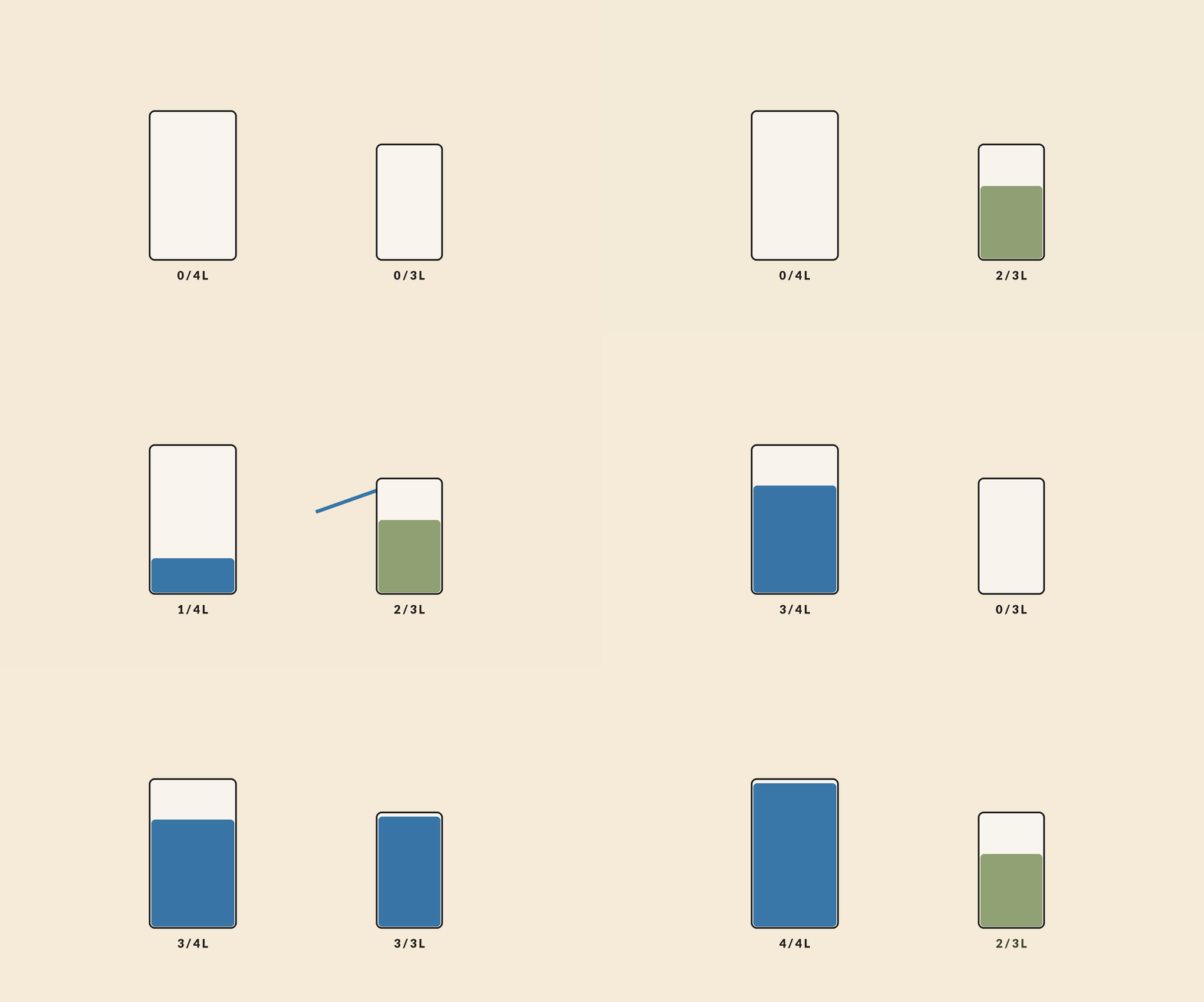
Four moves from (0, 0) to (4, 2)
Capacities 4 L and 3 L. Goal: a = 2 or b = 2. Start (0, 0). Apply BFS; write each successor that stays on the returned path.
- fill 3 L: (0, 0) → (0, 3)3 L jug full
- pour 3→4: transfer min(3, 4−0) = 3(3, 0)
- fill 3 L: (3, 0) → (3, 3)3 L jug full again
- pour 3→4: transfer min(3, 4−3) = 1(4, 2) — goal, b = 2
Pro tip. The last pour transfers 1 L, not 3 L, because the 4-litre jug had only 1 L of room. That is the min rule from the pour concept, and it is why 2 L is left behind.
6BFS you can run
The listing is the successor function plus the queue from Search Problems and Breadth-First Search. States are tuples so they can sit in a set. Each frontier entry carries the path of pairs behind it, which is how the returned answer is a sequence of pours and not only the final pair. The goal test in the listing is the either-jug predicate; change one line to require a = 2 and you will watch the path grow from four moves to six.
This is the paper's water-jug experiment — the 'war-jug' typo on the question paper. It is not a new algorithm. It is the uninformed-search loop pointed at a twenty-state space you can print.
Figure. successors returns fill, empty and pour pairs as a set. Each frontier entry is a pair plus the list of pairs behind it — that list is the answer. The goal test is a == 2 or b == 2; change it to a == 2 and the path grows from four moves to six.
What the listing does
- Six neighbourssuccessors returns the fill, empty and pour pairs as a set, so a no-op pour is one pair, not six.
- Queue of pathsEach frontier entry is a pair plus the list of pairs behind it — that list is the answer.
- Either-jug stopa == 2 or b == 2. Change that line to a == 2 and the path grows from four moves to six.
Water-jug BFS, either-jug goal
from collections import deque

def successors(a, b, A=4, B=3):
    t = min(a, B - b)
    u = min(b, A - a)
    return {
        (A, b), (a, B), (0, b), (a, 0),
        (a - t, b + t), (a + u, b - u),
    }

def water_jug(A=4, B=3):
    start = (0, 0)
    frontier = deque([(start, [start])])
    seen = {start}
    while frontier:
        (a, b), path = frontier.popleft()
        if a == 2 or b == 2:
            return path
        for nxt in successors(a, b, A, B):
            if nxt not in seen:
                seen.add(nxt)
                frontier.append((nxt, path + [nxt]))
    return None
Coding lab. BFS to 2 L runs in the app, with checks on your output.
Notes
- Two jugs, capacities 4 L and 3 L, start empty; a move is fill, empty, or pour.
- A state is the pair of current volumes; how you reached that pair is node bookkeeping.
- Breadth-first search returns a shortest sequence; the goal test decides whether 2 L in either jug is enough.
Exam traps & shortcuts
- Write the six successors before you write the queue — a missing pour is a missing branch, not a bug in BFS.
- If the exam says 'measure 2 L' and does not name a jug, the goal test is 2 L in either; insisting on the 4 L jug adds two extra pours.
- The paper's 'war-jug' is this problem: same capacities, same three move kinds.
Recap
Next: graph colouring as a CSP.
- The problem
- 4 L and 3 L jugs, start empty, fill / empty / pour. The paper's war-jug is this.
- State
- The pair (a, b). Hash the pair, not the pour history — twenty pairs, not a tree of sequences.
- Pour
- Transfer min(source, room in destination). From (4, 0) that is 3 L and the pair becomes (1, 3).
- Goal test
- Either jug = 2 is four moves to (4, 2). The 4-litre jug = 2 is six moves to (2, 3).
- BFS
- The uninformed-search queue pointed at this space. Same algorithm, a successor function you can print.
Practise The Water-Jug Problem
Reading is free and needs no account. Practice, mocks and progress live in the app.
- 2 quick checks with worked explanations
- Timed mocks scored with the real marking scheme
- Readiness tracked per topic, kept on your device