Retail Investing · Indian Securities Markets
Exchanges and Market Indices
NSE and BSE as trading venues; Sensex and Nifty as benchmarks, not investable promises by themselves.
Eight concepts. Exchanges are the venues; indices are scoreboards. A dedicated Nifty 50 walk-through — basket, rules, scoreboard, and index-not-fund — sits beside the Sensex/Nifty count peg. Retail investors often treat an index level as a product they own; this topic separates venue, benchmark, weighting, and ownership.
- Retail Investing
- Easy level
- 8 concepts
- 6 practice questions
1NSE and BSE
The National Stock Exchange (NSE) and Bombay Stock Exchange (BSE) are India's main equity exchanges. They match buy and sell orders under exchange rules within the SEBI framework.
Listed equity trades on these venues through a registered broker.
Figure. Two venues, one door: retail orders reach NSE or BSE only through a registered broker.
| Exchange | Retail cue |
|---|---|
| NSE | Major electronic equity venue; Nifty family |
| BSE | Major equity venue; Sensex |
| Access | Through a SEBI-registered broker |
Retail equity trades on NSE/BSE are normally placed through
- A SEBI-registered broker
- An unregistered tipster
- Direct cash to the index committee
Exchange access for retail is via registered brokers.
2What an index is
An index is a number that tracks a basket of securities with stated rules. It is a benchmark, not automatic cash in your demat.
Index funds or ETFs are products that aim to track an index.
Figure. An index compresses a rule-based basket into one number. Watching that number is not owning the basket.
| Term | Meaning |
|---|---|
| Index | Rule-based basket scoreboard |
| Index fund / ETF | Product that aims to track an index |
| Index level | Published number — not demat cash by itself |
The Nifty 50 index level by itself means
- A benchmark number for a defined basket of stocks
- Cash credited to every PAN automatically
- A SEBI promise of fixed returns
An index is a benchmark. Ownership needs a fund, ETF, or the stocks.
3Sensex and Nifty 50
BSE Sensex tracks 30 large companies; NSE Nifty 50 tracks 50. Both are widely described as free-float market-capitalisation weighted equity benchmarks.
Everyday talk that "the market was up" often means one of these rose.
Figure. Two headline scoreboards: Sensex tracks 30 large BSE names, Nifty 50 tracks 50 on the NSE.
| Benchmark | Count / home |
|---|---|
| Sensex | BSE; 30 stocks |
| Nifty 50 | NSE; 50 stocks |
| Weighting | Free-float market-cap weighted (usual description) |
Sensex and Nifty 50 track how many stocks respectively?
- 30 and 50
- 50 and 30
- 100 and 100
Sensex 30; Nifty 50.
4Nifty 50 as basket, rules, scoreboard
The Nifty 50 is an NSE equity index whose basket is fifty large, liquid companies chosen under published methodology. Everyday talk that "the market was up" often points at this basket moving as a whole.
Membership is not a tip sheet: eligibility and liquidity tests apply, weights are usually described as free-float market-capitalisation weighted, and the list is reviewed on a published schedule so names can enter or leave.
The published Nifty 50 level is a scoreboard for that basket under those rules. Watching the number is not the same as owning the fifty stocks in your demat, and it is not the same as owning units of a mutual fund or ETF that tracks the index.
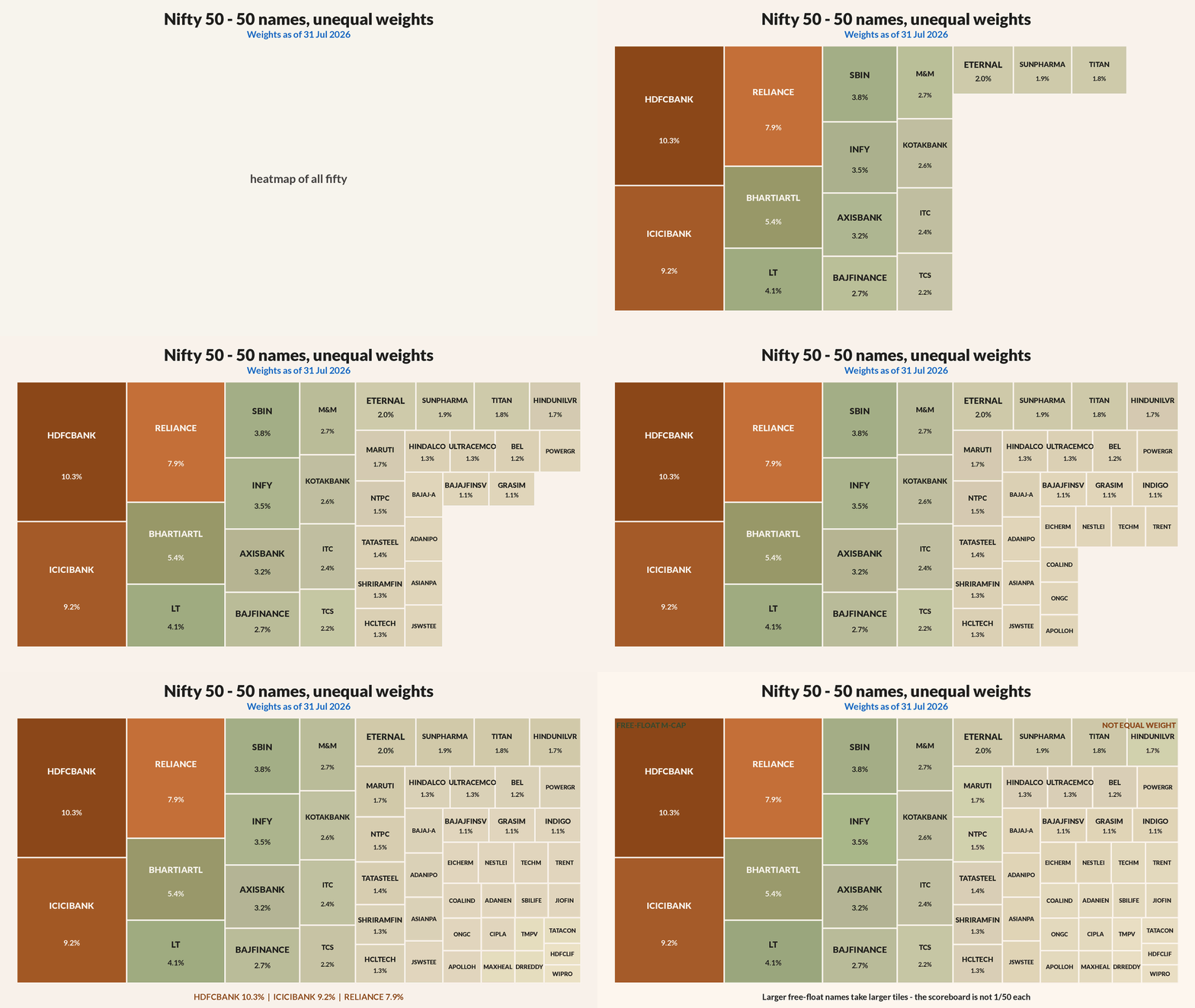
How to read Nifty 50
- BasketName the fifty-company NSE list as the concrete basket.
- RulesApply eligibility, free-float market-cap weighting, and periodic review.
- ScoreboardRead the published level as the basket under those rules.
- Not ownershipSeparate watching the level from demat stocks or fund units.
| Idea | What it means |
|---|---|
| Basket | 50 large, liquid NSE names under methodology |
| Rules | Eligibility, free-float market-cap weights, periodic review |
| Scoreboard | Published index level — not demat cash by itself |
| Index vs product | A fund/ETF may track the index; the index is not the fund |
5Free-float market-cap weighting
Free-float market-cap weighting gives more influence to companies with larger market value of shares available for public trading.
Headline Indian equity indices are not equal-weighted in the usual description.
Figure. Same total shares, different free float: only the tradable slice feeds index weight, so Q carries more weight than P.
| Idea | Effect |
|---|---|
| Free-float market cap | Larger free-float giants weigh more |
| Equal weight | Each name same — not the usual Sensex/Nifty story |
| Retail cue | Index moves often driven by large constituents |
Free-float market-cap weighting means
- Larger free-float companies influence the index more
- Every micro-cap equals the largest bank
- Weights are random each morning
Large free-float names dominate moves.
6Index move vs your stock
Your stock can fall on a day the Nifty rises. An index averages a basket; company news still drives single names.
Diversified equity funds reduce single-stock drama; they do not remove market risk.
Figure. Same week, opposite stories: the basket average drifts up while one company slides on its own news.
| Observation | Interpretation |
|---|---|
| Index up, stock down | Possible — basket ≠ every name |
| Index as mood | Useful market mood gauge |
| Single-stock risk | Still company-specific |
If Nifty is up 1% and your stock is down 3%, that
- Can happen because an index is a basket
- Is impossible by SEBI rule
- Means your broker stole index points
Indices and single stocks diverge constantly.
7Other indices you will hear
Beyond the large-cap Sensex and Nifty 50, India also publishes midcap and small-cap indices (baskets of medium and smaller companies) and sector indices (a basket drawn from one industry only, such as banks, IT or pharma).
Each family is a different basket, so the same year tells different stories. A sector index rides a single industry's fortunes, so it can fall even in a year the broad market rises — and midcaps can beat large caps or lag them badly.
When a tip says "the index," ask which one.
Figure. Illustrative year, not real data: large caps rose 8% and midcaps 15%, yet one sector index fell 6% — its single industry had a bad year even as the broad market climbed. Three baskets, three stories: ask which index a tip means.
| Family | Rough use |
|---|---|
| Headline large-cap | Sensex / Nifty 50 — the broad-market story |
| Mid / small-cap | Medium and smaller companies — swingier than large caps |
| Sector | One industry only — can fall while the broad market rises |
A midcap index and the Nifty 50
- Can tell different stories on the same day
- Must move identically by law
- Are both T-Bill indices
Different baskets, different stories.
8Using indices as benchmarks
Investors use indices to judge whether an active fund beat the market sleeve it claims to follow.
A fair comparison matches the fund's universe.
Figure. Illustrative: against Nifty 50 this small-cap fund looks like a laggard; against its matching small-cap universe it actually won.
| Use | Caution |
|---|---|
| Performance comparison | Match fund universe to benchmark |
| Asset-class history | Index returns approximate the sleeve |
| Mismatch | Wrong benchmark flatters or punishes unfairly |
Judging a small-cap fund mainly against Nifty 50 alone is
- Often a mismatched benchmark
- Always the only legal method
- Required because midcap indices are banned
Match the benchmark to the strategy.
Notes
- NSE and BSE are the main Indian equity exchanges.
- An index is a rule-based basket benchmark, not automatic ownership.
- Sensex tracks 30; Nifty 50 tracks 50.
- Single stocks can diverge from the index.
- Match performance benchmarks to the strategy's universe.
Formulas
- Sensex = 30 (BSE); Nifty 50 = 50 (NSE).
- Free-float market-cap weight → large free-float names dominate moves.
Exam traps & shortcuts
- Ask "which index?" before trusting a market story.
- Own the market via funds/ETFs/stocks — not the published level alone.
Reference tables
| Peg | Fact |
|---|---|
| Venues | NSE and BSE — access via registered broker. |
| Index | Rule-based basket scoreboard — not automatic demat cash. |
| Sensex / Nifty | 30 / 50; free-float market-cap weighted. |
| Weighting | Large free-float names move headline indices more. |
| Divergence | Your stock can disagree with the index any day. |
| Benchmark | Compare funds to a matching universe. |
Recap
Keep these pegs.
- Venues
- NSE and BSE — access via registered broker.
- Index
- Rule-based basket scoreboard — not automatic demat cash.
- Sensex / Nifty
- 30 / 50; free-float market-cap weighted.
- Nifty 50
- Basket of 50 → rules (eligibility, free-float weights, review) → published scoreboard; index ≠ fund.
- Weighting
- Large free-float names move headline indices more.
- Divergence
- Your stock can disagree with the index any day.
- Benchmark
- Compare funds to a matching universe.
Practise Exchanges and Market Indices
Reading is free and needs no account. Practice, mocks and progress live in the app.
- 6 exam-style questions on this topic, with explanations
- A 6-question practice set that ends the chapter
- Timed mocks scored with the real marking scheme
- Readiness tracked per topic, kept on your device