Retail Investing · Mutual Funds & SIPs
Debt Credit and Risk Disclosures
Issuer and credit strategies, gilt and floating mandates, and PRC risk disclosures.
Debt Credit and Risk Disclosures is taught as investor education, not a recommendation. Use the mandate, current disclosures and your own horizon; regulatory facts are stated as of 4 Aug 2026.
- Retail Investing
- Easy level
- 3 concepts
- 5 practice questions
1Issuer and credit strategies
Corporate Bond, Credit Risk, Banking & PSU Debt and Sectoral Debt differ by issuer or credit opportunity set, not simply by maturity.
A widening credit spread can lower bond value before default; lower liquidity can amplify the NAV impact of stressed selling.

| Lens | What to read |
|---|---|
| Corporate Bond | Corporate issuer quality mandate |
| Credit Risk | Lower-rated credit exposure mandate |
| Issuer sets | Banking/PSU and sectoral debt |
A credit-spread widening can
- Reduce a bond's market value
- Guarantee a higher NAV
- Remove liquidity risk
Required spread up generally means price down.
2Gilt, constant maturity and floating-rate strategies
Gilt removes ordinary corporate credit exposure but not interest-rate volatility; a government-security fund can still have a falling NAV.
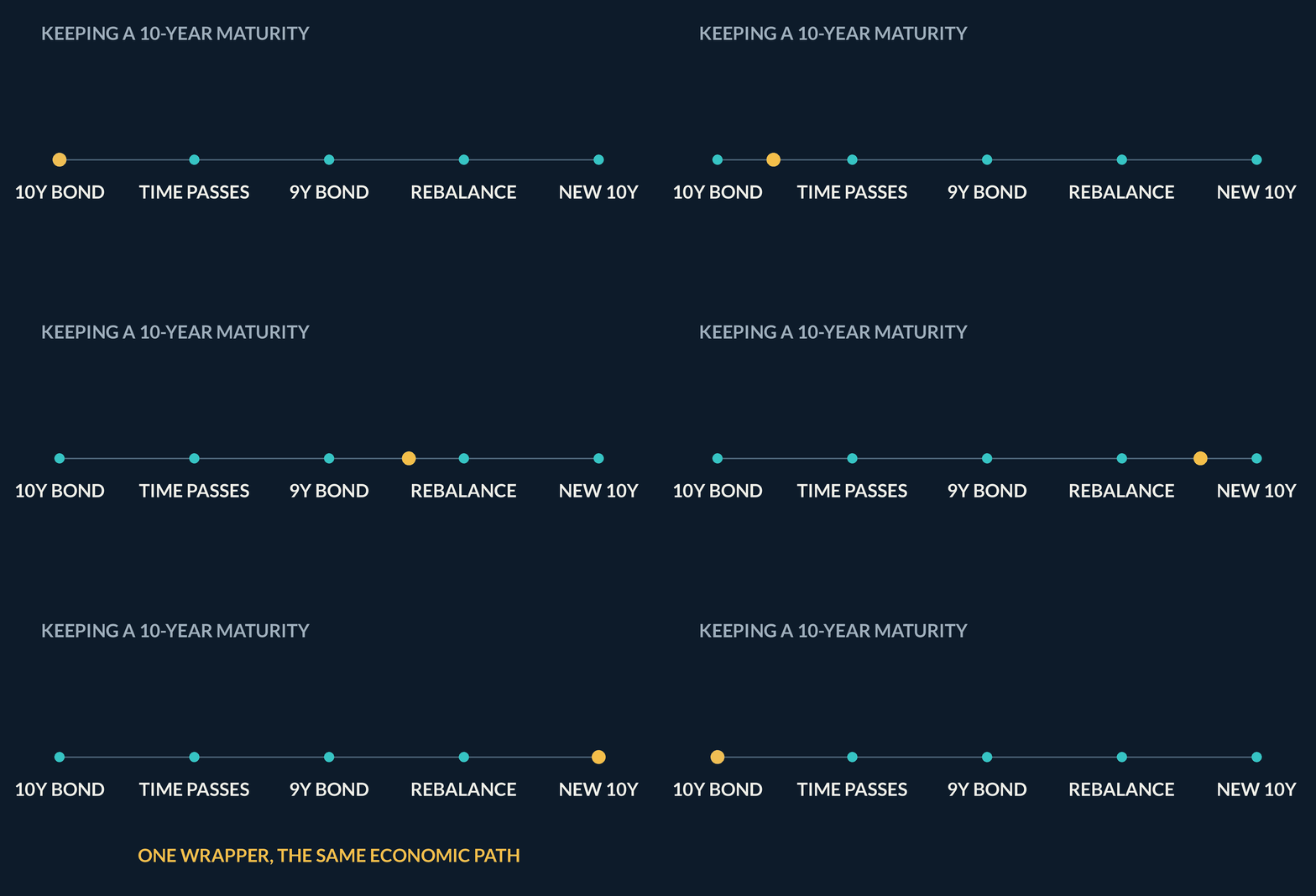
The 10-year constant-maturity category must rebalance to maintain its maturity profile, while floating-rate strategies reset coupons but retain spread, liquidity and basis risks.
| Lens | What to read |
|---|---|
| Gilt | Government securities; rate risk remains |
| 10-year constant | Rebalances to maintain maturity |
| Floating | Coupon reset; other risks remain |
A gilt fund's NAV is
- Sensitive to interest-rate moves
- Guaranteed stable
- Identical to a bank deposit
Sovereign credit does not remove duration risk.
3PRC, Riskometer and the 2026 transition
The Potential Risk Class (PRC), Riskometer, portfolio disclosures and stress/liquidity information answer different risk questions and should be read together.
The February 2026 categorisation allowed a six-month transition; scheme names or mandates may change, so verify the latest SID/addendum rather than treating this lesson as a live subscription status.
Figure. Read the rails as separate decision lenses; no label alone determines return, risk, or tax.
| Lens | What to read |
|---|---|
| PRC | Credit and interest-rate risk grid |
| Riskometer | Scheme risk label |
| Transition | Check latest SID/addendum |
During the 2026 transition, the sound action is to
- Check the latest scheme documents
- Assume every old label is unchanged
- Ignore investor notices
Current documents govern the migrated scheme.
Notes
- Corporate Bond, Credit Risk, Banking & PSU Debt and Sectoral Debt differ by issuer or credit opportunity set, not simply by maturity.
- Gilt removes ordinary corporate credit exposure but not interest-rate volatility; a government-security fund can still have a falling NAV.
- The Potential Risk Class (PRC), Riskometer, portfolio disclosures and stress/liquidity information answer different risk questions and should be read together.
Formulas
- Category name ≠ economic exposure ≠ tax classification
- Read mandate + portfolio + costs + liquidity
Exam traps & shortcuts
- Separate the product wrapper, investment strategy and tax classification.
- Treat every dated regulatory fact as reviewable, not permanent.
Reference tables
Use this map before comparing scheme names or trailing returns.
| Concept | Primary question |
|---|---|
| Issuer and credit strategies | Corporate issuer quality mandate |
| Gilt, constant maturity and floating-rate strategies | Government securities; rate risk remains |
| PRC, Riskometer and the 2026 transition | Credit and interest-rate risk grid |
Recap
Keep the axes separate and re-check dated documents.
- Issuer and credit strategies
- Corporate Bond, Credit Risk, Banking & PSU Debt and Sectoral Debt differ by issuer or credit opportunity set, not simply by maturity.
- Gilt, constant maturity and floating-rate strategies
- Gilt removes ordinary corporate credit exposure but not interest-rate volatility; a government-security fund can still have a falling NAV.
- PRC, Riskometer and the 2026 transition
- The Potential Risk Class (PRC), Riskometer, portfolio disclosures and stress/liquidity information answer different risk questions and should be read together.
Practise Debt Credit and Risk Disclosures
Reading is free and needs no account. Practice, mocks and progress live in the app.
- 5 exam-style questions on this topic, with explanations
- A 3-question practice set that ends the chapter
- Timed mocks scored with the real marking scheme
- Readiness tracked per topic, kept on your device