Retail Investing · Mutual Funds & SIPs
Hybrid Funds in India
Current allocation bands and the difference between gross and net exposure.
Hybrid Funds in India is taught as investor education, not a recommendation. Use the mandate, current disclosures and your own horizon; regulatory facts are stated as of 4 Aug 2026.
- Retail Investing
- Easy level
- 6 concepts
- 5 practice questions
1Hybrid funds
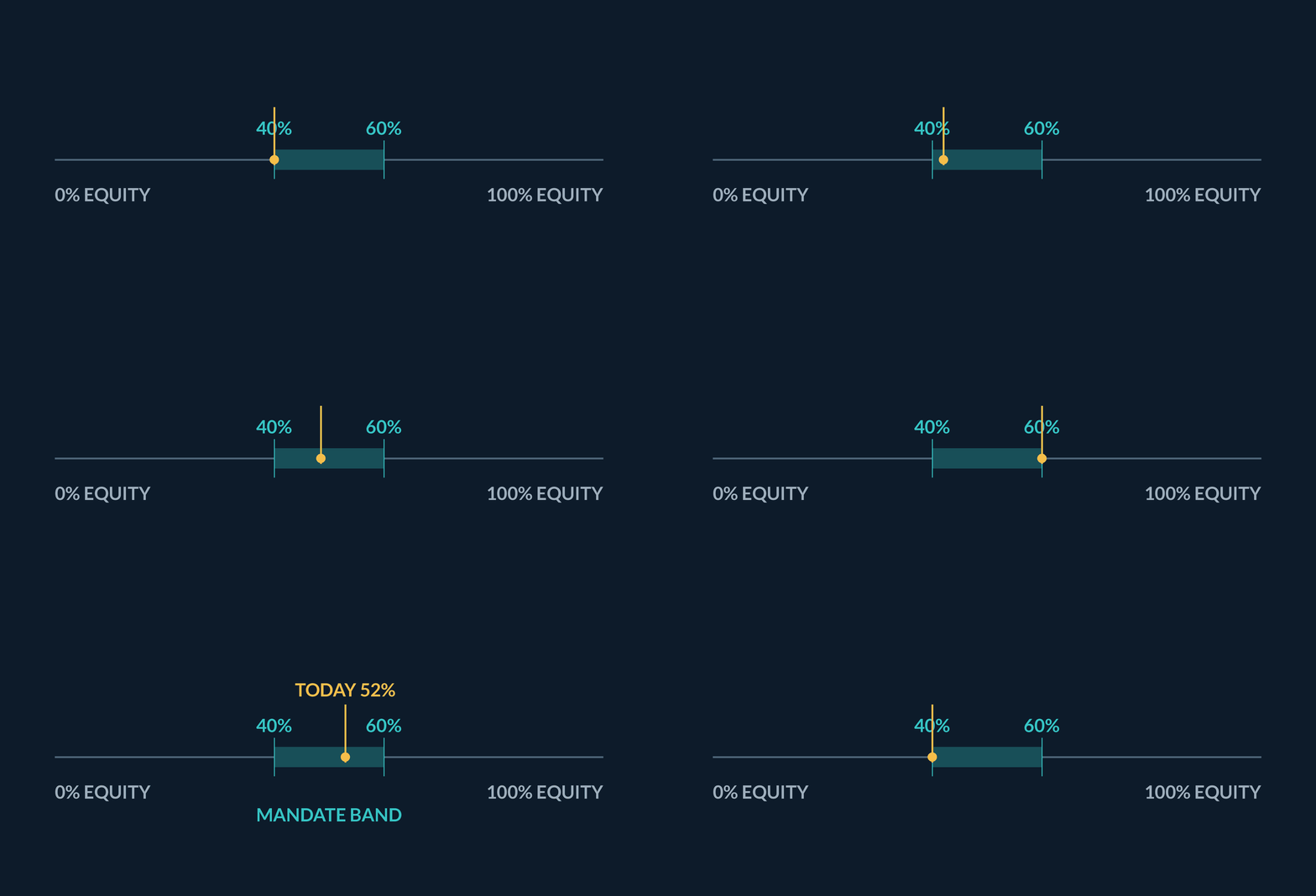
Hybrid funds mix equity and debt in stated ranges. They are not magic "best of both" without trade-offs.
Read the allocation band before assuming safety.
| Item | Fact |
|---|---|
| Hybrid | Mix of equity and debt |
| Band | Stated allocation range |
| Trade-off | Still market risk on equity sleeve |
Hybrid funds
- Combine equity and debt per mandate
- Hold only T-Bills always
- Are unregulated tip baskets
Mixed sleeves.
2Current hybrid category bands
Conservative Hybrid holds 10–25% equity and 75–90% debt; Balanced Hybrid holds 40–60% in each without arbitrage; Aggressive Hybrid holds 65–80% equity and 20–35% debt.
These are category allocation ranges as of 4 August 2026, not return or downside guarantees.
Figure. The three hybrid bands are defined by their equity/debt split: Conservative sits at 10–25% equity, Balanced at 40–60% each, and Aggressive at 65–80% equity. Segment widths use the mid-point of each SEBI range and the label carries the range. These are category allocation limits, not return or downside guarantees.
| Lens | What to read |
|---|---|
| Conservative | Equity 10–25%; debt 75–90% |
| Balanced | 40–60% each; no arbitrage |
| Aggressive | Equity 65–80%; debt 20–35% |
Aggressive Hybrid's equity band is
- 65–80%
- 10–25%
- Exactly 100%
The current band is 65–80% equity.
3Multi-asset allocation
A Multi Asset Allocation fund uses at least three asset classes with at least 10% in each under the current category rule.
The third sleeve can diversify drivers, but commodity, overseas or other exposures bring their own volatility, liquidity and tax analysis.
Figure. A Multi Asset Allocation fund must hold at least three asset classes with a floor of 10% in each — that fixed 30% is the category rule; the remaining ~70% is allocated at the manager's discretion. The third sleeve diversifies drivers but brings its own volatility, liquidity and tax analysis.
| Lens | What to read |
|---|---|
| Minimum classes | At least three |
| Minimum sleeve | At least 10% each |
| Review | Economic and tax axes separately |
A current multi-asset category needs
- At least three asset classes with 10% each
- Only equity and debt
- A guaranteed hedge
Three classes and a 10% floor define the category.
4Arbitrage: gross equity vs directional risk
The Arbitrage category keeps at least 65% in equity and equity-related instruments, often pairing cash equities with offsetting futures.
Gross equity can therefore be high while net directional equity risk is much lower; basis, execution, liquidity and return-spread risks remain.
Figure. Arbitrage keeps at least 65% in equity, but cash positions are paired with offsetting futures, so net directional equity risk is close to zero. The gap between the two bars is the hedge — gross equity is not the risk you carry. The near-zero net figure is illustrative; basis, execution, liquidity and return-spread risks remain.
| Lens | What to read |
|---|---|
| Gross equity | At least 65% category exposure |
| Hedge | Cash/futures positions can offset |
| Residual risks | Basis, execution and liquidity |
In an arbitrage fund, 65% gross equity means
- Not necessarily 65% net market direction
- A guaranteed equity rally
- No basis risk
Offsetting futures can reduce net direction.
5Equity Savings: three moving sleeves
Equity Savings currently requires at least 65% gross equity, 15–40% net equity and at least 10% debt.
Read the hedge and debt sleeves because gross equity alone overstates directional stock-market exposure.
Figure. Equity Savings runs three sleeves at once: at least 65% gross equity, but only 15–40% net directional equity once the hedge is set, plus at least 10% debt. Read the net figure — gross equity alone overstates how much stock-market exposure you actually carry. The net-equity bar is drawn at the 27.5% mid-point of its range.
| Lens | What to read |
|---|---|
| Gross equity | At least 65% |
| Net equity | 15–40% |
| Debt | At least 10% |
Which number best describes directional equity in Equity Savings?
- Net equity, currently 15–40%
- Gross equity alone
- Debt allocation
Net exposure is the directional lens.
6Hybrid is not a safety guarantee
A mixed portfolio can still fall when equity, duration, credit or liquidity risks move against it, and correlations can rise during stress.
Choose by mandate, actual allocation, rebalancing rule and horizon; the word balanced is not capital protection.
Figure. Read the rails as separate decision lenses; no label alone determines return, risk, or tax.
| Lens | What to read |
|---|---|
| Equity sleeve | Market drawdown risk |
| Debt sleeve | Duration, credit and liquidity |
| Mix | Correlation can change |
The word hybrid guarantees
- Nothing about capital protection
- A positive month
- Fixed tax treatment
The underlying sleeves still carry risk.
Notes
- Hybrid funds mix equity and debt in stated ranges. They are not magic "best of both" without trade-offs.
- Conservative Hybrid holds 10–25% equity and 75–90% debt; Balanced Hybrid holds 40–60% in each without arbitrage; Aggressive Hybrid holds 65–80% equity and 20–35% debt.
- A Multi Asset Allocation fund uses at least three asset classes with at least 10% in each under the current category rule.
- The Arbitrage category keeps at least 65% in equity and equity-related instruments, often pairing cash equities with offsetting futures.
- Equity Savings currently requires at least 65% gross equity, 15–40% net equity and at least 10% debt.
Formulas
- Category name ≠ economic exposure ≠ tax classification
- Read mandate + portfolio + costs + liquidity
Exam traps & shortcuts
- Separate the product wrapper, investment strategy and tax classification.
- Treat every dated regulatory fact as reviewable, not permanent.
Reference tables
Use this map before comparing scheme names or trailing returns.
| Concept | Primary question |
|---|---|
| Hybrid funds | Mix of equity and debt |
| Current hybrid category bands | Equity 10–25%; debt 75–90% |
| Multi-asset allocation | At least three |
| Arbitrage: gross equity vs directional risk | At least 65% category exposure |
| Equity Savings: three moving sleeves | At least 65% |
| Hybrid is not a safety guarantee | Market drawdown risk |
Recap
Keep the axes separate and re-check dated documents.
- Hybrid funds
- Hybrid funds mix equity and debt in stated ranges. They are not magic "best of both" without trade-offs.
- Current hybrid category bands
- Conservative Hybrid holds 10–25% equity and 75–90% debt; Balanced Hybrid holds 40–60% in each without arbitrage; Aggressive Hybrid holds 65–80% equity and 20–35% debt.
- Multi-asset allocation
- A Multi Asset Allocation fund uses at least three asset classes with at least 10% in each under the current category rule.
- Arbitrage: gross equity vs directional risk
- The Arbitrage category keeps at least 65% in equity and equity-related instruments, often pairing cash equities with offsetting futures.
- Equity Savings: three moving sleeves
- Equity Savings currently requires at least 65% gross equity, 15–40% net equity and at least 10% debt.
- Hybrid is not a safety guarantee
- A mixed portfolio can still fall when equity, duration, credit or liquidity risks move against it, and correlations can rise during stress.
Practise Hybrid Funds in India
Reading is free and needs no account. Practice, mocks and progress live in the app.
- 5 exam-style questions on this topic, with explanations
- A 5-question practice set that ends the chapter
- Timed mocks scored with the real marking scheme
- Readiness tracked per topic, kept on your device