Retail Investing · Mutual Funds & SIPs
Fund of Funds
Ownership layers, fund families, and the convenience versus control trade-off.
Fund of Funds is taught as investor education, not a recommendation. Use the mandate, current disclosures and your own horizon; regulatory facts are stated as of 4 Aug 2026.
- Retail Investing
- Easy level
- 4 concepts
- 5 practice questions
1What a Fund of Funds owns
A Fund of Funds (FoF) owns units of one or more underlying funds instead of holding every end security directly.
The investor owns FoF units; the FoF owns underlying units; the underlying portfolios create the economic exposure.
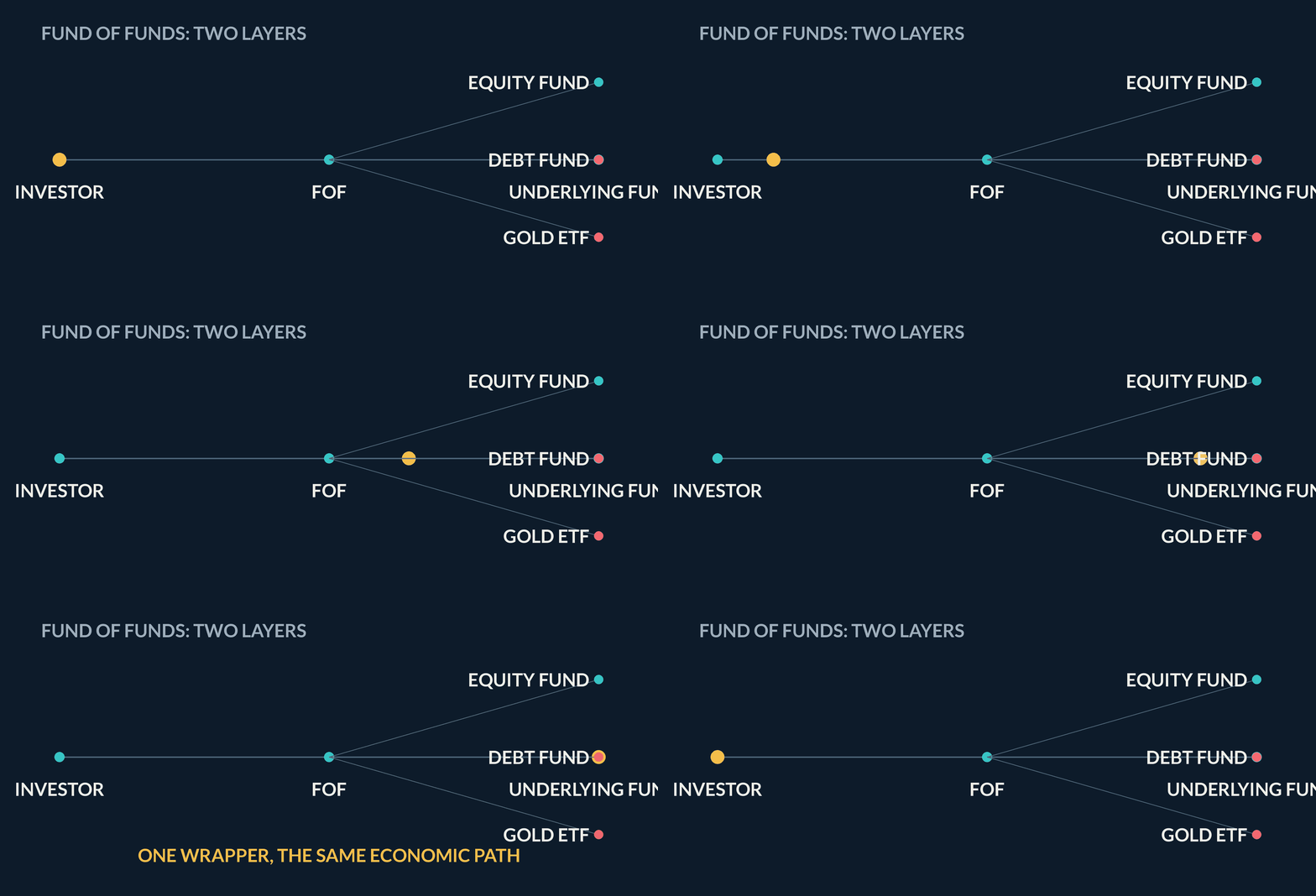
| Lens | What to read |
|---|---|
| Investor | Owns FoF units |
| FoF | Owns underlying fund units |
| Underlying | Holds securities or assets |
A FoF normally owns
- Units of underlying funds
- Only the AMC building
- A guaranteed return
Ownership is layered.
2FoF families
FoFs can provide gold, domestic equity allocation, debt allocation, multi-asset, passive-basket or overseas exposure.
Classify the underlying economic exposure separately from the FoF wrapper and from dated tax treatment.
Figure. Read the rails as separate decision lenses; no label alone determines return, risk, or tax.
| Lens | What to read |
|---|---|
| Single exposure | Gold ETF or overseas feeder |
| Allocator | Multiple equity/debt/asset funds |
| Management | Active or passive underlying mix |
FoF tells you primarily
- The ownership wrapper
- The final asset risk by itself
- Tax treatment forever
Inspect the underlying funds.
3Convenience and limits
A FoF can package rebalancing, manager selection or access without the investor transacting in each underlying fund.
The convenience reduces control over underlying choices and may add costs, overlap, concentration or manager-allocation risk.
Figure. Read the rails as separate decision lenses; no label alone determines return, risk, or tax.
| Lens | What to read |
|---|---|
| Convenience | One transaction and allocation process |
| Limit | Less control over underlying choices |
| Risk | Overlap and allocator decisions |
A FoF convenience trade-off is
- Less direct control over underlying funds
- No layered exposure
- Guaranteed diversification
The wrapper delegates selection.
4FoF return versus underlying return
FoF NAV reflects underlying fund returns plus cash, expenses, timing and rebalancing; it need not equal a simple headline underlying return.
For a multi-fund FoF, changing weights and flows further separate the wrapper's path from any one constituent.
Figure. Read the rails as separate decision lenses; no label alone determines return, risk, or tax.
| Lens | What to read |
|---|---|
| Underlying | Fund-level returns |
| FoF | Weights, cash and expenses |
| Gap | Timing and rebalancing effects |
Why can FoF and underlying returns differ?
- Wrapper costs, cash and timing
- FoF has no NAV
- Underlying returns are fixed
The wrapper adds implementation.
Notes
- A Fund of Funds (FoF) owns units of one or more underlying funds instead of holding every end security directly.
- FoFs can provide gold, domestic equity allocation, debt allocation, multi-asset, passive-basket or overseas exposure.
- A FoF can package rebalancing, manager selection or access without the investor transacting in each underlying fund.
- FoF NAV reflects underlying fund returns plus cash, expenses, timing and rebalancing; it need not equal a simple headline underlying return.
Formulas
- Category name ≠ economic exposure ≠ tax classification
- Read mandate + portfolio + costs + liquidity
Exam traps & shortcuts
- Separate the product wrapper, investment strategy and tax classification.
- Treat every dated regulatory fact as reviewable, not permanent.
Reference tables
Use this map before comparing scheme names or trailing returns.
| Concept | Primary question |
|---|---|
| What a Fund of Funds owns | Owns FoF units |
| FoF families | Gold ETF or overseas feeder |
| Convenience and limits | One transaction and allocation process |
| FoF return versus underlying return | Fund-level returns |
Recap
Keep the axes separate and re-check dated documents.
- What a Fund of Funds owns
- A Fund of Funds (FoF) owns units of one or more underlying funds instead of holding every end security directly.
- FoF families
- FoFs can provide gold, domestic equity allocation, debt allocation, multi-asset, passive-basket or overseas exposure.
- Convenience and limits
- A FoF can package rebalancing, manager selection or access without the investor transacting in each underlying fund.
- FoF return versus underlying return
- FoF NAV reflects underlying fund returns plus cash, expenses, timing and rebalancing; it need not equal a simple headline underlying return.
Practise Fund of Funds
Reading is free and needs no account. Practice, mocks and progress live in the app.
- 5 exam-style questions on this topic, with explanations
- A 4-question practice set that ends the chapter
- Timed mocks scored with the real marking scheme
- Readiness tracked per topic, kept on your device