Retail Investing · Equity & Fundamental Analysis
Key Ratios and Valuation Literacy
Common ratios retail investors meet — what they mean, not magic buy signals.
5 concepts. Foundation literacy for retail investors.
- Retail Investing
- Easy level
- 5 concepts
- 5 practice questions
1Margin ratios
Gross, operating, and net margins show how much of revenue survives costs at each stage.
Compare margins to history and peers; a lone number without context misleads.
Figure. Each bar keeps only what survives the next layer of cost: 100 of revenue becomes 40 gross, 25 operating, 15 net. Margins are these heights read against the revenue bar - and they only mean something next to history and peers.
| Item | Fact |
|---|---|
| Gross margin | After direct costs |
| Operating margin | After operating costs |
| Net margin | After all P&L items |
Rising revenue with collapsing margins can mean
- Growth is becoming less profitable per rupee of sales
- Risk has disappeared
- SEBI caps your losses
Margins matter.
2ROE and ROA intuition
Return on equity and return on assets relate profits to the capital base. High ROE with heavy leverage needs a second look.
These are literacy tools, not automatic buy triggers.
Figure. Both firms hold the same 100 of assets and earn the same operating profit; B finances 60 of its assets with debt, so after interest its profit lands on a 40-equity base and reports the higher ROE. Check leverage before applauding.
| Item | Fact |
|---|---|
| ROE | Profit vs equity |
| ROA | Profit vs assets |
| Caution | Leverage can juice ROE |
Very high ROE driven mainly by high debt should make you
- Check leverage and sustainability
- Buy blindly
- Ignore the balance sheet
Leverage caution.
3P/E literacy
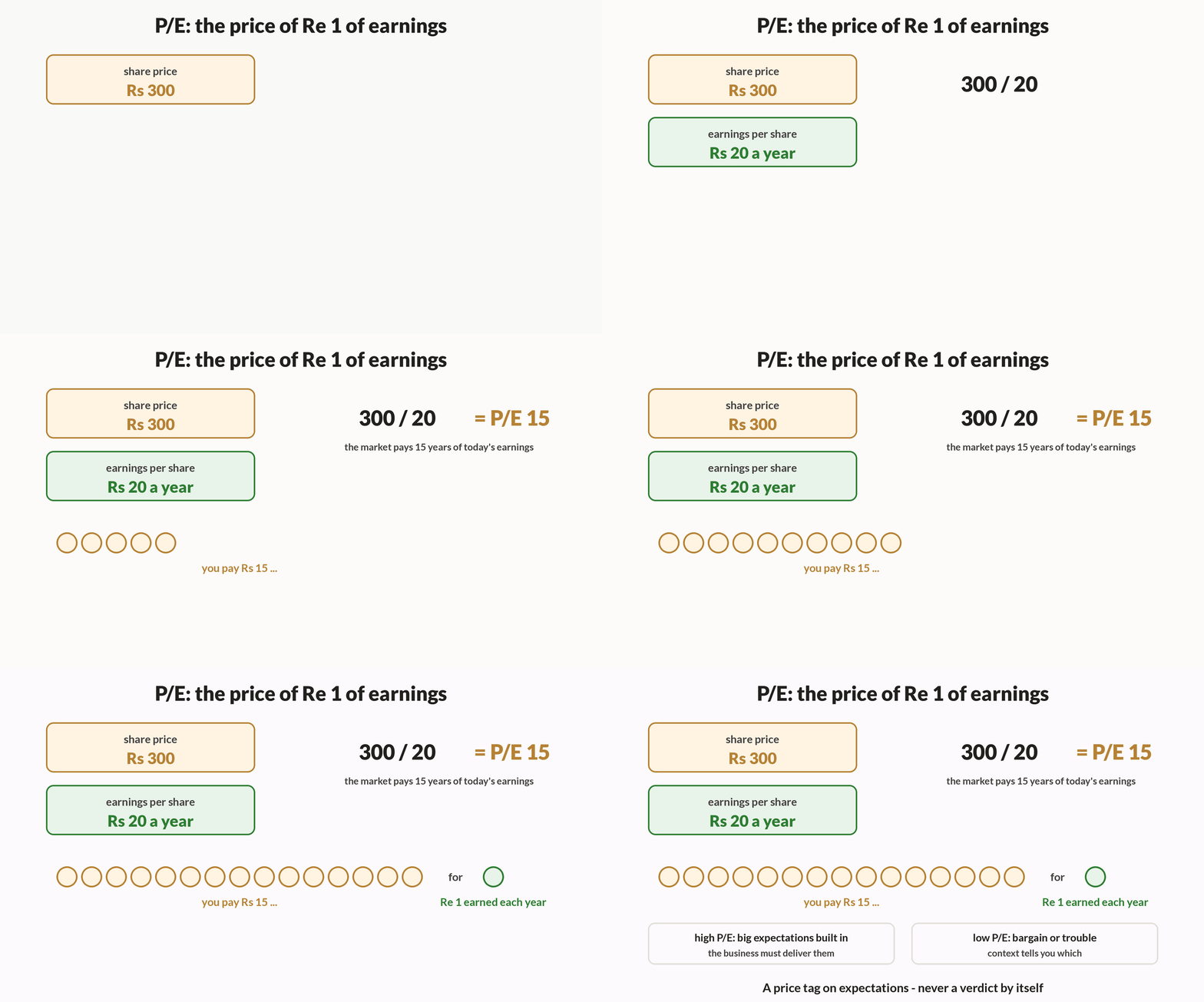
Price-to-earnings compares price to earnings. A high P/E can mean high expectations; a low P/E can mean a bargain or a trap.
Never use P/E alone without growth, quality, and cycle context.
| Item | Fact |
|---|---|
| High P/E | Often high expectations |
| Low P/E | Cheap or troubled |
| Rule | Context required |
A low P/E automatically means
- Nothing by itself — context is required
- A guaranteed bargain
- SEBI-certified upside
Context required.
4Other common multiples
Price-to-book and price-to-sales appear in screens. Banks and asset-heavy firms often use book; early loss-makers sometimes talk sales.
Each multiple fits some models better than others.
Figure. No multiple is universal - match the yardstick to where the economics live: book value for balance-sheet businesses, sales when profits have not arrived yet, earnings once they have.
| Item | Fact |
|---|---|
| P/B | Price vs book equity |
| P/S | Price vs sales |
| Fit | Match multiple to business type |
Using P/S can be more common when
- Earnings are not yet meaningful but sales are
- The firm is a T-Bill
- Demat KYC fails
Match tool to stage.
5Valuation is a range
Valuation is an estimate under assumptions, not a single true number. Margin of safety means demanding a gap versus your estimated value.
Being precisely wrong to two decimals is still wrong.
Figure. The honest output of valuation is the 90-120 band, not one number. The bracket between the price tick at 75 and the band's lower edge is the margin of safety - the cushion that pays for the errors in your assumptions.
| Item | Fact |
|---|---|
| Estimate | Depends on assumptions |
| Margin of safety | Room for error |
| Humility | Ranges beat false precision |
Margin of safety means
- Buying with a cushion versus your estimated value
- Using maximum leverage
- Trusting GMP only
Cushion for error.
Notes
- Gross, operating, and net margins show how much of revenue survives costs at each stage.
- Return on equity and return on assets relate profits to the capital base. High ROE with heavy leverage needs a second look.
- Price-to-earnings compares price to earnings. A high P/E can mean high expectations; a low P/E can mean a bargain or a trap.
- Price-to-book and price-to-sales appear in screens. Banks and asset-heavy firms often use book; early loss-makers sometimes talk sales.
- Valuation is an estimate under assumptions, not a single true number. Margin of safety means demanding a gap versus your estimated value.
Formulas
- After direct costs
- Profit vs equity
- Often high expectations
Exam traps & shortcuts
- Revise the table pegs before any quiz.
Reference tables
| Peg | Fact |
|---|---|
| 1.Margin | After direct costs |
| 2.ROE | Profit vs equity |
| 3.P/E | Often high expectations |
| 4.Other | Price vs book equity |
| 5.Valuation | Depends on assumptions |
Recap
Keep these pegs.
- 1.Margin
- After direct costs
- 2.ROE
- Profit vs equity
- 3.P/E
- Often high expectations
- 4.Other
- Price vs book equity
- 5.Valuation
- Depends on assumptions
Practise Key Ratios and Valuation Literacy
Reading is free and needs no account. Practice, mocks and progress live in the app.
- 5 exam-style questions on this topic, with explanations
- A 5-question practice set that ends the chapter
- Timed mocks scored with the real marking scheme
- Readiness tracked per topic, kept on your device