Retail Investing · Equity & Fundamental Analysis
ROE vs the Price You Pay
ROE is profit on book equity, not on the market price. P/B, earnings yield, and why a high-ROE stock can be a poor buy — and why a chart that 'changed ROE' often only moved the…
Five concepts. Helio earned PAT 16 on opening book equity 80, so ROE is 20 percent. That formula has no share price in it. Cedar Tools Ltd is a second teaching company: PAT 12 on book 40, so ROE is 30 percent — still not a live tip. This lesson is the usual mix-up: ROE looks like it moved when the chart moved, because the price you pay is a different denominator. Same Helio numbers as the cash lessons.
- Retail Investing
- Medium level
- 5 concepts
1ROE is PAT divided by book equity
Return on equity (ROE) asks: how much profit did the business earn on the owners' book equity? Helio Year 1 PAT is 16. Opening book equity is 80. ROE = 16 / 80 = 20 percent. Some people use average equity (80 + 96) / 2 = 88, which gives 16 / 88 ≈ 18 percent. This lesson uses opening equity so the arithmetic stays one line.
Book equity is an accounting residual on the balance sheet — assets minus liabilities — not the stock-market value of Helio. The share price does not enter this fraction. If someone tells you 'ROE changed' because Helio's ticker doubled, they substituted a market number into a book formula.
Figure. ROE is the 16 of PAT standing on the 80 of book equity — 20 percent. The market price is not in the picture.
How it works
- NumeratorPAT for the period — Helio 16.
- DenominatorBook equity, usually opening — Helio 80.
- Refuse the tickerMarket cap is not book equity.
Helio Year 1 ROE
PAT 16, opening book equity 80, 10 crore shares. Compute ROE and book value per share.
- 16 / 800.20 = 20 percent ROE
- Book value per share 80 / 10Rs 8
- Price is not usedstill 20 percent if the ticker is 8 or 80
Pro tip. If the price is missing from your ROE scratchpad, you are doing it right.
2You buy at market price, not at book
When you buy Helio, you pay the market price, not the book value. With 10 crore shares and a price of ₹40, market cap is 40 × 10 = ₹400 crore. You are paying 400 for a business that earned 16. Your earnings yield is 16 / 400 = 4 percent — not the 20 percent ROE.
Earnings yield is PAT divided by market cap, or EPS divided by price. Helio EPS is 16 / 10 = ₹1.60. At ₹40, P/E is 40 / 1.60 = 25, and earnings yield is 1 / 25 = 4 percent. ROE told you what the business earned on book. Earnings yield tells you what that earning is relative to the price you actually pay.
Figure. Same 16 of PAT. On book 80 it is 20 percent ROE. On the 400 you pay it is 4 percent earnings yield. The height you paid is the one that sets your starting yield.
How it works
- Market capPrice times shares — Helio 40 × 10 = 400.
- Earnings yieldPAT / market cap = 16 / 400 = 4 percent.
- Keep both20 percent is the business on book; 4 percent is you at this price.
Helio at Rs 40
10 crore shares, price ₹40, PAT 16. Compute market cap, EPS, P/E, and earnings yield.
- Market cap 40 \times 10400
- EPS 16 / 10Rs 1.60
- P/E 40 / 1.6025
- Earnings yield 16 / 4000.04 = 4 percent
Pro tip. Four percent is what 16 of earnings is, as a yield on a 400 purchase. It is not ROE.
3P/B is the bridge between ROE and earnings yield
Price-to-book is market price divided by book value per share, or market cap divided by book equity. Helio at ₹40: book value per share is ₹8, so P/B = 40 / 8 = 5. Equivalently 400 / 80 = 5.
When ROE uses opening book and the P/E uses the same PAT, earnings yield ≈ ROE / (P/B). Helio: 20 percent / 5 = 4 percent, which matches 16 / 400. A high-ROE business bought at a high P/B can be a low-yield purchase. The bridge is mechanical. It is not a buy or sell rule — Helio might still be able to reinvest at 20 percent, which can justify a P/B above 1. The arithmetic still holds.
Figure. Twenty divided by a P/B of 5 is 4. The first bar is the business on book; the third is what that business yields at today's price.
How it works
- Compute P/BHelio 400 / 80 = 5.
- DivideROE / P/B = 20 percent / 5 = 4 percent.
- CheckThat 4 percent is earnings yield at this price.
Cedar Tools: ROE versus earnings yield at a price
Cedar Tools Ltd (teaching company, not a tip): PAT 12, opening book equity 40, 5 crore shares, price Rs 24. Compute ROE, market cap, P/B, and earnings yield. Check that yield equals ROE divided by P/B. Then recompute yield at Rs 48 with PAT and book unchanged.
- 12 / 400.30 = 30 percent ROE
- Market cap 24 \times 5120
- P/B 120 / 403
- Yield 12 / 1200.10 = 10 percent
- ROE / P/B 0.30 / 30.10
- At Rs 48: yield 12 / (48 \times 5)0.05 = 5 percent
Pro tip. Cedar's ROE is 30 percent at both tickets. At Rs 24 you earn 10 percent on the price you pay; at Rs 48 that yield is 5 percent. High ROE is not a cheap purchase.
4High ROE at a high price can be a poor buy
Helio's 20 percent ROE is a fact about the business on book. At P/B 5 you earn a 4 percent earnings yield on the price you pay. At P/B 1 — price ₹8, market cap 80 — earnings yield equals ROE: 16 / 80 = 20 percent. Same PAT, same book, very different purchase.
This is why a screen that sorts on ROE alone can trick you. The high-ROE name may already be priced so that your yield is ordinary. The cheap-looking low-ROE name may be priced at half of book. Neither fact is a recommendation. The lesson is to pair ROE with P/B (or with earnings yield) before calling a stock 'high quality at any price.' Quality of the business and quality of the purchase are two questions.
Figure. Same Helio, same 20 percent ROE. At book you start at a 20 percent earnings yield; at five times book you start at 4 percent. The missing height is the premium you paid.
How it works
- BusinessHelio ROE 20 percent at both prices.
- Purchase A₹40, P/B 5, yield 4 percent.
- Purchase B₹8, P/B 1, yield 20 percent.
Helio ROE versus yield at three tickets
Helio Sensors Year 1: PAT 16, opening book equity 80, 10 crore shares. Tickets are Rs 8, Rs 40, and Rs 80. Compute ROE, then earnings yield at each ticket.
- 16 / 800.20 = 20 percent ROE
- Book value per share 80 / 10Rs 8
- At Rs 8: yield 16 / (8 \times 10)0.20 = 20 percent
- At Rs 40: yield 16 / (40 \times 10)0.04 = 4 percent
- At Rs 80: yield 16 / (80 \times 10)0.02 = 2 percent
Pro tip. ROE stays 20 percent at every ticket. Earnings yield is 20 percent, then 4 percent, then 2 percent — the business did not change; the price you pay did.
5When the chart moves, ROE usually did not
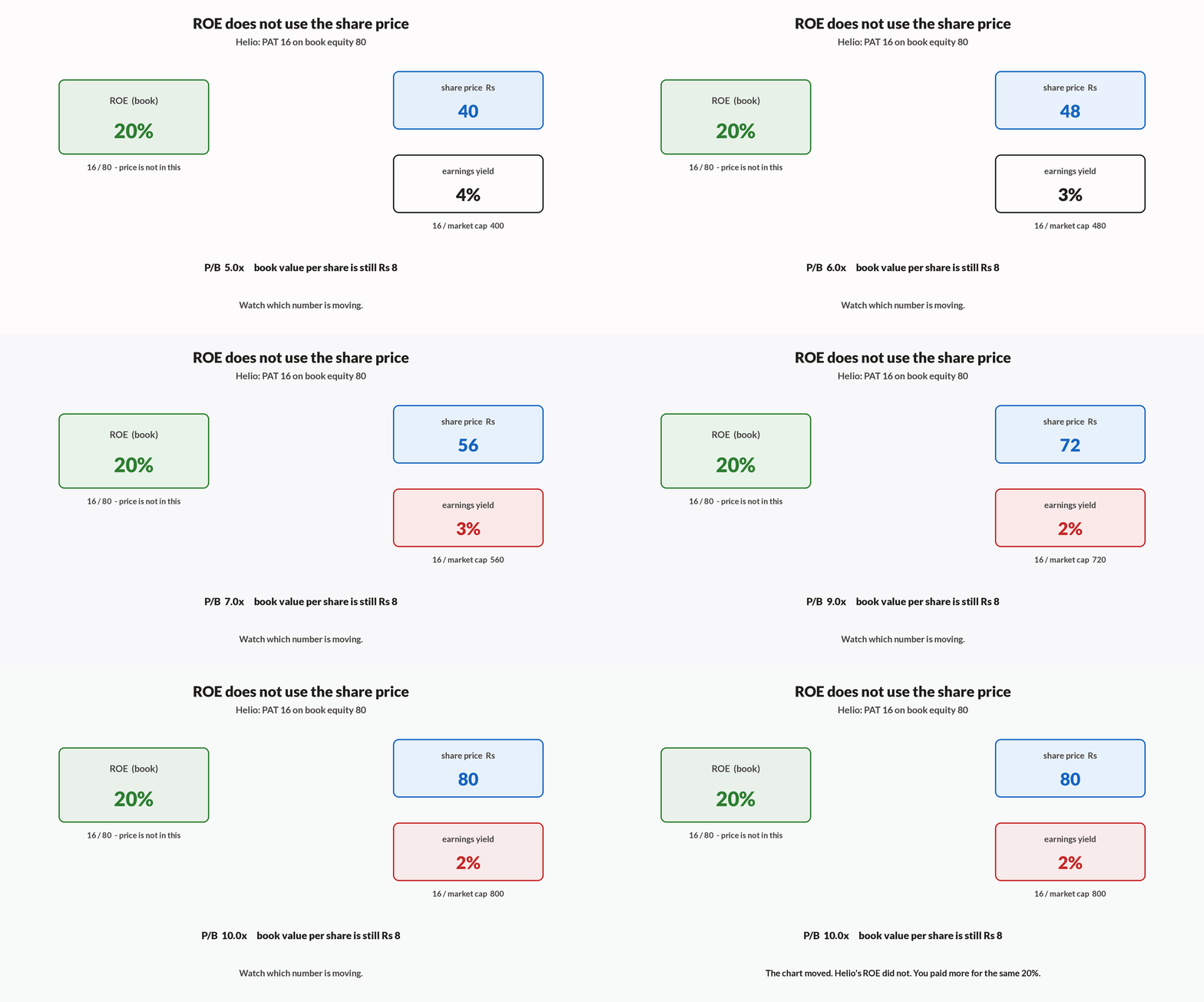
Suppose Helio's price doubles from ₹40 to ₹80 overnight with no new PAT and no new book equity. ROE is still 16 / 80 = 20 percent. Market cap is now 800, P/B is 10, earnings yield is 16 / 800 = 2 percent, P/E is 50. The chart changed. The business's ROE did not.
People still say 'ROE changed' for three honest mix-ups: they watched price return and named it ROE; a website plotted a market ratio and labelled it ROE; or book equity later changed because of new shares issued at the high price, which can move true ROE next year. The first two are labelling errors. The third is a real book-equity change — still not 'the ticker is the ROE.' If PAT and book did not move, ROE did not move.
How it works
- Hold PAT and book16 and 80 — ROE locked at 20 percent.
- Move only price₹40 → ₹80. P/B 5 → 10. Yield 4 percent → 2 percent.
- Name the moverThe chart. Not ROE.
Helio's ticker doubles
Start at ₹40: ROE 20 percent, P/B 5, yield 4 percent. Price jumps to ₹80. PAT and book unchanged. Recompute.
- ROE 16 / 80still 20 percent
- P/B 80 / 810
- Yield 16 / 8002 percent
Pro tip. Write ROE with book in the denominator. If you wrote market cap there, you computed earnings yield and misnamed it.
Notes
- ROE = PAT / book equity. Helio Year 1: 16 / 80 = 20 percent. Price is not in the formula.
- You buy at market cap. Earnings yield = PAT / market cap. Helio at ₹40: 16 / 400 = 4 percent.
- Earnings yield ≈ ROE / (P/B) when the same PAT is used.
- A doubled ticker with unchanged PAT and book leaves ROE unchanged and halves earnings yield.
Formulas
- ROE = PAT / book equity
- Earnings yield = PAT / market cap = 1 / (P/E)
- P/B = market cap / book equity
- Earnings yield ≈ ROE / (P/B)
Exam traps & shortcuts
- If a chart labelled ROE tracks the share price, it is not ROE.
- Pair every ROE with a P/B (or an earnings yield) before calling a purchase high quality.
Reference tables
Same PAT 16 and book 80 in every column. Only the ticket changes.
| Ticket | Market cap | P/B | Earnings yield | ROE |
|---|---|---|---|---|
| Rs 8 (at book) | 80 | 1 | 20% | 20% |
| Rs 40 | 400 | 5 | 4% | 20% |
| Rs 80 | 800 | 10 | 2% | 20% |
Recap
Keep the two denominators apart.
- ROE
- PAT / book — Helio 16/80 = 20 percent
- You pay
- Market cap — 400 at Rs 40, not 80 of book
- Yield
- PAT / price you pay — 4 percent at Rs 40
- P/B bridge
- Yield ≈ ROE / P/B
- Chart
- Price can move with ROE frozen
Practise ROE vs the Price You Pay
Reading is free and needs no account. Practice, mocks and progress live in the app.
- Timed mocks scored with the real marking scheme
- Readiness tracked per topic, kept on your device